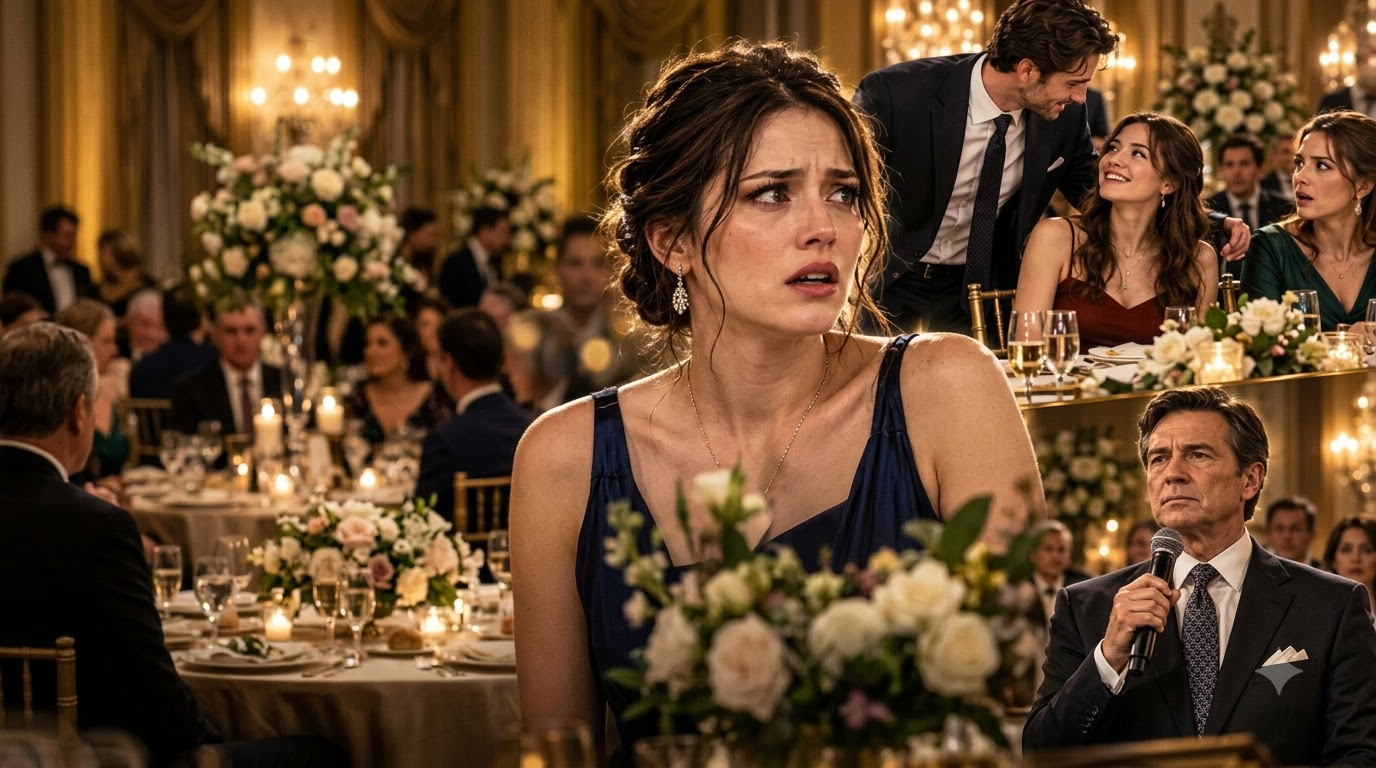

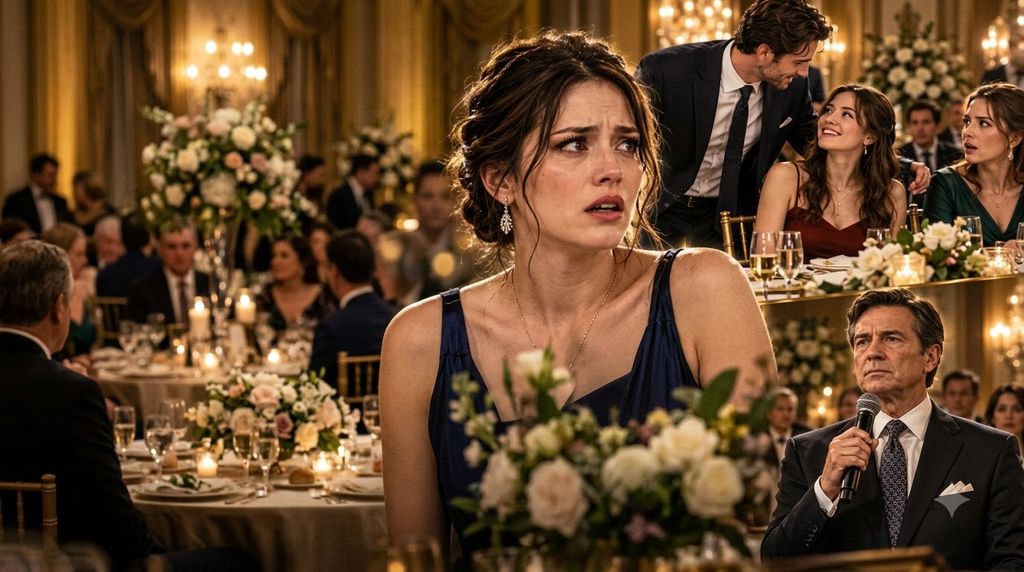
At my father’s 60th birthday gala, my fianceé brought a younger woman from his grad school and seated her in my designated chair at the head table. While the entire extended family froze in stunned silence, my father calmly finished his meal, took the microphone, and announced, “The engagement is canled, and there is no longer any need to proceed with the multi-million dollar joint venture between the Towns End family and the Sterling family.”
Chapter 1. The seat stolen at the 60th birthday.
My father, Marcus Townsend’s 60th birthday gala was held in the grand ballroom of a historic luxury hotel in Manhattan. A massive crystal chandelier sparkled from the ceiling, and a montage of photos looking back on my father’s 60 years lined the walls. Business partners, relatives, and old friends over a hundred invited guests had gathered. I was walking around with my mother, greeting each person one by one.
I am Natalie Townsend, 29 years old. I am an architect and one of the heirs to Towns and Urban Development, handling major redevelopment projects for my father’s company. That day also held another significant meaning. It was the first time that so many relatives from both families had gathered in one place since I got engaged to my fianceé, Julian Sterling.
The Sterling family was another prominent real estate dynasty in New York. Our engagement wasn’t a pure business arrangement determined from the start. We had known each other since college, dated for years, and eventually our families approved of the marriage. That was why I believed it. I believed that with Julian, we could support each other through both our public and private lives.
That belief shattered about an hour into the reception. The entrance doors opened and Julian appeared. An hour late. If it were just that, I would have assumed a meeting ran long. The problem was that he wasn’t alone. Next to him was a young woman wearing a white dress, Madison Hayes. She was a younger designer who had been in the same graduate research lab as Julian, currently working as a junior architectural designer.
Julian had mentioned her a few times before. She’s talented but lacks confidence. I just can’t leave her alone. She’s like a little sister to me. I had believed those words. Looking back now, I think I just wanted to believe them.
Without even apologizing to me, Julian walked toward the head table. practically leading Madison by the hand. Seated at the head table were my father, my mother, Julian’s parents, and the representatives of both extended families. The seats for Julian and me had been prepared right next to my father. For a split second, I thought Julian was walking toward me, but instead he pulled out my chair. Then he smiled at Madison. You can sit here.
I couldn’t believe my ears. Madison whispered a small butt and glanced at me. She looked apologetic, yet deep in her eyes, there was an unmistakable sense of triumph she couldn’t completely hide. Julian placed a hand on her shoulder and guided her right into my seat. In an instant, the atmosphere in the ballroom shifted. Whispers erupted from the nearby tables. “Who is that girl? Isn’t that Natalie’s seat? Did the fianceé bring her?”
I stood there frozen. My mind went completely blank. Before the anger even hit me, the sheer humiliation washed over me. In front of more than a hundred people, I felt like I was being told, “You don’t need to be here.”
My mother’s face changed color and she started to stand up. Julian’s mother also looked like she was about to say something to him. The only person who said nothing was my father. He didn’t even look at Madison. He took a bite of the appetizer in front of him, acting as if absolutely nothing was happening.
“Dad,” I called out. My father looked at me quietly. “Sit down, Natalie.” What had been brought out was a folding chair. hastily added to the far edge of the head table. I bit my lip and took that seat. I kept my back perfectly straight. I refused to cry. At least not here.
Julian finally looked at me. There was no guilt on his face. In fact, he looked as if he wanted to say, “Don’t make a scene over something this trivial.” Madison shrank into herself, wearing the face of a victim. I said nothing until my father finished eating. My father ate at his usual pace. He showed no panic, no anger. Finally, he drank his coffee, placed his napkin on the table, and picked up the MC’s microphone. The room fell dead silent.
Thank you all for coming to my 60th birthday celebration today. His voice was steady and calm. Since you are all gathered here, I have one announcement to make. My father looked at Julian. Then he looked at me. The engagement between my daughter Natalie and Julian Sterling is dissolved as of today. The air in the room stopped. Julian shot up from his seat. Mr. Townsend, please wait.
My father continued. Furthermore, the Hudson River Gardens joint venture which Towns End Urban Development and Sterling Properties were advancing together will be placed under review. It was a plan predicated on a multi-million dollar joint investment. But there is no need to force a partnership with a party with whom we cannot maintain a foundation of trust.
Even Julian’s father, Thomas Sterling, stood up. Marcus, please. Natalie<unk>s engagement and our business are two separate matters, aren’t they? My father looked at him directly for the first time. If you wanted to keep them separate, you should have taught your son the difference between professional boundaries and personal affairs first. His voice was low, yet it reached every corner of the ballroom.
Today is my 60th birthday celebration. My daughter’s fianceé brought another woman and seated her in my daughter’s chair. This goes beyond a romantic dispute. It is an act of profound disrespect toward our family.
Julian panicked. Madison is just a junior colleague. She’s not used to events like this and was incredibly nervous. So, does being nervous entitle someone to sit in the seat reserved for the guest of honors family? My father asked quietly. Someone let out a small gasp. Julian’s face turned bright red. Tears welled up in Madison’s eyes. I I really didn’t mean to.
That was when I stood up. Madison. Even to my own surprise, my voice was completely composed. It no longer matters what your intentions were. Madison looked up. What matters is that Julian gave my seat to you and you sat in it. That fact alone is all that matters.
Julian glared at me. Natalie, you’re being too harsh. Maddie didn’t do anything wrong. At that exact moment, something snapped inside me. Right? I smiled. Then let’s just say I’m the one at fault, Julian. The engagement is over. That’s the only thing that won’t change. For the first time, the arrogant confidence vanished from Julian’s face.
I walked over and stood next to my father. He gently draped his suit jacket over my shoulders. Let’s<unk> go home. Yeah. My mother stood up, too. Behind us, I could hear the Sterling family shouting, Madison’s quiet sobbing, and the overlapping murmurss of the relatives, but I never looked back.
Once we got in the car, my mother started crying. Natalie, you must be so frustrated. I just nodded, keeping my eyes on the window. Staring straight ahead, my father spoke. Money can always be remade. Projects can be rebuilt. He paused for a moment. But if you allow yourself to be treated like garbage, the dignity takes a very long time to get back.
The moment I heard those words, the tears I had been holding back finally fell. I wasn’t crying because the engagement was over. I was crying because the thing I had cherished for so long had not been cherished the same way by the other person. That fact simply hurt.
Chapter 2. The ended engagement and the beginning of the chase.
The next morning, the intercom at the front door rang. The moment my mother looked at the monitor, she frowned. It was Julian. He wasn’t in his suit from yesterday, but he looked like he hadn’t slept at all. Please let me see Natalie. My mother didn’t open the door. Please leave. There is nothing left to discuss. Mrs. Townsend, it’s a misunderstanding. Maddie and I. I heard his voice halfway down the stairs and stopped.
Misunderstanding? What a convenient word. It shifts the undeniable fact of the pain inflicted onto a problem of the victim’s interpretation. I walked to the foyer and told my mother to open it. The door clicked open. Julian’s face instantly brightened. Nat, stop calling me that. My smile was gone. Mr. Sterling, the engagement is dissolved. Do you really think you can erase years of our relationship over one night? I didn’t erase it. I ended it. Julian caught his breath. Yesterday, Maddie was just nervous, so I let her sit down. I thought you, out of anyone, would understand. You thought I would just put up with it because it was me, didn’t you? No. Then why was it my seat? No answer. Why didn’t you ask me for a single word of permission? Silence. Why is it that you only tell me to be the adult whenever it comes to protecting Madison?
Julian’s expression twisted in distress. You’re strong, aren’t you? Maddie is different. That girl is all alone. I laughed. There it is again. Julian finally seemed to realize what he had just said. I’m strong, so I don’t get hurt. I’m good at my job, so I’ll be fine. Even if I’m ignored, Madison is weak, so she must be protected. I took a step back. If that’s the kind of dynamic you want to choose, go ahead. I’m opting out. Natalie, wait. You don’t have to cut off the business partnership, too, do you? That final sentence erased any lingering doubt in the back of my mind. So, it was always about that in the end. No, that’s not what I meant. Go home, Mr. Sterling.
Julian stared at me for a long time. You’re going to regret this. That is for me to decide. I shut the door.
An hour later, I received a call from my father telling me to come to the office. The executive board and the VP of finance were gathered in the conference room. On the projector screen was Towns and Urban Development stock chart. It had plummeted since the opening bell. Sterling Properties had announced they were pulling their planned investment in the Hudson River Gardens project. Furthermore, they had reportedly informed several financial institutions that they had concerns about Towns End’s financing plans. A portion of Towns End shares held by Sterling was also dumped on the open market. It wasn’t quite blatant enough to be definitively ruled as market manipulation, but the timing was undeniably deliberate.
This is clearly their retaliation for calling off the engagement, the VP of finance said. My father had his arms crossed, silently looking at the documents. What is the status of the Hudson River Gardens construction? He asked me. We haven’t broken ground yet. We’ve acquired the land, but with Sterling’s capital pulled. We are facing a short-term cash flow shortage.
Hudson River Gardens. It was the first massive residential project I had been involved with from the foundational design phase since returning from my studies abroad. It was a mixeduse development integrating green spaces, a daycare facility, and community hubs. It was an incredibly important step in my career because it over overlapped with my relationship with Julian. I had somehow envisioned it as a symbol of our future together and overnight it had been thrown into a crisis.
Dad, I’m so sorry. I said to him when we were left alone after the meeting. My father looked up. For what? Because of my personal issues. The company is My father sighed. Don’t flatter yourself. Huh? If this company could be toppled just because one person’s engagement fell apart, then I’m a terrible CEO. I fell silent, caught off guard.
My father pulled a different file from his drawer. Thomas Sterling had been trying to increase his equity stake in Hudson River Gardens for a while. Look at this revised draft of the joint venture agreement. As a condition for capital provision, there’s a clause transferring a portion of Towns End’s voting rights and development leadership over to Sterling. Wait, so he was planning to use the engagement to gradually take over our side? I suspected as much, my father said quietly. Even without what happened yesterday, I was going to stop it before the final contracts were signed. You knew? Then why didn’t you stop the engagement? That’s a separate issue. I didn’t interfere with your choice to pick Julian. My father smiled faintly. I am your father, but I am not the owner of your life. Those words pierced my chest.
As for the company, we have alternative plans ready. He flipped a page. A bridge loan from our primary bank. Utilizing a private equity real estate fund through a joint venture LLC, converting a portion of the land into a long-term hold to lower the short-term capital burden. It’s not perfect, and it will take time. So, what do you need me to do? I asked. As the lead architect, redesign Hudson River Gardens so it remains viable even without Sterling’s money. My father looked right at me. Natalie, your job isn’t to wait to be chosen by someone. It’s to make your own proposals a reality.
That afternoon, I received a call from an unknown number. Natalie, is this you? It was a soft, familiar voice. Madison Hayes, what do you want? I heard things are getting rough with Hudson River Gardens, she said. I could almost hear a faint, smug smile beneath the faint concern. I thought maybe I could help you out. Do you know of a foreign investment fund looking for urban development projects in the US? The name is, she paused for a beat. Helios Capital. My hand stopped writing.
In the world of architecture and real estate investment, there wasn’t a single person who didn’t know that name. A massive investment firm backed by European capital that had grown explosively in New York and London. There had been rumors of them aggressively expanding their US portfolio. What’s the catch? I asked. Madison’s voice brightened. I love how fast you catch on. Of course, this isn’t out of the goodness of my heart. The Urban Oasis project that won the Nova International Design Award three years ago, I want you to transfer the copyright and CAD files to me.
She was extorting me for the one project I was most proud of in my life. And simultaneously, the one piece of my past I wanted to look at the least. Why do you want that? A young designer needs a portfolio. That’s all. I’ll give you one day to think about it. The call disconnected. I stared at the screen, unable to move for a long time.
Helios, Urban Oasis, and Madison. Out of those scattered words, a face from three years ago emerged from the depths of my memory. A white button-down shirt, the model making studio. A back turned to me in the rain. Harrison Foster. He was the person I needed to apologize to the most in this world.
Chapter 3. What I stole three years ago.
It was that night when I called Samantha Sam Miller. Sam was a friend from my college days. now a partner at a top tier executive search firm in Manhattan. She was a slightly terrifying woman who claimed investigating people’s career histories was her hobby. “Is it true you called off the engagement?” was the first thing she shouted. “Where did you hear that? It’s circulating in the industry gossip before it even hits the news. So, can I go punch Julian Sterling in the face once? Don’t. Fine. I won’t make it twice.” She made me laugh a little. And right now, I was grateful for that laugh.
I told her what Madison had said about Helios. Sam’s tone shifted. Hold on a second. Let me look it up right now. The sound of rapid typing. A few minutes later. Got it. Head of the US division. Who? My heart felt like it was going to stop. Just as you thought. The background is Columbia University’s graduate school of architecture. But he dropped out of the master’s program halfway through. Then a gap of a few years followed by Harvard Business School. joined a European private equity fund, hit home runs on several major urban regeneration deals, and now he’s the managing director of Helios Capital Americas. Natalie, do you know him?
I couldn’t answer for a moment. We didn’t just go to the same school. It was just a voice over the phone, but I closed my eyes. 3 years ago, I was doing a visiting year at Columbia University’s Graduate School of Architecture, Planning, and Preservation. While studying, I was working on a project close to my final thesis to submit to the NOVA International Design Award. With only a month left until the deadline, my concept was falling apart, and I was on the verge of crying alone in the studio when I met Harrison.
He was a secondyear grad student. He was famous among the architecture students. He understood design, structural engineering, and urban planning flawlessly to the point where major firms were directly requesting him for research. Yet, despite his brilliance, he was never arrogant. “Are you stuck?” he asked, looking at my blueprints. I tried to hide my embarrassment. “Just a little bit. People who are just a little bit stuck don’t smash their models three times,” he said, pointing to the graveyard of failed chipboard models on the floor. “From that day on, we started talking. He never gave me the answers. Instead, he gave me questions. What will the people living in this building see first in the morning? You shouldn’t just put greenery there because sky gardens look pretty. How do you create a system where elderly residents don’t have to go all the way down from the fifth floor to the ground floor just to meet people? Through his questions, my design slowly transformed, connecting residents and nature vertically within a city block. Small gardens and communal spaces woven into the structure linked by multi-level pedestrian pathways, urban oasis. The core of my proposal was born.
Simultaneously, I fell in love with Harrison. I thought he looked at me specially, too. Until one day, a photo of a woman popped up on his smartphone screen. A smiling woman leaning affectionately against his shoulder. The caption read, “My love, my everything.” Looking back now, I should have just asked him, “Who is she? When was this taken?” But the Mi back then couldn’t ask. I was terrified of getting hurt. So, I selfishly decided on the answer myself. He has a girlfriend. He’s only nice to me because I’m a junior student. I was the only one who misunderstood.
And then I did the worst possible thing. Harrison was conducting research on vertical community ecosystems which was unpublished. I took the core philosophy of his research and incorporated it into my own project. I didn’t just reference it. I used a significant portion of his structural concepts almost exactly as they were. Furthermore, I submitted my project to the NOVA award before he published his thesis. My project won the gold medal. Shortly after, when Harrison submitted his similar concepts to an academic journal, he was accused of plagiarism. If you only looked at the submission timestamps, I was first. I should have told the truth. But I couldn’t. I was terrified of losing the award. Terrified of disappointing my father. Terrified my career as an architect would end before it began. Harrison underwent a severe academic investigation and lost his sponsorship from an engineering firm. Ultimately, he left the university.
The day he came to the front of my apartment building, it was pouring rain. Natalie, completely drenched. He didn’t yell. He just asked why. I told him I didn’t know what he was talking about. Over and over. Harrison stared at me for a long time. I believed in you. That single phrase still echoes in my ears. He left. And that was the last time I saw him.
On the other end of the line, Sam gasped. Natalie, that is horrible. It’s horrible. I did a terrible thing, but me telling you this now, it’s too late, isn’t it? It’s late, but it’s not zero. I bit my lip. Sam continued. And now Madison wants the rights to that exact award-winning project. The head of Helios is Harrison. That can’t be a coincidence. Are you going to make the deal? I am, but not to hand the copyright over to Madison.
I pulled out the Nova Award certificate from my desk drawer. First, I had to sort out the legal rights of that project. I had no right to sell the parts that used Harrison’s ideas as my own. And then, I’m going to go see him. I was terrified. I wanted to run away, but I refused to do the exact same thing I did 3 years ago.
The next day, I met Madison at a hotel lounge in Manhattan. She smiled with satisfaction when she saw the documents I prepared. However, this isn’t a contract transferring all copyrights to you. I said it was an agreement drafted by a lawyer confirming the right structure and ceasing its use. Natalie, this isn’t what we agreed on. Madison’s face dropped. It is. We need to confirm if there’s anything I can even give you first, but the promise still holds. I cannot resell something I stole to you. Madison froze. What are you talking about? I looked right at her. You know, don’t you about Harrison? For a second, a literal split second, Madison’s eyes wavered. That was all the confirmation I needed. Why she knew about Helios executives visiting the US. Why she knew about my past with Harrison. Explain everything, I demanded. If you don’t, the deal is off. I stood up from the table. Madison panicked. Please wait. I turned back.
Tonight, Harrison is attending a charity gala. She gave me the name of the hotel. That’s it. I’ve only met him once, but he asked me about you. What did he ask? Who you’re dating now? How your work is going? Whether you were still using the Nova Award design. My chest tightened. Madison smiled faintly. Natalie, Harrison, he hasn’t forgiven you. I know if I go see him, I might lose everything, but I’m still going. I put the documents back in my bag. The result of running away was the mess I was in now.
When I stepped out of the hotel, a cold wind was blowing. 3 years ago, I chose a lie because I was afraid of losing things. This time, even if I end up losing everything, I will choose the truth. I felt it was the only way to distance myself from the person I used to be.
Chapter 4. The person I reunited with was my creditor.
The charity gala was held on the top floor of a hotel overlooking Central Park. I had requested a formal invitation under towns and urban development via a corporate donation. I chose a simple black dress, not because I wanted to stand out, but because I wanted to go without any unnecessary armor.
The moment I entered the ballroom, eyes gathered on me, my broken engagement, the dissolution of the joint venture with the Sterling family, our plummeting stock in just a few days. I had become a minor celebrity in the industry rumor mill. But I didn’t care about their staires. I was only looking for one person in the center of the room.
Harrison Foster was easy to find. Wearing a sharp black suit, he was a bit leaner than he was 3 years ago, his expression composed. Despite being surrounded by investment bankers and real estate executives, he alone seemed strangely quiet. I set my glass down and walked straight up to him. Harrison. He looked at me. It’s been a while. Our eyes met. Those were the eyes I had seen in my dreams countless times over the last 3 years. Anger, disappointment, coldness. But now his eyes felt even further away than all of that.
Miss Townsend, just being called by my last name made my chest ache. Could I have a moment of your time to speak about an investment? That, too. But before that, my voice almost shook. About 3 years ago, Harrison gave a faint cynical smile. now because your company is in trouble. It’s a brutal assumption, but completely justified. I don’t blame you for thinking that. And honestly, if the company hadn’t been in crisis, I might have run away again. Saying it out loud made me feel pathetic, so I won’t claim my timing is noble. I looked him in the eye, but I don’t want to turn my apology into a lie, too. The smile vanished from Harrison’s face.
The core concept of Urban Oasis was stolen from your unpublished research, I said. My voice was quiet so as not to be overheard, but to me it felt like I was screaming in a public square because my submission was timestamped first. You were accused of plagiarism and I didn’t tell the truth. I know. I know your research funding was cut. I know you left the university. I know everything. His voice dropped lower. So what? You want to apologize? Will apologizing bring the past back? It won’t. my recommendations, my research grants, my career path. None of it comes back. So, what is this for? I took a deep breath so that I stopped running. Harrison fell silent. You don’t have to forgive me. In fact, I don’t want you to forgive me easily. I pulled out a single sheet of paper.
“This is a formal declaration to the NOVA award committee stating there is a severe rights violation regarding the winning entry, requesting a formal review and returning the award. I am submitting this tomorrow morning.” Harrison looked at the paper. “It will impact your company. I know your credibility as an architect too. I know the Sterling family will be thrilled.” “Even so,” I said, “I am ending it myself.” Harrison remained silent for a long time. Then he said something entirely unexpected.
“Do you mind if I record this?” I nodded. He pulled out his phone and hit record. I repeated what I did three years ago: what I stole, how I stayed silent, how I forced the blame onto him. I made no excuses. When I finished, Harrison stopped the recording. “What are you going to do with that?” I asked. “Nothing right now. You’re not going to get revenge.” “What good does it do me to force an apology out of you and regress to being a victim from the past?” I was taken aback by his response. Harrison looked out the window.
“What I want isn’t to see you cry. It’s to correct the record. The record to the NOVA committee. Not just that.” He looked at me. “Three years ago, my complete blueprint design was used under someone else’s name for a commercial project.” “What?” “You stole a piece of my core concept, but there is someone else who took my entire set of CAD files.” My brain couldn’t catch up. “Who?” “I can’t say yet.” “Why?” “Because I’m still gathering the evidence.” Harrison paused for a second.
“Let me ask you one thing. What did Madison Hayes tell you?” I explained that she demanded my copyright in exchange for an introduction to Helios. Harrison’s eyebrow twitched slightly. “I never told her to take your project.” But Madison said, “Well,” she admitted she only met me once. A brief exchange of business cards at an industry event. I held my breath. Then she lied. “Using your name,” Harrison’s voice was icy. “It seems so.” At that moment, my phone vibrated. It was my father. When I answered, his voice was stiffer than usual.
“Natalie, can you get back to the office right now?” “What happened?” “Sterling leaked the initial geological survey data for Hudson River Gardens to the press.” My stomach dropped. The initial survey had highlighted risks of soft soil and unstable bedrock. However, that issue had been completely resolved through subsequent secondary surveys and advanced soil stabilization engineering. But if they only leaked the old data, it would look like we were hiding a critical structural danger. “The banks are calling us,” my father said.
“I’m on my way.” I hung up. Harrison seemed to have gathered what happened. “Thomas Sterling, probably the outdated geological report.” I stared at him in shock. “You know about that?” “I saw the same report during our investment due diligence. Helios was investigating Hudson River Gardens as one of our potential US market entries.” “Obviously.” “Well, before I met you,” Harrison answered matter-of-factly. “Investing isn’t romance after all.” I couldn’t help but let out a small ironic laugh. Even in this situation, Harrison held out a single business card.
“You don’t need to bow your head to me to save your company,” he said. “Huh?” “If you want capital, pitch it to me as a viable business.” His eyes weren’t the eyes of the kind upper management from 3 years ago. Nor were they the eyes of an avenger. They were the eyes of a pure investor. “Let’s separate settling the past from our current work.” I gripped the card tightly. The engagement I lost at my father’s 60th birthday. The trust I lost three years ago. And now the crisis facing my company. It all felt tangled together into one massive knot.
But I felt like Harrison was telling me to untangle them one thread at a time. That night, on my way back to the office, I made a decision. At tomorrow’s press conference, I wouldn’t just address the soil issue. I would address my past before anyone else could tear me down. I would do it myself. Chapter 5. I returned the gold medal myself. At 10:00 a.m. the next morning, Towns End Urban Development’s press conference was standing room only. Media outlets had flooded us with inquiries regarding the Hudson River Gardens geological issue. My father offered to give the explanation himself.
I shook my head. “I am the lead architect, and I have to talk about the Nova Award too.” My mother looked worried. “Natalie, does it have to be today?” “Because it’s today, I have to announce my own personal scandal.” Right when the company was backed into a corner from a pure PR perspective, it might have been the worst possible timing. But if I hid it until it was convenient, I’d just be repeating what I did 3 years ago. The press conference began. The first question was exactly what we expected.
“Is the leaked initial geological report authentic?” “It is authentic,” I said. A murmur rippled through the room. “However, it is a preliminary phase 1 survey. Based on those results, we conducted extensive secondary core drilling and completely overhauled the foundation engineering with third-party geotechnical experts.” I brought up the slides on the screen: the secondary data, design revisions, invoices for the soil stabilization work, and peer reviews.
“There is zero truth to the allegation that we compromised safety. On the contrary, because we identified the risks early, we adapted the plan to be secure.” “Then why was an outdated report leaked to the outside?” “We are investigating the data breach with cyber security experts and will take necessary legal action.” Up to this point, it was exactly as we prepared. I took a sip of water. My father looked at me from my side. He nodded. Now it was time for my own story. “There is one more matter I must report on a personal level.” The reporters looked up.
“Three years ago, I was awarded the gold medal at the Nova International Design Award.” The atmosphere shifted instantly. “My winning entry, Urban Oasis, incorporated parts of unpublished research belonging to Harrison Foster, a graduate student at Columbia University at the time. Without his permission.” Dead silence. The only sound was the rapid clicking of camera shutters. “I should have admitted it then. However, terrified of losing the award, I did not tell the truth.” My throat burned, but I didn’t stop.
“As a result, Mr. Foster was wrongfully accused of plagiarism and suffered severe damage to his academic and professional career. This morning, I formally submitted a request to the NOVA committee to revoke my award and undergo a retroactive review.” Hands shot up all at once. “Miss Townsend, are you admitting to plagiarism? Was the company aware of this? What is your current relationship with Mr. Foster?” The questions flew at me. I answered them one by one. My father did not know. The company was not involved. I take full responsibility.
Legal copyright issues will be sorted out via attorneys. I have apologized to Mr. Foster, but that does not mean I am forgiven. “Why come forward now?” I thought for a second before answering that one. “Because I was afraid. For three years, I was terrified of losing what I had built.” I looked straight at the cameras.
“But I finally realized that achievements protected by a lie aren’t actually achievements at all.” The press conference was a firestorm. By the afternoon, my name was trending across news sites. Young architect admits to plagiarism. Townsendair apologizes for past theft. Social media was flooded with brutal comments. It was completely justified. Her dad’s company is already sketchy, and now her whole resume is fake. The more I read, the more my chest hurt. But I never once said I was misunderstood.
Meanwhile, regarding the soil issue, independent experts reviewed our data after the conference and publicly validated our safety measures. Towns End’s internal investigation also made a massive breakthrough. We acquired security footage and access logs showing a former Towns End contractor meeting with Sterling Properties corporate counsel to hand over a USB drive alongside a trace on the wire transfer. My father didn’t flaunt this at the press conference.
Instead, he filed it through our lawyers to the NYPD and federal regulators, and simultaneously sent a cease and desist letter to Sterling Properties. “Due process hits a lot harder than a public execution,” my father had said. “If you try to punch your opponent with pure emotion, you’ll end up tripping yourself.” That night, while I was alone on the company roof, I got a text on my phone.
“Harrison: I saw the press conference.” “That was all I typed back.” Sent: “I’m sorry it took so long.” A few moments later, “Harrison: I accept the apology. I don’t know if I forgive you yet.” My chest ached a little, but I was incredibly grateful for the honest words. Sent: “Understood.” Another text came through. “Harrison: Just because you returned the award doesn’t mean all the work you’ve done since is erased.” I stared at the screen.
“Harrison: Conversely, just because you held the award doesn’t mean you were a genius all by yourself. Prove it with your own blueprints from now on.” It was harsh, but exactly right. It brought tears to my eyes. It wasn’t exactly cheering me on. It read more like a challenge. Sent: “I will.” That night, I slept soundly for the first time in a while. I had lost a major honor, but I had let go of the secret I’d been carrying for 3 years. I had lost something, yet my body felt lighter. Chapter 6. The morning trust fell.
The morning after the press conference, the reception phones at Towns End Urban Development rang non-stop the moment I arrived. Contractors, banks, architectural firms, and the media. The news that I had surrendered my Nova Award had spread faster than I could have imagined. In the elevator, two employees noticed me and immediately stopped talking. That silence hurt the most. Getting yelled at would have been easier. When I walked into the CEO’s office, my father had just finished a Zoom call with our primary bank. Hudson River Gardens’ credit line is temporarily under review.
Obviously, the successor of the company just admitted to plagiarism. They need to verify our corporate governance. My stomach sank. “I’m sorry.” “It’s me again.” My father closed his laptop. “Don’t apologize to the wrong people. Apologize to the employees by doing your job.” It was strict, but he was right. At 10:00 a.m., I gathered the Hudson River Gardens project team: architecture, sales, finance, legal, construction. Nearly 40 people packed the conference room. I stood at the front and bowed my head deeply.
“I am deeply sorry for causing so much anxiety due to my actions.” No one said a word. “This is a personal issue of my past. However, as the project lead, I bear the responsibility for affecting the company.” I walked to the whiteboard and wrote three words: capital, credibility, schedule. “Starting right now, we are going to protect these three things one by one.” The VP of finance raised his hand.
“If the bank initiates a full review, our cash on hand will only cover the design and site prep payments for the next two months. We can’t force the construction phase forward.” The construction manager chimed in. “We’ll face delays.” “Delays are fine,” I said. Everyone looked at me. “Pushing forward with unstable funding and having to halt mid construction is far more dangerous. We will be completely transparent with all our contractors about the situation.” The head of sales grimaced.
“If we’re that honest, some firms will walk away.” “Even so, we don’t hide anything.” I said it as much to convince myself as them. After the meeting, Khloe Jenkins, a young architect on the team, stayed behind. She was 26, a hire I had been involved with right after I returned to New York. “Natalie, can I ask you one thing?” “Yes.” “Weren’t you terrified at the press conference yesterday?” I couldn’t help but smile a little. “I was terrified, but I just had to look like I wasn’t.” Khloe looked somewhat relieved.
“I saw your NOVA award project when I was in college. That’s why I applied to Towns End Urban Development.” My chest tightened. “I’m sorry.” “So, please don’t say it like that.” I looked at her, surprised. “I didn’t want to join because you won a shiny medal.” Khloe continued, “I loved the small public works projects you designed after that, like the community daycare center by the subway station. It was a project that got almost no media attention.” “You remember that?” “The way the stroller parking was designed so it didn’t clutter the entrance.
The benches you put outside the nursing room so fathers could sit comfortably. Things like that.” The back of my eyes burned. I had always thought that gold medal was the ultimate proof of my worth, but someone else had been watching the real work I did. “Thank you.” This time I could say it without apologizing. That afternoon, my father and I went to our primary commercial bank in Midtown. Sitting in the boardroom were the managing director and the head of risk assessment. The questions, as expected, were brutal.
“How do you assess the impact of this award revocation on your future architectural contracts?” “There is a possibility it will affect a portion of our bids. The brand value of Hudson River Gardens may take a temporary hit.” My father sat next to me and said nothing. He was going to make me answer every question.
“However, the structural safety and financial viability of the project are not dependent on my personal awards.” I laid it out methodically: the latest soil surveys, third-party structural reviews, pre-sale weight lists surrounding real estate comps, tenant negotiations with daycare and medical providers. “Would it make it easier for the bank to approve the loan if I step down as the lead architect?” I finally asked. The managing director looked slightly conflicted. “It’s not that simple.” “But if necessary, I will step down.” My father looked at me for the first time, but he didn’t stop me.
“Protecting the project is more important than protecting my title,” I said. The head of risk assessment closed his folder. “Miss Townsend, give us one week.” We didn’t get an answer right there. In the car ride back, my father spoke. “Were you really prepared to step down if necessary?” “Aren’t you frustrated?” “I am.” “As long as you’re frustrated, that’s fine. It means you still love the work.” A week later, our credit line was maintained, albeit with conditions: an external auditor strictly monitoring the project, quarterly progress reports, and additional collateral.
It wasn’t an easy deal, but we weren’t just hanging by a thread anymore. We were officially moving forward. That night, my father bought two cheap cans of beer. We sat on the company roof. “This isn’t really a victory worth a toast, Dad.” “It’s a toast to not collapsing.” He clinked his can against mine. “Natalie.” “Yeah.” “Trust is something you lose in a single day.” “I know.” “And it will probably take years to get back.” I looked up at the Manhattan skyline. “I know. I won’t rush it.” My father took a sip.
“Don’t try to play the good person to win trust back. Just keep the promises you make. If something is impossible, say it’s impossible. That’s all there is to it.” I nodded. Just because I told the truth at a press conference didn’t mean my life magically became clean the next day. In fact, this was where the real work began. Honesty doesn’t guarantee forgiveness. Apologizing doesn’t instantly restore credibility, but slowly restacking the bricks one by one is far better than piling lies on top of lies. Right now, I truly believed that. Chapter 7. The true whereabouts of the winning work.
A few days later, Sam called me. “Natalie, the Nova Award situation is way messier than we thought.” “What now?” “Do you remember Harrison’s complete final blueprint for his vertical community ecosystem?” My heart thumped loudly against my ribs. “Yes.” “It was used in a different commercial project. Someone sent me the files. 3 years ago, a massive real estate developer in New York collaborated with a university for a mixed-use urban facility student design competition.
In the section listing the winning proposal’s author, there was a name: Julian Sterling.” “No way.” “Julian was getting his MBA back then. He wasn’t even an architecture student. Yet, the winning design was almost a carbon copy of Harrison’s final thesis drafts. Furthermore, the corporate partner on the project was a subsidiary of Sterling Properties.” I collapsed into my office chair. In the chaos of me stealing a piece of Harrison’s core concept, someone else had swiped his entire final CAD files, and the Sterling family used it to secure a commercial deal.
“Did Julian know?” I didn’t have proof of how much he knew yet, but his name was on it. I immediately took the files to my father. He read through them in silence. “Thomas Sterling,” he muttered. “You think so, too, Dad?” “Julian couldn’t have funneled university research into a commercial pipeline all by himself.” My father immediately contacted our corporate lawyers. Simultaneously, I decided to go see Harrison at the Helios Capital America’s office. Harrison didn’t look surprised when he saw the files. “You knew?” I asked.
“I found out a year and a half ago.” “Why didn’t you tell me?” “If I had told you, would you have believed me?” I couldn’t answer. The Natalie of 3 years ago probably would have blindly trusted Julian. “I was investigating to clear my own name.” Harrison opened a thick folder: old email logs, server access histories, terminal login records from the architecture lab, communications between Thomas Sterling’s subsidiary and an external university consultant.
“I’m just a few pieces of evidence away from a complete case.” “So, did you move back to the US for revenge?” “Half for work, the other half.” Harrison paused. “To finish it.” Those words carried a heavy weight. “To finish me, too.” “If I wanted to crush you and be done with it, I would have done it three years ago.” “Then why did you ask Madison about me?” Harrison’s eyes darted away slightly. It was the first time I’d seen him look flustered.
“She was the only person in the industry I ran into who knew what you were up to.” “Even investigating my fiance?” “It was part of the due diligence.” “You’re a terrible liar.” Harrison sighed heavily. “I really don’t want to hear that from you.” The tension in the room eased just a fraction, but we quickly returned to the matter at hand. “Madison tried to use your name to take the rights to my award-winning project,” I said. “She’s very close to Julian. Probably closer than you think,” Harrison replied with a bitter smile.
“If you know that, is it possible she acted on behalf of the Sterling family?” Harrison nodded. That night, my phone rang. It was Madison. She was crying. “Natalie, please help me.” “What happened?” “I can’t get a hold of Julian. He won’t answer.” “Why are you telling me this?” “No, you don’t understand. I was tricked.” According to Madison, Julian had told her that if she could build a bridge to Helios Capital, he would think seriously about their future together.
Moreover, Thomas Sterling had promised her that if she could secure the copyright to Urban Oasis, he would make her the lead architect on a new Sterling Properties development. “So, that’s why you approached me?” “Yes.” “And the 60th birthday gala?” Silence. “Julian told me you wouldn’t care.” “You knew that was my seat.” My blood ran cold, just as I thought.
“But I wanted to be recognized, too. That’s why I sat there. I’m so sorry.” I closed my eyes. Her words overlapped entirely with the me from 3 years ago. I wanted it. I wanted to be recognized. I wanted to prove I was better. And because of that, I reached out and took what belonged to someone else. “Madison.” “Yes.” “I am in no position to forgive you,” I said. And I heard her catch her breath.
“But I will tell you one thing. You need to confess everything right now.” “What do you mean?” “What Julian told you, what the Sterlings offered you, how you used Helios’s name. If you tell the truth, I will understand why you did it.” I spoke quietly. “I ran away for 3 years for the exact same reasons.” A long silence hung on the line. The next day, Madison, accompanied by a lawyer, submitted all her communication logs with Sterling Properties.
Hidden within them was the smoking gun: details of how Thomas Sterling acquired Harrison’s design data three years ago, direct instructions ordering Julian to submit it under his own name, and records showing Thomas authorizing the bribe to our former contractor to steal the Hudson River Gardens Geological Survey. My father looked at the documents. “This is the end of Thomas Sterling.” I shook my head. “We aren’t the ones ending him.” My father looked at me. “Let the authorities handle it.” My father chuckled softly.
“You’ve grown up.” Hearing that made me happy, but it also terrified me. If the Sterling family collapsed, what would Julian do? I thought I had known him for years, but right now, he felt like a total stranger. Chapter 8. The day the Sterling family collapsed. The news that Thomas Sterling was the target of a federal investigation broke suddenly. Allegations of corporate fraud, falsifying international business records, and involvement in corporate espionage. The headlines spread like wildfire. Sterling Properties stock crashed, and an emergency board meeting was convened.
That night, Sam called me. “Natalie, I have even crazier news.” “I don’t think I can take any more surprises.” “The person who finally handed over the most damning evidence against Thomas Sterling to the board was Julian.” I couldn’t say a word. I checked the news feed. He had turned on his own father. The next morning, Sterling Properties held a press conference. Julian stood at the podium.
“As a member of the executive board, I deeply apologize for the actions that have damaged the trust in our company.” He bowed deeply. He then announced that his father, Thomas, had been suspended from all duties, and the company would fully cooperate with the external investigative committee. Following a subsequent emergency board vote, Julian was appointed as the new CEO. It was incredibly complex. It looked like the righteous act of a whistleblower exposing his father’s crimes. Yet simultaneously, it resulted in him taking the absolute top seat at the company, which was his true goal.
Probably both, I thought. A few days later, Julian reached out. He wanted to meet just once. I considered refusing, but there were still lingering corporate entanglements between us. I informed our legal team of the time and place and met him at a cafe in the afternoon. Julian looked exhausted and thin. “Did you see the news about my dad?” I handed over the files. “I heard.” “I believe I did the right thing.” I didn’t answer. Julian gave a bitter smile.
“You’re looking at me like you doubt it.” “Whether I trust you and whether your whistleblowing was the right move are two separate things.” “You’ve changed.” “I was always like this. You just never bothered to look.” He looked down, about the 60th birthday. “I really am sorry.” “Yeah.” “Maddie and I never slept together.” “I really don’t care.” That last line seemed to hurt him the most. Julian’s face twisted in pain.
“I just always assumed you’d be right there next to me, so I treated you carelessly.” “I think so, too.” “Madison relied on you.” “I handled my job, my family obligations, everything. I just pretended I could do it all.” “I get that now.” “A bit late.” “Yeah.” Uncharacteristically, he didn’t argue back. Julian pulled out a folder. It was a proposal for Sterling Properties to inject $5 million in fresh capital into Hudson River Gardens. “What is this? If it’s not an apology, is it a bribe?” His eyes shifted to business mode.
“My dad’s scandal tanked our credibility. If we can publicly resume our joint venture with Townsend, it sends a strong message of stability to the market, and it solves your cash flow problem. Mutually beneficial.” I closed the folder. “I’ll review it with the board, but it has absolutely zero connection to our former engagement.” “I know.” He paused for a long second. “But even so, maybe someday.” “No.” I didn’t hesitate. Julian let out a short laugh. “You’re quick. But I guess giving false hope is cruder.” “It is.” He stared out the window.
“Are you dating Harrison Foster?” “That is none of your business.” “Do you still love him?” “Who I love matters less right now than doing my job properly.” Julian was quiet for a long time. Finally, he spoke. “Natalie, it wasn’t until I lost you that I realized how terribly I treated you.” “Then don’t do it to the next person.” “The next person? Huh?” He smiled bitterly. “It really is over.” “That night at the birthday?” I nodded. Before leaving the cafe, he bowed his head deeply. “I’m sorry.” I didn’t tell him I forgave him.
“I hear you,” was all I said. When I returned to the office, my father was waiting. “Are we taking the money?” “Depends on the conditions.” “It feels a bit like throwing Julian a lifeline, though.” “Don’t do it to save him. Take it only if the project needs it.” My father smiled, looking satisfied. “That works for me.” Right then, an official investment proposal arrived from Helios Capital.
It wasn’t for Hudson River Gardens. It was for something much bigger. A massive redevelopment of a city-owned waterfront district in Brooklyn. The city was soliciting proposals from private developers via an RFP, request for proposal. Helios would provide the financial backing for whichever developer won the bid.
There was only one condition attached to the proposal sent to Townsend. The lead architect must be Natalie Townsend.
“I looked at the brief and immediately called Harrison.”
“Is this you throwing me a pity lifeline?”
“No. Then what is it?”
“An investment condition. Why me?”
“Because I want to see your real blueprints this time. Not the past award winner. I want to see what the current you can design. If you lose the bid, we don’t invest.”
“You’re ruthless.”
“It’s just business.”
I laughed over the phone. I felt like I could hear Harrison smiling, too. “You don’t wait for someone to save your life. You propose a vision, and if you win, the capital follows. If you lose, you try again.” That was a much better way to live.
I opened a brand new sketchbook. The awards section of my resume was now entirely blank, but the white page didn’t scare me anymore because it was empty. I could draw anything.
Chapter nine.
“I only need one lead character in my life.”
The Brooklyn Waterfront Redevelopment RFP was a massive undertaking. Residential units, commercial office space, retail, disaster resilience hubs, public parks, daycare, and senior living, all integrated into a neighborhood designed to last the next 20 years.
I assembled our design team. In the very first meeting, I laid out my vision. “I don’t want to build a flashy postcard perfect landmark.” The younger architects looked a bit disappointed. “Then what’s our centerpiece?”
“The people. We designed backward from the daily movements of the people who will actually live there, not the building itself.”
Three years ago, I only wanted to draw renders that would get praised, something that would shock judges, something that looked great on Instagram. Now, I felt differently. A parent carrying a toddler, someone in a wheelchair, a worker coming home from a night shift, a senior citizen prone to isolation. Architecture exists to make their daily lives just a little bit easier.
The team walked the neighborhood. 6:00 a.m. Noon in the pouring rain. 11:00 p.m. We interviewed local residents, bodega owners, daycare workers, and city emergency planners.
My father kept telling me to rest. My mother brought Tupperware meals to the office. Sam brought gossip instead of food. “Did you know Sterling Properties is bidding, too?”
I knew Julian was submitting a solo bid for his company. That was fine. In business, an ex-fiance is just another competitor.
One night, Harrison showed up at the office. “Is an investor allowed in the design room?” I asked.
“Just checking progress. No meddling, I promise.”
“I know.” He looked at our physical model. There was no giant central mega tower. Instead, the density was distributed across several midrises. A green pedestrian pathway connected the ground floors and rooftops, communal spaces that could double as evacuation shelters during a hurricane. A community kitchen and a small library sandwiched between the senior housing and the daycare center.
“Do you have a name for it?” Harrison asked.
“Not yet.”
“Back with the Nova Award, I picked the name first.”
“I’ve grown up.”
“Glad to hear it.”
A brief silence fell. Staring at the model, I finally asked the question. “Harrison.”
“Yeah.”
“The photo from 3 years ago.” His hand stopped. “The woman on your phone? Uh, she was your girlfriend, right?”
Harrison stared at me for a few seconds, then he let out a long, heavy sigh. “She’s my older sister.”
“We’re in New York.” My brain completely short-circuited, but the caption, “My love, my everything.” My sister grabbed my phone and posted that herself. She has zero sense of personal boundaries. I slammed my hands on the desk. “Are you kidding me?”
“Dead serious.”
I was humiliated. I spent years thinking. Thinking.
Harrison didn’t laugh. “You should have just asked.”
“I know. I should have. Look at me.”
“What?”
Harrison slightly averted his eyes. “I liked you.”
My heart stopped. “Back then?”
“Back then? And now?” Harrison looked back at me. “Are you going to ask me about it now?”
A long silence. “It’s not simple. Even now,” he said, and it was the most honest thing he could have said. The memory of liking you and the memory of you betraying me live in the exact same place.
I nodded. “I know.” But Harrison looked back down at the model. “I do want to know who you are now.” That was more than enough. I smiled. “I want to know who you are now, too. Not the terrifying investor out for revenge, but I’m slightly terrifying.”
“That’s rude. But you talk more than you did three years ago. Three years ago, you ran away.”
“Ouch. Fair point.”
We both laughed.
Just then, my phone buzzed. It was Julian. “Julian, do you have time tomorrow afternoon?” I texted back. “If it’s about business, I’ll make time.”
“Business only.”
The next day, Julian walked me through Sterling Property’s proposal, a massive high yield luxury tower complex. The design was incredibly polished and hyperefficient. “It’s a great proposal,” I said honestly.
“Thanks, but I know you’re submitting your own.”
“I am.”
Julian closed his folder. “Natalie, yeah, I saw the files my dad had about what happened between you and Foster. That you plagiarized him. And that my dad used the chaos to steal his complete blueprints.”
“Yeah, I lent my name to that overseas project 3 years ago.” I stayed silent. There were parts I didn’t know, but halfway through I figured it out.
He looked pained. “Why didn’t I stop it? Because I wanted the prestige.” He laughed at himself. “Just like you, I couldn’t say no.”
So that was it. The reason he turned his father into the feds wasn’t purely out of a sense of justice. He wanted to save the company and his own position before it all blew up.
“I get it.”
“I said, ‘You despise me.'”
“I think you’re slightly more honest now than you used to be.”
Julian laughed. “You’re brutal.”
“We’re even.”
As he got up to leave, he said, “I’m not losing this bid. Neither am I. If I win, you have to tell me congratulations.”
“Sure, just that.”
He smiled bitterly. “I really got demoted from the lead role, didn’t I?”
I shook my head. “No.”
“What?”
“The lead character of my life was always me right from the start.”
Julian didn’t say anything else.
I went straight back to the office. This wasn’t a story about choosing a man. Not Julian, not Harrison, not Sterling, not Helios. I refused to shove myself into a multiple choice question anymore. I will do my own work. I will take responsibility for my past. I will choose my own relationships. That was the only way forward.
Chapter 10. The day of the pitch.
I borrowed nothing. With 3 weeks until the submission deadline, I practically lived at the office. But there was one major difference from three years ago. I didn’t try to carry the entire load myself.
I asked structural engineers about structural integrity. I consulted emergency planners for disaster resilience. I talked to daycare directors about child care facilities and nursing home operators about senior housing. Simply admitting I don’t know when I didn’t know something made the design remarkably stronger.
The project name became Open Sky. Not a garden high in the clouds, but creating breathable spaces, margins between buildings, margins between people.
On the day of the final presentation, the room was filled with heavy-hitting developers, Sterling Properties, National Real Estate Trusts, infrastructure conglomerates, and Towns and Urban Development. Based on sheer scale alone, we were the underdogs.
My father sat in the back row of the auditorium. “Are you nervous?” My mother asked me.
“A little. Your father has been chugging water for the past hour.” I looked at my dad. It was true. He couldn’t sit still. He was definitely more nervous than I was. I couldn’t help but smile.
Sterling Properties presented first. Julian took the stage. He was commanding. His proposal maximized urban efficiency, connecting the subway, retail, residential, and office space with the shortest possible transit times. The ROI projections were incredibly strong. It was exactly the kind of pitch institutional investors adored. The applause was thunderous.
Then it was my turn. I walked onto the stage. In the past, I might have scanned the room to see if Harrison was watching. Today, I didn’t look for him. I only looked at the judges.
My first slide wasn’t a glossy architectural 3D render. It was a single photograph I had taken on site. A mother pushing a stroller in the rain, struggling to hold an umbrella. Our proposal began with this single image.
“I started.” The room went perfectly quiet. “When we talk about urban redevelopment, the focus usually shifts to soaring skyscrapers and gleaming retail hubs. But for the people who actually use a city, what matters most might just be the ability to walk home on a rainy day without getting soaked.”
“Next slide. A nurse getting off the night shift. An elderly man with a cane. A neighborhood hurricane evacuation drill. Open Sky is not a city designed to be looked up at. It is a city designed to be walked through.”
I pointed to our physical model. “We’ve created a dual level pedestrian corridor connecting the ground floor and the second level, providing covered walkways shielded from the rain. The green roofs aren’t just for aesthetics. They are engineered for storm water retention and serve as temporary staging areas during a flood or hurricane. We integrated daycare, healthcare, and retail into the residential fabric so that people organically interact in their daily routines rather than isolating these services into distinct zones. To ensure construction costs don’t spiral, we’ve utilized practical standard MEP systems.”
I took a deep breath. “I cannot stand here and promise you that architecture alone can make people happy.” I paused. “But we can make the walk home in the rain a little easier. We can make sure someone hears a friendly voice on a lonely day. We can make sure no one is left completely alone when a disaster strikes. I believe architecture can do at least that much.”
When I finished, there were a few seconds of absolute silence. Then applause erupted. Whether it was louder than Julian’s, I couldn’t tell. I bowed deeply and returned to my seat.
My father’s eyes were red. “Are you crying?”
“Got dust in my eye. It’s dusty in here.”
“Oh, please.” My mother laughed.
The results were announced that evening. “Winning proposal: Towns and Urban Development.” I stared at the paper, unable to process it immediately. Sam screamed into the phone. My mother cried. My father kept repeating.
“Obviously,” while his voice trembled, I got a text from Julian. “Julian, cheers. Congratulations.”
“Sent, thank you. Your proposal was excellent, too.”
A moment later, “Julian, that’s the side of you I never hated.” I didn’t reply.
That night, Harrison called. “Congratulations.”
“Thank you. As promised, Helios will begin the formal investment committee review. It’s not a blank check. We have an investment committee. It’ll be rigorous.”
“Of course, it will be. But couldn’t you just compliment me a little bit today?”
Silence. “It was incredible.” His voice softened. “Much better than 3 years ago.”
My chest grew hot. “Three years ago, it was mostly your brilliance carrying it. Today’s was your team’s design.”
Those words made me happier than anything else. Ever since I returned the award, I had been plagued by impostor syndrome. Did I really have any talent? Were all my past accolades just borrowed? Today, I finally saw a glimpse of the answer. I am not a lone genius, but I can listen to people, think alongside a team, and create my own kind of architecture. That was enough.
“I feel like I’ve paid back one of my debts to you.”
“Not yet.”
“Huh? It wasn’t a debt to me. The U from the past just paid back the U of today.”
I thought about it and smiled. “You say some complicated things.”
“I’m an investor. I deal in futures.”
We both laughed. It had only been a few months since my father’s 60th birthday gala, but it felt like my life had moved forward by decades.
Chapter 11. The people who protected the gardens.
While we were prepping the Brooklyn bid, the restructuring of Hudson River Gardens was running in parallel. The media was obsessed with the Sterling family scandal and my revoked award. But for the people on the ground, the only thing that mattered was whether the excavators would turn on tomorrow.
One morning, the general contractor’s site manager, Mark Morrison, called me. “Miss Townsend, could you come down to the site?”
Inside the fencing of the preconstruction site, heavy machinery for the secondary soil drilling was lined up. Mark was in his mid-50s and had worked with my father for over 20 years.
“I heard the news about the bank,” he said. “I’m sorry to worry you. Some guys in our home office are saying we should pull out.”
My chest tightened. “I understand, but I want you to stay.” He looked surprised. “Why?”
Mark pointed at the dirt. “When the issues with the soil first popped up on this site, you delayed the schedule, didn’t you?”
“Yes.”
“Usually young developers hate doing that. Extra drilling costs money and time. Safety is more important and you actually delayed it.” He smiled. “That’s why I don’t believe all the garbage on the news.”
I was speechless. However, Mark’s face turned stern. “You must guarantee our payment terms. If you can’t, tell me early. I can’t let the subcontractors take the hit.”
“Understood. If I can’t guarantee that, I will step down.”
“Good. Business doesn’t survive on goodwill alone. Trust isn’t assuming someone will do you a solid. It’s keeping the terms you promised and giving the other party the choice to stay or leave.”
I completely overhauled the budget and schedule. I pushed some of the expensive landscaping to phase two. I downgraded the luxury finishes in the model units. I slashed the marketing budget, but I did not touch the budget for soil stabilization, safety protocols, or contractor payouts.
The board pushed back. “If we make the marketing materials look cheap, we’ll lose pre-sales.”
“Finishing the building comes before looking good,” I argued. “Our competitors are running massive ad campaigns. We are not competing with them right now.” I told the board, “We are suspected of being a company that hides problems. Running slick, expensive ads right now will backfire.”
Instead, we hosted an open house at the construction site to explain the soil remediation. We invited prospective buyers and local residents. Mark explained the engineering. We didn’t limit the Q&A. “Is it really safe? The old report said it was a hazard zone. What about long-term settling?”
The questions were brutal. I couldn’t answer all of them. When I didn’t know, I handed the mic to the geotechnical engineer. “I cannot give you a 100% accurate answer on that right now.”
In the past, I would have been terrified to say those words. Now, I found it much more terrifying to guarantee something I didn’t know.
After the town hall, a married couple stayed behind. They were in their 30s with a small child. “We came here intending to cancel our deposit,” the husband said. “I understand, but we’re going to think about it a bit longer,” the wife added. “Honestly, hearing you admit when you didn’t know something made me feel a lot safer.”
I was shocked. If someone just smiled and told me it’s absolutely 100% safe, that would be way scarier. I made a mental note of those words. Absolutely. Whether in architecture or in life, it’s a word you shouldn’t use lightly.
A few weeks later, the cancellation rate for Hudson River Gardens stabilized much lower than we feared. Furthermore, a local credit union and a real estate fund backed by a life insurance company stepped up to review gap funding for the project. Instead of replacing the Sterling family’s massive capital injection with a single entity, we were diversifying the funding across multiple partners, exactly as my father had mapped out.
“Don’t rely too heavily on any single player,” my father said.
“Does that apply to personal relationships, too?” I asked.
My father laughed. “You can figure that one out yourself.”
One evening, I returned from the site to find Harrison waiting in the company lobby. “What are you doing here?”
“I had a meeting nearby.”
“Really? Half true. The other half was to see your face.”
I blushed slightly. We weren’t officially dating yet, but I wasn’t as afraid of these kinds of comments as I used to be. “Today I told a prospective buyer, ‘I don’t know.’ Be careful how you say that in front of an investor. It needs to be followed by, ‘But I will find out and confirm.’ Micromanaging, but important.”
Walking together, I told him about Hudson River Gardens, how the contractors stayed, how the buyers agreed to wait, how the funds were considering stepping in. Harrison listened, then said, “So, it wasn’t your father who saved the company, and it wasn’t Helios either.”
“Yeah. A lot of people just made small choices to stick around.”
“Exactly. I like the way you phrased that. In a movie, a massive influx of capital swoops in overnight to save the day. But in reality, a company doesn’t survive because of one hero. The bank waits a week. The contractors keep digging. The employees don’t quit. The buyers listen to the pitch. The experts sign off. The accumulation of those small ‘we’re not leaving yet’ moments is what keeps a company alive.”
I promised myself I would never forget that.
Chapter 12. What it means to return honor.
The official notice from the NOVA award committee arrived a week after we won the Brooklyn bid. My gold medal was formally revoked and the official records would be amended. Simultaneously, they announced a retroactive investigation into the handling of Harrison Foster’s research, admitting flaws in both the judging process and the university’s handling of the situation. The plagiarism allegations against Harrison were officially cleared. His honor, delayed by 3 years, was restored. Of course, the lost time wouldn’t come back, but correcting the record still meant everything.
I boxed up the gold trophy and shipped it back to the organizers. Looking at the empty spot on my shelf, I didn’t feel as sad as I thought I would. Instead, I placed a photo of the Open Sky physical model there.
“I like this one better,” my mother said.
“It’s not very flashy.”
“That’s fine. It looks like you.”
Things progressed with the Sterling family’s fallout as well. Thomas Sterling was deep in federal indictments and civil lawsuits. Julian, as the new CEO, was swamped trying to rebuild his company’s reputation. Madison had quit Sterling Properties and moved to a boutique design firm, reportedly submitting to competitions under her own name.
Now, I received one letter from her. “I am going to start over from scratch with my own designs.” It was short. I wrote a reply. “Me, too.” That was it. It didn’t mean I forgave her. I had no intention of being her friend, but as someone who knew what it was like to make the same mistake, I figured from here on out, she just had to walk on her own two feet.
The Helios Investment Committee approved the funding for Open Sky, but Harrison didn’t rubber stamp it. Profitability, ESG compliance, disaster resilience, exit strategies. He grilled me with brutal questions multiple times. I answered every single one. When I didn’t know, I took it back to the team.
“You’re a lot more ruthless than I expected.” I told him after the final review.
He didn’t miss a beat. “We’re injecting tens of millions of dollars into your company. There is no boyfriend discount.”
“Wait, boyfriend?” Harrison stopped in his tracks. I stopped, too. “Did you just say that out loud?”
“I didn’t. You did?”
“I should have recorded it. Your personality got worse.”
“I wonder whose fault that is.”
We laughed. These kinds of moments were increasing, but we still weren’t officially together. I didn’t want to rush it. I didn’t want to choose Harrison out of residual guilt, and Harrison didn’t want to choose me just based on old memories.
One day, we talked about our college days. “Why didn’t you just report me to the dean right away back then?” Harrison thought for a moment. “At first, I thought you would come forward yourself.” My chest ached. “You were waiting a little.”
“I’m sorry. And please don’t let me use that word as a crutch anymore.”
“A crutch? I don’t want to just say I’m sorry to make everything go away.”
“Strict, but right. So, what should I do instead?”
“Watch my actions from now on.”
I nodded. “I will.”
Harrison smiled a little. “I’m a victim, but that doesn’t give me a free pass to do whatever I want.”
“What do you mean?”
“Investigating you, looking into your engagement with Julian, looking into your company’s financials. It wasn’t just for the job.”
“Ah, you were still hung up on me when you say it so bluntly.”
“I can’t even be mad. I know, but I didn’t use Madison to corner you.”
“I know that.”
“I didn’t ruin your engagement to crush the Sterings either.”
“I know.”
Harrison’s voice turned serious. “I was investigating Thomas Sterling, but I had no idea what was going to happen at your father’s 60th birthday gala.”
“Can I trust you?”
“You don’t have to trust me immediately. I like that answer. Take your time and verify it.”
I smiled. “Then I will.”
One evening after an early design meeting for Open Sky, my father invited Harrison and me to dinner. As soon as he saw Harrison, my father said, “You helped my daughter a lot in the past.” I felt incredibly awkward.
Harrison sat up straighter. “Yes, sir.”
My father bowed his head. “As her father, I apologize for what she did to you, Mr. Townsend. You don’t need to apologize for that. I know, but let me say it.” My father looked up. “Also, when you left the university, I was the anonymous donor who provided your fellowship.”
I almost dropped my fork. Harrison looked just as shocked. “The prep funds before you went to Harvard HBS and a portion of your tuition. I arranged it.”
“Why?”
My father glanced at me. “I couldn’t just ignore a young man whose life was derailed because of my daughter.”
“You never told me,” I said.
“If I told you, you would have chased after him out of pure guilt.”
He was probably right. I had them keep my name from you, too, Mr. Foster.
Harrison was silent for a long time. “Thank you very much.”
My father shook his head. “No need for thanks. You reached where you are now on your own merit.”
On the walk home, I said to Harrison, “My dad really just does whatever he wants without telling anyone, but it saved me a bit. How back then I felt like the whole world had cut me off. But knowing someone reached out a hand from the shadows, it changes how the past looks.” I spoke softly. “I want to change it, too.”
“Change what? The way you look at me in your past?” He looked at me.
“That will take time.”
“That’s fine, really, because I waited three years, so I might make you wait three years.”
Harrison laughed. “That’s way too long.”
Seeing his smile, I realized for the first time, we aren’t going back to the past. We are taking our past with us and starting something entirely new.
Chapter 13. From my father’s company to our company.
Once the Open Sky project kicked off, my workload exploded. It wasn’t just design anymore. City council negotiations, community board meetings, investor briefings, contractor coordination, lead certification, traffic studies. The world expanded far beyond what I could see just sitting at an architect’s desk in my dad’s company.
At the same time, Towns and Urban Development itself needed to change. My father, as the founder, was decisive and fast, but everything funneled through him. “Dad, if you have a heart attack, this company stops functioning,” I said at a board meeting.
My father scowled. “Don’t jinx me. I just turned 60. I’m young.”
“60 isn’t young.” My mother chimed in. “Your blood pressure was high yesterday, Marcus.”
My father shut up.
I proposed decentralizing approval authority by project and bringing in more independent board members. I also created a system where junior architects could pitch designs directly. At first, my father micromanaged. “Who approved this invoice?”
“It didn’t come to my desk. I changed the system so it doesn’t have to.”
“I didn’t hear about this.”
“I explained it to you. I don’t remember. That sounds like a you problem, Dad.”
My mother laughed from the sidelines. It felt more like a family squabble than corporate reform.
But slowly, the company shifted from Marcus Townsend’s company to an actual corporate organization, Townsend Urban Development.
One day, my father called me into the CEO’s office. On his desk was the executive succession plan. “At the next shareholder meeting, I’m stepping down as CEO.”
“What? You’re staying on as chairman, right?”
“But making me CEO. It’s too fast.”
“It’s not fast. I’m not even 30 yet.”
“Buildings don’t care how old you are. Experience doesn’t magically accumulate just because you sit in a chair waiting.”
My father laughed. “Go fail.”
“That’s mean.”
Build a company where you can afford to fail small.
“That sounded exactly like him. But I have one condition,” he added.
“What?”
“Do not copy my management style.” I was surprised.
My father looked out the window. “I grew this company by making hard, absolute decisions. But because of that, I created a culture where everyone just watched my face to see what I wanted. I made you do that, too.”
“Dad, you run it your way.” My chest felt hot. “I’m terrified.” I admitted honestly.
“Good.” My father nodded. “Do it terrified.”
At the shareholder meeting, I was officially appointed as the CEO. There was opposition, of course.
“She’s the founder’s daughter. She’s too young. She only knows architecture.” All entirely valid concerns.
During my inaugural address, I said, “I do not believe I am a better executive than my father.” The room fell silent.
“However, I strive to be a CEO who can admit when I do not know something. Towns and Urban Development is no longer a family business. It is a company that belongs to everyone who works here and everyone who lives in the cities we build.”
As I spoke the words, the weight of the responsibility physically settled into my shoulders.
After the ceremony, flowers arrived from Julian. The card had one line. “Congratulations on making CEO. I won’t lose to you in business.” I smiled.
Sterling Properties was slowly recovering under his leadership. Madison had moved on to a smaller firm and was grinding through competitions. Sam was still meddling in my private life.
“So, are you and Harrison just business partners?”
“Yes.”
“Really? So, going to the MoMA on a Sunday is a site visit?”
“Yes.”
“And the wine bar in the West Village after was market research?”
I hung up the phone.
That weekend, Harrison and I went to an art museum. It truly was for an architecture exhibit, mostly. On the way back, we walked along the East River.
“Good work this week, madam CEO.”
“Stop calling me that. At work, I’m the CEO.”
“Not right now.” Harrison smiled. “Right. Natalie.”
Hearing my first name still felt different than it did in the past. I stopped walking.
“Harrison.”
“Yeah.”
“What are we doing? I don’t want to leave this ambiguous. I don’t want to make assumptions. I’m not repeating what I did 3 years ago.”
Harrison stopped, too. “I love you.”
It was a fast ball. My face flushed.
“Since 3 years ago. It’s different from 3 years ago.”
“How?”
“Back then, I thought you were just a talented, slightly awkward junior student. Now, you’re someone who failed, looked pathetic, apologized, and still went back to work.”
I felt like crying. “Is that a compliment?”
“A massive one. I love you, too.”
I finally said it. There were no misunderstandings this time. Harrison held out his hand. I took it. There was no dramatic movie-style kiss or grand promises. We just held hands and walked and that was fine.
Loving someone doesn’t mean handing your entire life over to them. It means walking next to them. Not necessarily at the exact same speed, but noticing when the other person stops. For the person I am now, that was exactly what I needed.
Chapter 14. The first mistake I made as CEO.
In my third month as CEO, I made my first massive mistake. Riding the momentum from winning the Open Sky bid, I rushed the launch of a new affordable housing initiative aimed at young professionals. I was confident in the concept, keeping rent low while providing communal kitchens and co-working spaces to prevent urban isolation for singles. The problem was that I rushed the timeline.
“I want it ready for a spring launch,” I had said. With that one sentence, the company scrambled. The design department worked overtime. Sales rushed the leasing prep and the GC’s staffed up to meet the compressed schedule. I was getting weekly reports saying everything is on track and I believed them.
One night, Khloe Jenkins texted me. “Can we talk for a minute?”
The next morning in the conference room, I noticed the dark circles under her eyes.
“What’s wrong?”
“We need you to delay the schedule for the new housing project.”
My reflex was to say no. We had already announced it. The ad campaigns were running. We had covenants with the banks, but I kept my mouth shut. “Tell me why.”
Khloe pulled out the time sheets. The design team’s overtime was spiking. PTO usage had flatlined. Two junior architects were out sick. “We thought, because it was you, Natalie, that if we just pushed through, you’d be happy.”
My heart sank. “Why didn’t you tell me sooner?”
“Because the boss created an environment where we couldn’t.”
“I’m sorry. I pushed you too hard. The CEO kept saying, ‘Spring launch is an absolute must.’ Absolute, the very word I swore not to use at the Hudson River Gardens Town Hall. I was using it myself. Give me two weeks,” I said.
“For what?”
“To redraw the schedule.”
At the board meeting, I proposed delaying the launch by 3 months. The pushback was fierce.
“The marketing spend will be entirely wasted. How do we explain this to the investors? We’ll lose ground to our competitors.”
They were all correct. I answered them. “The cause of this delay is me.” The boardroom went quiet. “I received reports from the ground that both design quality and labor compliance are at critical risk. If we force this through and a major flaw occurs, the losses will far exceed the sunk marketing costs.”
“A delay right after you become CEO makes you look weak to the market,” one independent board member noted.
“It might,” I admitted, “but I refused to define strength as forcing people to meet a broken deadline.”
The delay was approved.
That night, my father called. I heard, “Are you mad?”
“Why would I be? A CEO’s job includes taking losses.”
He was halfway encouraging me. My father chuckled. “The issue is whether you hide the loss or fix it.”
“I promised I’d build a different company than yours, Dad. But I ended up forcing a top-down deadline anyway.”
“The traits you hate most in yourself are usually the ones you inherited. You’re a terrible father because we’re family.”
After I hung up, I told Harrison about it. He didn’t coddle me. “As an investor, please forward the revised prospectus, explaining the delay. As your boyfriend, go to sleep early tonight. That’s it. You can do your reflecting tomorrow.”
I laughed a little. “If I fail as a CEO, are you going to stop liking me?”
“That’s a very childish question.”
“Just answer it.”
Harrison thought for a moment. “I don’t hate people who fail. I hate people who blame their failures on others.”
I fell silent.
“So, I don’t hate you right now. Right now, the future depends on your actions.”
“Strict as always, right back at you.”
3 months later, the new housing project launched behind schedule. The design issues were ironed out, and the staff’s hours had normalized. The financial hit from the wasted ad spend wasn’t small, but post-launch occupancy rates were stellar.
Standing in the finished communal lounge, Khloe Jenkins said, “I’m glad I spoke up, boss. I wanted to notice before you had to say anything. A CEO who notices everything is terrifying.”
“True, so keep telling me. I will.” I smiled.
Sitting in the CEO’s chair didn’t automatically make me a stronger person. It just made it dangerously easy to assume I already knew all the answers. At that 60th birthday gala, someone stole my seat. Now as CEO, my seat was so big that I had to be careful not to crush the voices of the people around me. Protecting your place is not the same as clinging to power. Respecting your own dignity is not the same as believing you are always right. It took a year, but I was finally beginning to understand the difference.
Chapter 15.
A year after that seat, a year had passed since my father’s 60th birthday gala. Open sky had officially broken ground. It would take years to finish. Right now, there was just dirt, massive steel pilings, and excavators. Nothing like the beautiful 3D renders yet. But every time I visited the site, my heart raced. The lines I drew on a blueprint were inching closer to reality. Towns and Urban Developments financials had stabilized. Helios remained a demanding investor, and Harrison remained a relentless partner even after we started dating.
“Can you justify this cost overrun?” He’d grill me in meetings.
“I’ll explain it at home.”
“This is business.”
He was an ice cold investor. But after the meetings, he’d always leave a coffee on my desk. That was just who he was.
My parents started traveling more. My father remained chairman, but he stopped coming into the office every day. For the first month, he couldn’t handle the boredom and would show up at 7:00 a.m. I told him to go home.
My mother called me. “Tell him louder. He’s currently giving executive coaching to my potted ficus plant.”
Now they go to hot springs and museums together.
For my father’s 61st birthday, there was no grand ballroom gala, just a quiet family dinner. My dad, my mom, me, and Harrison pouring Harrison a glass of wine. My father said, “Last year’s birthday was a disaster.”
“Dad, you’re saying that right in front of him?”
“But if that hadn’t happened, we wouldn’t be here now.”
My mother laughed. “When Julian brought that other girl in, I couldn’t believe you just sat there and finished your entire steak, Marcus.”
My father shrugged calmly. “I was hungry.”
“Liar. It was expensive beef. It would be a waste.”
“Bigger liar.”
Harrison and I laughed.
A moment later, my father looked at me. “Natalie.”
“Yeah.”
“Do you resent me for calling off your engagement that day?”
I thought about it a little.
My father looked surprised.
“A little because honestly I wanted to be the one to end it myself.”
My father went quiet. “But the me back then couldn’t move so you saved me. But next time let me say it first.”
My father smiled. “Next time Harrison will say it.”
My mother swatted his arm. “Stop saying unnecessary things.”
I looked at Harrison. The tips of his ears were slightly red. “We haven’t decided on anything yet.”
My father looked a bit disappointed. “I see. No rush.”
“I’m not,” I said. “The old me thought that getting married would organize my life perfectly. Having a fiance, working at the family company, holding an international award. It was a flawless resume. But when One Piece fell, the whole thing collapsed. It’s different now. Even if I don’t have the title of CEO, even if I’m not dating Harrison, even if I wasn’t Marcus Townsend’s daughter, I want to be someone who does her own work, admits her own mistakes, and chooses her own life.”
After dinner, Harrison and I walked near my apartment. The winter air was sharp.
“What were you doing exactly one year ago today?” Harrison asked.
“Crying in my room.”
“You in London, thinking about you just a little.”
“A lot, honestly. I practice saying that.” I laughed, waiting at a crosswalk.
Harrison spoke again. “Natalie, yeah, I do want to marry you someday.”
My breath caught in my throat for a second.
“You don’t have to answer now.”
“Why?”
“Because you’ll overthink it if I make you decide right now.”
“That’s mean.”
“It’s a fact.”
I thought for a second, “Then wait until I’m the one who brings it up.”
“I’ll wait. Even if it takes 3 years.”
“That’s a long time.”
We had had a similar conversation before. We both laughed, but I squeezed his hand. “I won’t run away.”
Harrison squeezed back. “Then I’ll wait.”
Before heading inside, we looked at a photo sent from the open sky site. They were still pouring the foundation. Nothing was built yet. But maybe people are the same way. When things break down, when you make a mistake, when it looks like you have absolutely nothing left, that doesn’t necessarily mean it’s the end. You can rebuild from the foundation up. It takes time. It won’t look exactly like it did before. But this time, it will take the shape you chose yourself.
At my father’s 60th birthday gala, I lost a seat, the chair next to my fianceé. Back then, I thought that was the only place I belonged. But I know better now. The chair someone else pulls out for you isn’t your only place in the world. The seat at the head of the conference room you built yourself. The stool in front of your drafting table. The dinner table with your family. The park bench next to the person you love. You don’t just have one place to belong. And just because someone else sits in one of your chairs, it doesn’t mean your entire life is stolen from you. What matters isn’t clinging to the seat you were given, but having the strength to stand up and walk to the next one on your own.
Thank you for listening to this story to the end. In relationships and families, it is easy to fall into the trap of thinking, “We’ve been together so long, they should just understand me.” But when your patience is taken for granted or your dignity is treated lightly, continuing to ignore that discomfort is not necessarily love. On the flip side, people make mistakes. Like Natalie, you might one day realize that you were the one who deeply hurt someone else. We cannot erase the past, but we can acknowledge it, apologize for it, and change our actions so we do not repeat it. Whether you are the one who was hurt or the one who caused the hurt, the only person who can choose how to rebuild your life in the end is you.
If you were in Natalie’s shoes and your fianceé seated another woman in your chair at a major family milestone, what would you do? I would love to hear your thoughts in the comments. If this story resonated with you, please leave a like and subscribe to the channel for support. I will continue to bring you stories of people taking their lives back after being broken. Until next time, I’ll see you in the next