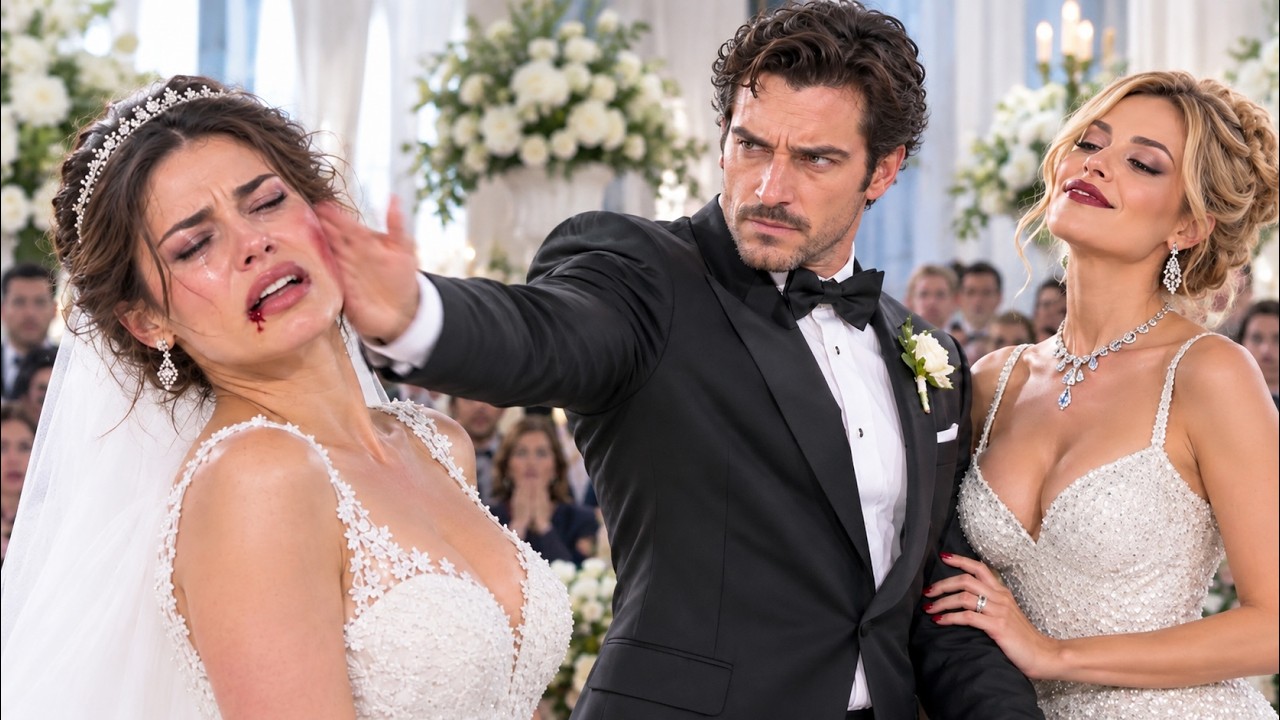
The slap cracked beneath the glass dome of the Lakeshore Conservatory before the string quartet could cover it. Clara Whitmore’s head turned sharply to the side. Her tiara slipped a quarter inch and a thin line of blood slid from the corner of her mouth.
In front of her, Adrienne Voss still held his hand in the air as if he wanted all 300 guests to see exactly how it had been done. Beside him, Vanessa Cole clung to his sleeve with an expression of wounded innocence that did not match the gleam in her eyes.
The white roses, the candles, and the silk ribbons kept the room looking like a fairy tale. Nobody moved, yet dozens of phones kept recording.
Clara did not look at the man she had married 40 minutes earlier. She looked at Vanessa’s throat. Resting against her collarbone was a pear-shaped diamond on a platinum chain. And on the left edge of its setting was a tiny notch. 22 years ago, Clara’s mother had caught that pendant in a car door, and her father had refused to have the damage repaired. He said some things should be allowed to remember. That necklace had vanished from his office safe the week he died. The police called it a burglary. Clara had spent 3 years believing them.
Adrienne was the first to speak. He told the room in the warm and regretful voice that had sold a thousand luxury apartments that his bride had been unwell for weeks. He said she had become paranoid and jealous and that she had just lunged at a guest in front of everyone they knew. Then he apologized for the scene and wrapped an arm around Vanessa’s shoulders as if she were the one who needed comfort. Nobody asked why a groom would hold his chief of staff so tenderly on his wedding day. Nobody defended the woman in the torn veil.
Clara noticed something else, and it frightened her more than the pain. His hand had been perfectly steady. A man who loses control shakes afterward. Adrienne’s fingers were calm, almost bored. The slap had not been rage. It had been a decision.
When he signaled to his security team, two men in dark suits moved toward her. Clara understood then that the wedding itself had been built as a stage with the guests as a jury, the cameras as evidence, and herself as the unstable bride who would be quietly removed. He had already written the headline. Jealous wife attacks guest. Billionaire shows restraint. Family asks for privacy.
She did not scream. She did not cry, though her eyes burned. She let the two men take her by the elbows and lead her down the aisle she had walked so proudly half an hour before. As she passed the front row, she lifted her hand as though to steady her veil, and her fingertips brushed the silver comb pinned behind her ear. It was no bigger than a coin. Beneath her fingertip, a tiny green light was glowing, steady, and silent, exactly as it had been since 6:00 that morning.
Adrienne watched her go with the satisfied face of a man who thinks the story is over. He had no idea that the real recording had only just begun to matter.
What could a woman possibly be holding that would terrify a billionaire enough to strike her in front of the entire city? If you want to see how far a betrayal like this can go, subscribe and stay with Clara.
11 months earlier, Clara Whitmore was not a bride and she was certainly not a woman anyone wanted to photograph. She was 31 years old and worked in a narrow lab above a laundromat on the south side of Chicago, where the whole building smelled faintly of detergent and warm cotton.
Her job was to rescue sound. Lawyers sent her cracked cassettes, water-damaged voicemails, and corrupted audio files, and she pulled the words back out of the noise. Most of her clients were tired people in small disputes, and she liked that. Nobody lied to a woman who could hear what was underneath.
She lived quietly in a one-bedroom apartment with a radiator that knocked all winter. Her father’s cardboard boxes sat in a storage unit across town unopened. Daniel Whitmore had been a structural engineer, a gentleman who talked to buildings as if they could answer.
Four years ago, the Harbor Point parking garage collapsed during a spring storm and killed six people. The developer lawyers pointed to one signature on the final inspection report, and it was her father’s. Eight months later, his heart stopped in his sleep. The newspapers called it guilt. Clara called it grief. And she never forgave the difference.
Her mother had died when Clara was nine. So after that funeral, there was no one left. She told herself the boxes could wait. She told herself that every month, and the lie got heavier each time.
Adrienne Voss walked into her lab on a rainy Thursday in October without an assistant and without a driver waiting at the curb. Clara knew his face from magazine covers. He was the founder of Voss Meridian, the company that had built Harbor Point. And for four years, his name had been a curse in her mouth.
He stood in the doorway with rain on his shoulders and asked quite humbly whether he could have 10 minutes. She almost told him to leave. Instead, she let him sit because she wanted to watch him lie.
He did not lie, or at least not in the way she expected. He said he had never believed her father was to blame. He said that after the collapse, his lawyers had advised him to let Daniel Whitmore carry the guilt and that he had been a coward and gone along with it.
For 4 years, the decision had sat in him like a stone. He said he had quietly funded a private review and that it had turned up something he could not ignore. Then he reached into his coat and set a small cassette on her desk. The label was in her father’s handwriting. It read, “Harbor Point, final notes and a date 3 days before the collapse.”
Clara stared at it for a long time. The tape was warped, the plastic cracked along one edge, and the oxide looked brittle with age. Adrienne said it had surfaced in a storage room at one of his old sites. He said his own technicians had called it unrecoverable, but he had heard she was the best in the country at Impossible Tapes. He asked her softly whether she could bring her father’s voice back.
She should have asked why a man who had stayed silent for 4 years had suddenly found a conscience. She should have asked why he came himself instead of sending a lawyer. But her father had been dead for 3 years, and the tape in front of her was the first piece of him that had spoken in all that time. She took it in both hands and told him she would try.
Adrienne thanked her, and for a moment his eyes looked wet. Then he stood, buttoned his coat, and walked out into the rain. And Clara watched him go with something dangerously close to gratitude. She did not know that he had already listened to every second of that tape. He had not come to her lab to find out what her father said. He had come to find out whether anyone else would ever be able to hear it.
It took Clara 19 days to coax the tape back to life. She baked it at a low temperature to bind the flaking oxide, cleaned each fragment of the cracked shell by hand, and rewound the spool onto a new hub one slow turn at a time. Most nights she worked until the laundromat downstairs went dark and the building fell quiet, and she wore her father’s old headphones because they still fit the shape of her head.
On the 19th night, through a wash of hiss, a man cleared his throat. It was him. Clara pressed a hand over her mouth and sat very still. Daniel Whitmore’s voice was tired and dry, the voice of a man dictating notes at the end of a long day. He spoke about curing times, about a delivery of steel that had arrived 2 weeks late, about a coffee that had gone cold on the dashboard of his truck. For 4 minutes and 11 seconds, her father was alive in the room, complaining about the weather. Then the tape broke apart into static. The rest of the reel was ruined, burned away by heat and time, and no amount of patience could bring it back.
She cried for a long while, and when she finished, she felt lighter than she had in years. She picked up the phone and called the only person who knew what the tape meant. Adrienne arrived within the hour, once again, without a driver.
He listened to the four minutes with his eyes closed and his jaw tight, and when it ended, he did not speak for a long time. Then he said very quietly that he had forgotten how much her father sounded like a man who loved his work. He thanked her. He said that whatever happened next, she had given a dead man his voice back and that nobody could ever take that from her.
After that, he kept coming around. First, it was a reason, a follow-up question about the tape, or a signed form for the lab. Then it was coffee, which he carried up the stairs himself and handed over with the awkward care of a man who had never learned how to be ordinary.
He did not talk about money. He did not mention the helicopter or the penthouse or the board of directors. Instead, he asked about the radiator that knocked all winter, and he listened when she answered. He admitted that he ate dinner alone most nights standing at a kitchen counter, and that the quiet in his house frightened him more than any lawsuit ever had.
Clara had spent 3 years being careful and she watched herself lower her guard anyway, one coffee at a time. He never pushed. When she grew quiet, he let her stay quiet. When she mentioned her mother, he did not offer a platitude, and he simply asked what she remembered. She told him about a yellow raincoat and a laugh like someone dropping silverware. He nodded as though he were filing it somewhere safe.
In December, he asked her to dinner. He picked a small Greek place on the north side where nobody would recognize him, and he arrived early to be sure he was not late. Over the course of the evening, he said something she did not forget. He told her that powerful people were surrounded by agreement and that he had been starving for someone who could say no. Clara laughed and told him she said no to most things before breakfast. He smiled as if she had handed him a gift.
There were small moments she explained away. One night, he asked in the middle of a story about something else entirely whether her father had kept any field notes from the Harbor Point site. Clara said she assumed he had since he kept notes on everything. Adrienne asked where they might be. She told him about the storage unit across town, the cardboard boxes she had never opened, the grief she kept stacked in a locked room. He touched her hand and said there was no hurry. Some boxes were not meant to be opened until the heart was ready.
Later driving home with the heater roaring, she realized he had never asked which storage company or which unit and that this was strange. Then she realized it was not strange at all because a careless man asks and a careful man waits to be told. She pushed the thought away. She did not want to find a flaw in the one good thing that had happened to her.
The first time she met Vanessa Cole was in January in the lobby of Voss Meridian, a glass tower with a fountain that ran without a sound. Vanessa was Adrienne’s chief of staff. She was tall and elegant with honey blonde hair pinned in a flawless knot, and she shook Clara’s hand with exactly the right amount of pressure. Her smile arrived a half second too fast. She said she had heard so much about Clara and that Adrienne’s face changed whenever he said her name.
Then, while Adrienne took a call across the lobby, Vanessa tilted her head and said something Clara could not stop turning over for the rest of the night. She said she was glad Adrienne had finally found someone who understood how to keep a secret. Clara asked what she meant. Vanessa laughed lightly and said she meant Adrienne’s schedule. Of course, he had never let anyone close enough to learn it. But her eyes lingered on Clara’s face just a moment too long, studying it the way a jeweler studies a stone.
That night, Clara sat alone in her lab with her father’s headphones around her neck and played the four minutes again. She had listened to them 40 times and she knew every breath. But this time, at the very end, just before the static swallowed everything, she heard something she had never noticed. It was a half sentence, thin as a thread, and her father’s voice had dropped as though he were afraid of being overheard. She slowed the audio to a crawl and turned up the gain until the room filled with the sound of his whisper. He said, “I’ve put the real numbers where only Clara will know to look.”
Clara went cold from her scalp to her heels. She had never told Adrienne about that line. She had played him the four minutes, and the whisper had been buried beneath the hiss, so deep that even he could not have caught it. She had let him believe the tape ended at an ordinary sentence about steel.
She turned off the equipment, opened a drawer, and took out a cheap digital recorder she used for field work. She did not know why she did it. She only knew that for the first time in months, she had a secret of her own, and that she was no longer sure whether she was protecting it from a stranger or from the man she was beginning to love.
Clara did not sleep that night. At dawn, she drove across the city to the storage unit she had avoided for 3 years. And for the first time, she did not ask herself whether she was ready. The whisper had changed the question. It was no longer about grief. It was about whether her father had left her something to find.
The unit smelled of dust and cold cardboard. 11 boxes sat stacked against the back wall, each labeled in his square engineers capitals. She opened them one at a time with her phone flashlight clenched in her teeth. Tax returns, old drafting pencils, a thermos with a dent in the lid, a framed photograph of her mother in the yellow raincoat, laughing at someone just outside the frame. Clara sat down on the concrete floor and held that photograph for a long time before she made herself keep going.
In the ninth box, beneath a stack of site manuals, she found a battered steel toolbox with a combination lock. She tried her birthday, and nothing happened. She tried her mother’s, then the date of the collapse, and the lock stayed shut. Finally, she tried the one number he had said aloud in the tape, the steel delivery that arrived two weeks late, and the latch sprang open with a soft click.
Inside lay a bundle of folded blueprints, a small notebook, and a flash drive wrapped in a strip of blue masking tape. Her father had always used blue tape for anything he trusted. She turned the notebook over in her hands and read the first page. It was a list of rebar counts and concrete pour dates for Harbor Point written in his careful hand. Beside the third pour, he had underlined one entry twice and written two words in the margin. Not approved.
Clara read it again, then again until the letters swam. Her father had signed the final inspection report. Every news story said so. Yet here, in his own handwriting, was a note that said the pour was never approved, and someone had signed in his name anyway.
Her fingers shook as she slid the flash drive into her laptop. It held scanned photographs of cracked columns, a spreadsheet of material invoices that did not match the work, and one short video filmed from inside the garage 3 days before the collapse. In the video, her father walked slowly along a concrete pillar with a flashlight. He spoke in the same tired voice she had just restored. He said the columns on level two were poured with half the steel the plans required, and that someone at Voss Meridian had ordered the cut to save money. He named no names. He said he had sent a warning memo to the developer the week before and received no reply. Then he looked directly into the camera and said, “If something happens to me, my daughter will know where to look.” The video ended there.
Clara realized she had stopped breathing and she gulped air and pressed her forehead against the cool lid of the toolbox. Her father had not died of guilt. He had died holding the proof that six people did not have to die either.
She sat in that storage unit for 3 hours, copying everything onto three separate drives. She had one inside a hollow bookend in her lab, mailed a second to an old college roommate with a note that said, “Only keep this unopened,” and taped the third beneath a drawer in her apartment. She did not tell Adrienne. She did not tell anyone.
She told herself she needed a lawyer, a verified chain of custody, and a way to make sure the evidence could not be quietly buried. But beneath those practical thoughts, a smaller voice kept asking the question she dreaded most. Had Adrienne known?
That evening, he arrived at her door with takeout and a bottle of wine, grinning like a boy who had gotten away with something. He kissed her cheek and asked how her day had been. Clara looked at the warmth in his face and tried to see a liar. She could not. She told him she had spent the afternoon sorting old paperwork. He nodded and unpacked dumplings onto her chipped plates, and he did not ask what paperwork. That was the first thing that frightened her. Adrienne asked about everything, so his silence about that one thing felt deliberate.
Over the following weeks, she began to test him gently. She mentioned the storage unit again, and he said something kind and vague. She mentioned the toolbox, and he asked whether it was heavy and nothing more. She mentioned her father’s final notes and for half a second his hand paused on the stem of his wine glass before moving again.
Then in late February, Adrienne proposed. He did it in her cramped kitchen with the radiator knocking in the background and a pot of pasta boiling over on the stove. He got down on one knee holding a simple ring, a small sapphire in a plain gold band, and said he did not want a spectacle. He said he wanted to spend his life making up for the four years he had let her father carry the blame. His voice cracked on the last word. Clara looked at the ring, then at his eyes, and found tears there that looked entirely real. She said, “Just part of her meant it, and part of her had already decided that the safest place to keep a dangerous man was close enough to watch.”
The next morning, while he slept in her bed, she slipped out and bought a second digital recorder, a tiny one, no bigger than a coin. She told herself it was for work. Then she sat in her kitchen and made a list of everything she needed to know, who ordered the steel cut, who signed her father’s name, who benefited when the garage fell, and whether the man who had just promised to love her had been in the room when it happened.
The wedding planner called that afternoon bright and efficient, and said Mr. Vos had already booked the Lakeshore Conservatory for June. The date was set. 300 guests had been invited and a press list had been arranged. Clara thanked her and hung up.
Then she noticed a small white envelope on the kitchen counter that she had not put there. Adrienne must have left it that morning. Inside was a single sheet of paper, a prenuptual agreement already signed on his side with a sticky note in his handwriting that read, “Just a formality. Sign when you’re ready.” She almost laughed. For a man who claimed to want nothing from her, he had certainly prepared the paperwork.
She flipped to page nine, where a clause had been highlighted in pale yellow. It stated that all personal papers, recordings, and documents inherited by either spouse would be held jointly in trust to be managed by the Voss Meridian legal department. Clara read that clause four times, and her blood turned to ice. It was not about love or about property. It was about her father’s boxes.
She folded the agreement carefully, slid it into her coat pocket, and turned off the kitchen light. In the dark, with her heart hammering, she understood exactly what she was marrying. Then she picked up the tiny recorder, held it against her palm, and whispered the words that would change everything. If he wants a wedding, I will give him one.
Clara did not sign the agreement. She did something far more dangerous. She told Adrienne she would sign it after the honeymoon, laughing as she said it, and he laughed with her. But she saw the muscle tighten in his jaw before the smile arrived, and she filed it away with everything else.
From that night on, she lived two lives. In the first, she was a happy bride to be who tasted cake samples and argued about flowers. In the second, she was a woman building a case in a locked room inside her own head.
She hired a lawyer first. Her name was Miriam Okafor, a former federal prosecutor in her 50s with silver streaked braids and a voice like a closing door. Clara met her in a diner across the river, a place with torn vinyl booths and nobody who read the business pages. She laid the three things she trusted on the table, the notebook, the video, and a print out of the prenuptual clause.
Miriam watched the video twice without speaking. Then she took off her reading glasses and said quietly that this was the kind of evidence people died over. Clara told her she already knew.
Miriam did not offer comfort. She offered rules. Never confront him. Never mention the video. Never let him see you afraid. Keep the originals in three places and never carry all three at once. And above all, she said, do not assume the evidence is enough. A man like Adrienne does not fear the truth. He fears the truth arriving in a form that cannot be dismissed. Her father’s video proved the steel was cut. It did not prove who ordered it. For that, Clara needed something Adrienne himself had said or signed, something with his fingerprints on it.
That was when Clara showed her the tiny recorder. Miriam looked at it for a long moment. She explained carefully that recording a private conversation could be legal or illegal depending on the state and the setting. Illinois required consent from every party. Clara listened, nodded, and asked a question. What about a room where everyone present had agreed in writing to be recorded? Miriam almost smiled. She said it depended on the room. Clara knew exactly which room.
In the stack of wedding paperwork, a vendor contract required every guest, caterer, and staff member to consent to audio and video capture during the event because Adrienne wanted the press to have full access. Page two, paragraph 6. He had written the permission himself.
Miriam sat back and for the first time her face showed something like respect. She said Clara would need to be patient and that she would need Adrienne to talk. So Clara planted herself in the rhythm of his life and waited.
She learned that he spoke most freely at night after wine in the study of his lakeside house where a framed photograph of the Harbor Point site hung beside a Picasso sketch. She learned that he took his calls on the balcony away from the staff. And she learned that Vanessa was never far from his phone.
One evening in April, Clara stood outside the study door holding two glasses of wine and heard her fiance’s voice on the other side, low and urgent. He was speaking to someone about a delivery. He said the old man’s boxes were still the problem. He said the girl was careful but sentimental and that the wedding would take care of the rest. Then Vanessa laughed, a soft private sound, and said that in six weeks the whole thing would be airtight.
Clara stood frozen in the hallway and the wine trembled in the glasses. She did not breathe until she heard his footsteps approaching. Then she turned, made her face bright and empty and pushed the door open with her hip.
Adrienne looked up and his face melted into tenderness. He said she looked like she had seen a ghost. Clara smiled and said she had only been thinking about the vows. He took the glass from her hand and kissed her forehead. And neither of them looked at Vanessa, who sat on the leather sofa, watching with an expression Clara could not read.
That night, Clara lay awake beside him and listened to his steady breathing. She thought about the word airtight. A prenup was not airtight. A prenup could be challenged, renegotiated, thrown out by a judge. Something airtight had to be permanent, something that could not be undone by a lawyer, a court, or a daughter’s change of heart.
Over the next weeks, small things began to shift. A box of her father’s drafting pencils she had left in her apartment went missing. A neighbor mentioned a man in a gray jacket asking about her schedule. Her lab computer began to behave strangely, folders opening that she had never touched. She told Miriam, who told her to say nothing and change nothing. Let them think she hadn’t noticed.
Then Vanessa began to appear at Clara’s side. She came to the dress fitting uninvited and corrected the neckline with a single practice touch. She came to the florist and rejected the roses Clara loved.
She came to the lab one afternoon wearing a cream coat and carrying a gift box tied with silver ribbon. Inside was a small silver comb no bigger than a coin set with a tiny pearl. Vanessa said it was a wedding gift from Adrienne, something old and something borrowed. She said Clara should wear it behind her ear, close to the veil, so the photographers could catch it in the light.
Clara thanked her warmly. She held the comb up to the window and turned it slowly between her fingers. It was beautiful. It was also, she noticed, a fraction too heavy for its size. Along the underside was a hairline seam as though two halves had been glued together by someone in a hurry.
Vanessa watched her face, waiting for something. Clara gave her nothing but a grateful smile.
That evening, she took the comb to the only person she trusted with a screwdriver, a retired electronics repairman named Mr. Lynfist, who lived below the lab. He opened it under a magnifying lamp without a word. Inside, nestled in a bed of tiny wires, was a transmitter no larger than a grain of rice and a battery that would last exactly one day.
Mr. Lynfist looked up at her over his glasses. He said someone had wanted to hear everything she said on her wedding day. Then he asked quite calmly what she wanted him to do with it.
Clara stared at the tiny device and a slow, dangerous idea began to take shape. She told him to put it back exactly as he found it. Then she asked him to build her another comb, identical in every way, with a recording chip of her own, hidden inside. She would wear the real one to the church. Adrienne would hear nothing but a bride who had no idea she was being watched. And on the morning of the wedding, she would carry the second one, switched on at 6:00, in the one place no one would think to look.
Mr. Linkst took 9 days to build the second comb. He worked in the back room of his apartment under a magnifying lamp with a cup of cold tea beside him and a radio murmuring baseball scores. When he finished, he set both combs side by side on a white handkerchief and asked Clara to tell them apart. She could not. The pearl was the same shade of cream. The seam was just as faint, and even the weight matched. Only one of them held a recording chip, and he had hidden its tiny green light beneath the pearl, where it would glow only if she tilted her head toward a mirror.
He explained the rest in the flat voice of a man who had spent 40 years fixing other people’s mistakes. The original comb would keep transmitting, so he had loaded it with a looping recording of Clara’s voice made from an ordinary morning of humming, small talk, and one nervous laugh. Anyone listening would hear a bride getting ready. They would not hear a woman who knew.
Clara asked where the original should go. Mr. Lynfist said it should go where it could be heard but not touched. After some thought, they chose the stem of her bouquet wrapped in white ribbon and carried in her own hands all day. The comb with the green light would go exactly where Vanessa had told her to put it behind her ear in full view of 300 guests. Clara decided that was the one place no one would think to look.
when she told Miriam the lawyer was quiet for a long time. Then she said Clara was either very brave or very foolish and that in her experience the two were hard to tell apart until the verdict came in. She repeated her rules slowly like a prayer. “Do not provoke him. Do not speak first. Do not leave the building without the recording. If anything goes wrong, walk away alive.”
Clara nodded to every word and meant none of them. She had already decided that she would stay in that room until it was over.
The weeks before the wedding blurred into fittings, tastings, and rehearsals. Adrienne was gentle and attentive, and he kissed her hands in front of the staff. He called her the calmest woman he had ever met. Clara smiled and thanked him, and underneath the smile, she studied him the way her father had studied cracked concrete, looking for the hairline fracture that proved the whole structure was lying.
She found it in small things. He never looked at the sapphire ring on her finger. When she mentioned her mother, he changed the subject. And whenever the word storage came up, even in passing, his eyes slid toward Vanessa.
Vanessa herself grew warmer as the date approached, which frightened Clara more than her coldness had. She brought pastries to the fittings and complimented Clara’s posture. She said she had grown up poor and wished somebody had looked after her the way Adrienne looked after Clara. It was a good performance.
Only once did it slip. While adjusting Clara’s veil, Vanessa’s fingers brushed the empty spot behind her ear and paused there a moment too long, as if she were checking something she expected to find. Clara held perfectly still. Then she smiled and said she was saving the comb for the day. Vanessa smiled back and said that was wise.
On the Wednesday before the wedding, Clara sat alone in her lab and reread her father’s notebook for the hundredth time. She did not know what she was looking for. She only knew that something in the whisper kept pulling at her.
I’ve put the real numbers where only Clara will know to look, not hidden where Clara could find them. Where only Clara would know to look. She closed her eyes and thought about what her father knew that nobody else did. He knew her handwriting, her laugh, and her mother’s yellow raincoat. He knew the story of the pear-shaped pendant, the car door, and the notch on its left edge that he had refused to repair. He had told that story to her a hundred times. He had never told it to anyone else.
Clara opened her eyes. The police report on the burglary was still in her desk drawer. She had read it so many times, the creases had gone soft. A break-in at her father’s office the week he died. The thief had taken nothing but a single item from the safe. The cash was left behind, and so were the bearer bonds and her father’s watch. The only thing missing was a small velvet box.
For 3 years, she had believed it was a robbery gone wrong. She had never asked why a thief would ignore everything valuable in that safe and take only one thing. She sat very still, and the radiator knocked in the silence like a fist against a door. If the pendant had been the target, then the numbers her father hid were inside it. And if someone had gone to the trouble of stealing it the very week he died, then that someone had been looking for the same proof she had finally found in a toolbox.
They had not been looking for money. They had been looking for evidence. She thought of Adrienne’s easy voice and his calm hands. She thought of how patiently he had waited for her to open those boxes. And she wondered, with a slow, sick turn in her stomach whether the necklace had ever left his house at all.
The night before the wedding, Adrienne came to her apartment one last time. He carried a single white rose and apologized for not staying. He said tradition kept him from seeing her until the ceremony. At the door, he kissed her forehead and held her a moment longer than usual. In a voice that was almost tender, he said he had a surprise for tomorrow. He said it was something that had belonged to her family and that it would be the first thing she saw after she walked down the aisle.
Clara kept her face soft and her breathing slow. She thanked him and watched him walk down the stairs. Then she closed the door, turned the lock, and leaned against the wood until her knees stopped shaking.
At 5:58 the next morning, her phone buzzed on the nightstand. It was a message from an unknown number for words long. Wear the comb. Smile wide.
At 6 a.m., Clara sat in front of her bathroom mirror and pinned the silver comb behind her left ear. She tilted her head toward the glass, and beneath the pearl, a pin prick of green light glowed once, steady and patient. Mr. Lynfist had told her it would stay lit for 14 hours. She did not intend to need that long.
She read the message again. For words, no name, no signature. She could not tell whether it was a threat or a warning. She decided, with the practical coldness she had learned over 11 months, that it did not matter. Either way, someone else in the story was watching Adrienne and somebody who watches a man that closely usually has a reason. She forwarded the message to Miriam without comment. The reply came in under a minute.
Do not answer it. Do not trust it. Do not stop recording.
The morning dissolved into hair pins and hands. A stylist pinned her veil. A photographer asked her to look toward the window. Vanessa arrived at 9:00 wearing a pale gold dress that was nearly white and nobody in the room said a word about it. She surveyed Clara from head to toe and fixed the position of the comb by a/4 in as though she were adjusting a camera. Her fingertip lingered on the pearl. Clara kept her eyes lowered and let her lashes hide her pulse.
At 10, Adrienne’s lawyers arrived with a leather folder and a notary. They explained that the civil registration had to be completed before the ceremony to avoid scheduling problems with the press. Clara asked if Miriam could be present. A lawyer in a gray suit said it was only a formality and that there simply was not time. Clara agreed with a smile that cost her something to hold.
She signed the marriage certificate in a small side room with four witnesses she had never met. Adrienne signed beside her, and his hand was steady. When it was done, he did not kiss her. He took the folder from the notary, slid it into a briefcase, and thanked everyone for their discretion. He told Clara he was proud of her. She noticed he did not look at her face when he said it. He looked at the briefcase.
And then, because she was watching for it, she noticed one more thing. Among the pages the notary had gathered, one had been signed by Clara without a single heading. She had not read it. It had been slid between two pages she did read, and she had turned both with the same flowing hand. A trick as old as paperwork. She said nothing. In her ear, the comb kept its tiny silent vigil.
At noon, Clara stood at the top of the conservatory stairs with her bouquet in her hands, and the stem of the bouquet pressed warm against her palm where Mr. Lynfist’s decoy hummed its looping lie. Beneath the glass dome, the string quartet began. 300 faces turned. The light fell through the panes in long white bars, and the white roses shivered in their silver urns.
She walked down the aisle alone. Her father was not there to give her away, and the empty space beside her felt like a person. She told herself he was walking with her. She told herself the whisper on the tape was the only vow she was making today.
Adrienne waited at the altar with his hands folded, wearing a tuxedo that looked like it had been cut from midnight. When she reached him, his eyes softened and for one terrible second she almost believed it. Then she saw Vanessa standing at the edge of the front row, one hand resting against her collarbone. Against her throat hung a pear-shaped diamond on a platinum chain.
Clara did not stop walking. She did not falter, but her heart lurched so hard she thought the whole room must have heard it. She knew that pendant the way she knew her own pulse. She knew the tiny notch on its left edge, the one her father had refused to fix. It had been 3 years since she had seen it. 3 years of believing it was gone. Adrienne had said it would be the first thing she saw. He had not lied. He had only failed to mention who would be wearing it.
The vows were mercifully short. A judge in a black robe asked the questions, and Clara said her answers in a clear, even voice. Adrienne said his with a perfect trembling sincerity. When they exchanged rings, his fingers were cold. When the judge pronounced them husband and wife, the applause rose like a wave, and the photographers surged forward.
Adrienne leaned in to kiss her. At the last second, he whispered against her cheek so quietly that only she could hear, and the comb behind her ear caught every syllable. He said, “You should have signed the prenup, Clara.” Her stomach dropped. She smiled for the cameras and whispered back, “I don’t know what you mean.” He pulled away with a gentle laugh and the room cheered.
The reception began under the glass dome. Waiters circulated with champagne. A band played something soft. Clara moved through the crowd on Adrienne’s arm, shaking hands with senators, developers, and people who had once whispered that her father was a murderer. Each of them congratulated her warmly. Each of them looked straight through her.
At 2:00, Vanessa glided toward them through the crowd, glowing in her pale gold dress with the pendants sparkling at her throat. She kissed the air beside Clara’s cheek and said so softly that nobody else could hear that she hoped Clara liked the surprise. Clara met her eyes and let the silence stretch. Then she reached out very gently and touched the notch on the pendant’s edge with her fingertip. She said, “My father never repaired this.”
Vanessa’s smile froze. Behind her, Adrienne went perfectly still, and across the glass dome, the string quartet played on, as though nobody had noticed that the temperature of the room had just dropped to freezing. Adrienne took Clara by the elbow, harder than any groom should, and steered her toward the stage in the center of the hall.
He said into her ear, in a voice like a closing blade, that it was time for the toast. Clara looked at the microphone at 300 waiting faces and at the small green light that nobody could see. Then she looked at her new husband’s raised hand and understood a heartbeat too late exactly what he had planned for the next 90 seconds.
Adrienne led her up the three steps to the stage as if he were guiding a sleepwalker. The microphone stood in a pool of white light and the quartet faded into a hush. 300 guests lifted their glasses. Somewhere in the back, a phone camera chirped and then another until the room glittered with tiny red recording lights.
Adrienne took the microphone with one hand and kept the other locked around Clara’s elbow. He thanked everyone for coming. He told them he was the luckiest man in Chicago and that his wife had brought something into his life that money never could. The crowd murmured with approval. He paused for effect and squeezed her arm until her fingers tingled.
Then he said with a sad little smile that he wanted to share one more thing because honesty was the foundation of any marriage. He said Clara had been struggling. The grief over her father had never really left her. In recent weeks she had grown suspicious and confused, seeing conspiracies in ordinary things. He asked the room to be gentle with her today and to forgive anything she might say.
Clara understood in that instant. This was not a toast. It was the opening argument of a trial in which she was the defendant. Whatever she said next, every person in this room had just been told not to believe it. He held the microphone out to her with a tender, patient expression.
Everyone was watching. The silence pressed on her ears like deep water. She could have smiled and thanked everyone. She could have raised her glass, walked off the stage, and kept the green light safe. Miriam would have told her to do exactly that. But a pear-shaped diamond glittered in the front row with the notch on its left edge facing the lights. And Clara had spent 3 years believing her father’s last gift to her was Ash.
She took the microphone. Her voice came out steady and clear. She thanked everyone for coming and said she had one small question for her husband’s chief of staff. She turned toward Vanessa and asked kindly where she had found the necklace she was wearing. A ripple went through the crowd. Vanessa touched the pendant and laughed lightly. She said Adrienne had given it to her as a thank you for years of loyalty.
Clara nodded and asked if Adrienne knew that it had been stolen from her father’s safe the week he died. The room went absolutely still. Adrienne’s smile did not move. He looked out at his guests with sorrowful eyes and said softly that this was exactly what he had feared.
He took the microphone gently from her fingers and for half a second his lips brushed her ear. In a voice too low for any microphone, he said, “Where did you put the real numbers, Clara?” Then he turned his hand over, lifted it, and struck her across the face. The sound cracked against the glass dome. The tiara slipped. Her head whipped to the side. The taste of copper bloomed on her tongue, and the world went white and ringing.
A woman in the third row cried out. A glass shattered somewhere near the bar, and Clara, with her cheek burning and her ears roaring, noticed what she would later describe to a judge as the most frightening detail of her life. His palm had landed with perfect precision, and he had not even blinked.
Adrienne lifted the microphone again. His voice shook now, just the right amount, as though regret were tearing him apart. He said he was sorry. He said he had never raised a hand to anyone in his life, but she had lunged at a guest and he had acted on instinct to protect a friend.
The performance was flawless. Vanessa pressed her fingertips to her lips and dropped her gaze like a wounded saint while her eyes gleamed with something that looked very much like victory. The guests sat frozen, phones raised, mouths open. Not one of them stood. Not one of them said a word.
Clara pressed the back of her hand to her lip and looked at the blood on her knuckles. She thought of her father in the empty garage, speaking into a camera, trusting that someone would listen. She thought of the six people who never came home. She did not cry. She held her head high and let Adrienne’s security men take her by the elbows.
They walked her down the aisle, past the white roses and the silent faces, past the sneering photographers and the senators who studied their shoes. As she passed the front row, she lifted her hand to steady her veil and brushed the silver comb. Beneath her fingertip, its tiny light still glowed. Everything was on tape. The whisper at the altar, the words on the stage, the slap, every syllable had been recorded in a room where every guest had signed away their right to object.
They took her through a service door, down a concrete corridor that smelled of bleach and spilled champagne. A guard on her left reached for her bouquet. She tightened her fingers around the stem, and he shrugged and let it go. The decoy was still humming its looping lie of an ordinary bride, and somewhere upstairs, someone was listening to it with growing confusion.
At the end of the corridor, a black SUV idled beside a loading dock. Rain streaked the windows. A driver stood beside the open door with his eyes lowered, and the guards guided her toward it. She understood then what was coming. They would put her in that car and take her to a private clinic with a friendly doctor. By evening, a statement would be released about her fragile mental state, and the video would be trimmed until it began a second before she spoke and ended a second before he moved.
The comb would be found. The phone would be taken. The woman in the white dress would disappear into a quiet room, and the world would call it kindness. She dug her heels into the wet concrete and refused to move. Then the older guard on her right, a broad man with gray temples and a scar through one eyebrow, leaned close to her ear. He did not look at her. He spoke so quietly that the rain almost swallowed it. He said, “Keep walking, Mrs. Voss. I’m the one who sent you the message.”
The guard’s name was Walter Briggs, and he did not slow down as he spoke. He kept one hand on her elbow so that anyone watching from the doorway would see only a security man doing his job. He told her in the flat voice of someone reporting weather that she had about 90 seconds before the driver’s phone rang and somebody upstairs realized the decoy had been playing the same hum for 3 hours.
Clara kept her eyes on the SUV and asked how he knew about the comb. He said he had spent 22 years as a police detective in Evston before Voss Meridian offered him triple his pension to run private security. Old habits did not die. 3 weeks ago, he had watched Vanessa carry a gift box into a jeweler’s workshop and come out without it. He had followed her. He had listened through a wall and he had heard her say the bride would be wearing something that would let them hear every word she said before the wedding was over.
He had not liked it, but he had liked the second thing he overheard even less. He said the Harbor Point collapse had not been an accident of greed. It had been a calculated risk that went wrong. Adrienne’s father had ordered the steel cut and Adrienne, then a young vice president, had signed the order to implement it. When Daniel Whitmore sent his warning memo, Adrienne read it. He chose to wait. Six people died on a Tuesday night in April, and by Wednesday morning, the lawyers were already writing her father’s name onto the inspection report.
Clara felt the pavement tilt under her feet. She pressed her nails into her palm until the world steadied. Then she asked why Walter was telling her now. He glanced at the scar through his eyebrow with a small, tired smile. He said his daughter was 26 and she had walked into a parking garage that very morning to get to work. He said some men could carry only so many secrets before they started to rot from the inside.
The driver lifted his phone to his ear. Walter’s grip tightened. He said there was one door 10 steps to the left behind a stack of catering crates. It led to the kitchen corridor and then to a side street where his own car waited, an old gray Buick no one in the building would look twice at. He would stage a scuffle. He would say she had broken free and run into the rain. By the time they organized a search, she would be on the other side of the river.
Clara asked what happened to him afterward. Walter shrugged and said he had retired once already. He could do it again. She counted the steps. 7 8 9. Behind her, the driver’s voice rose in sudden alarm. Walter spun around shouting that she was running. And before the other guard could react, Clara hiked up the sodden hem of her wedding gown and bolted for the crates. The bouquet stayed in her fist.
Rain hit her face like thrown gravel. She ran through the narrow door, down a corridor of stainless steel tables and hanging ladles, past a startled line cook who dropped a tray of petite fours and said nothing at all. A hand grabbed at her veil from behind and tore it free. She let it go.
The side door slammed open into a gray alley. The Buick idled at the curb with its engine rattling. She threw herself into the back seat, still holding the bouquet and curled below the window as Walter came sprinting around the corner, soaked and breathing hard. He slid behind the wheel, and the old car lurched forward just as two black SUVs swung into the alley behind them.
They took six turns in 90 seconds. Walter drove like a man who had done this before, cutting through a car wash, a loading bay, and a church parking lot before slowing at a red light as if nothing had happened. In the rear view mirror, his eyes found hers. He told her to take the comb out of her hair and keep it somewhere dry.
She unpinned it with trembling fingers. The green light still glowed under the pearl. 14 hours, Mr. Lynfist had said, and it had barely used six. She asked Walter what Adrienne had been looking for when he whispered in her ear. “Where did you put the real numbers?” Walter was quiet for a long moment.
Then he said he had spent three years wondering the same thing. After her father died, Adrienne had turned his offices upside down looking for something. A set of numbers, a ledger, a coded record of what had really been poured into those columns. Whatever Daniel Whitmore had hidden, it was the one thing that could connect Adrienne’s signature to the dead.
Clara looked at the bouquet in her lap, at the white ribbon wrapped around its stem, and a strange calm settled over her. She thought of the whisper on the tape where only Clara will know to look. She had spent 11 months looking in boxes. She had been looking in the wrong place.
She told Walter to take her to her lab. He frowned and said that was the first place they would search. Clara shook her head and said she did not need the lab. She needed the laundromat downstairs and the one machine in the corner that had been out of order since the week her father died.
Walter glanced at her in the mirror. Then his phone buzzed on the dashboard and the name on the screen made his face go gray. It was Adrienne and the message beneath it said, “I know where she’s going.” Walter did not answer the message.
“He lowered the phone to his knee, stared at the red light ahead,” and said very quietly that his company device had been tracked since the day he was hired. Every guard at Voss Meridian carried one. He had known it for years and had simply never given anyone a reason to look.
Clara asked how long they had. Walter said the light would turn green in 8 seconds, and that 8 seconds was about how long it took a man like Adrienne to forgive a mistake. He rolled down the window, dropped the phone into a storm drain, and heard it splash somewhere far below the street. Then he pulled forward as the light changed.
She asked whether Adrienne really knew about the laundromat. Walter thought about it for the length of a block. He said he did not think so. A man who knew would not have sent a warning. He would have sent a car. The message was a hook thrown into dark water to see who flinched.
But Adrien knew her lab, her apartment, and her storage unit, and sooner or later he would work through the list. They had perhaps an hour.
The Buick crossed the river under a sky the color of wet slate. Clara sat in the back seat in a ruined wedding gown with a bouquet in her lap and a comb in her palm, and she told Walter the story she had never told anyone.
In the weeks before he died, her father had started doing his laundry at the shop below her lab, even though he owned a perfectly good machine at home. She had teased him about it. He said he liked the sound of the old industrial washers. He said they were honest machines built by people who expected them to last.
One morning, she had found him on his knees in the corner with the back panel off the biggest washer, a rusted green giant that had been broken for a decade. He had grease to his elbows and a screwdriver in his teeth. When she asked what he was doing, he winked and said he was fixing the one machine in the world that would never have to run again.
She laughed. She thought it was an old man’s joke. Two weeks later, he was dead, and the machine had a handwritten sign taped to its door that read, “Out of order.” She had walked past it every day for 3 years.
They reached her block at 20 4. The laundromat sat between a pawn shop and a shuttered bakery, its windows fogged from the dryers. Walter parked half a block away and told her to wait. He walked the length of the street once slowly like a man looking for a lost dog.
When he came back, he said there were no black cars, no strangers, only an old man in the window who looked as though he had been waiting for her. It was Mr. Lynfist. He opened the side door before she knocked, still in his cardigan, holding a flashlight and a screwdriver. He did not ask about the dress. He did not ask about the blood on her lip. He only said quietly that he had watched the broadcast.
The press feed had gone dark 2 minutes after the slap, but a woman in the third row had streamed all of it. 40,000 people had already seen the slap. Nobody had seen what came before. Clara said they would.
The laundromat was empty at that hour. The dryers sat dark. The corner machine loomed behind a stack of folding tables, rust blooming along its seams, the paper sign curled and yellow. Clara knelt in her wet silk and lace, and set the bouquet on the floor beside her. Mr. Lynfist handed her the screwdriver. Her hands were shaking so badly that she dropped it twice.
Eight screws held the back panel in place. Her father had replaced every one with a fresh stainless bolt, and they turned like he had oiled them yesterday. The panel came away with a groan. Behind it, behind the dead motor and the knotted wires, she saw a flat gray steel case welded to the frame, sealed with a strip of blue masking tape.
She stopped breathing. Her father had always used blue tape for anything he trusted. Walter gave her a utility knife. She sliced the tape and the lid lifted with a soft sigh of air. Inside, wrapped in a clear plastic sleeve, lay a thick ledger in his square capitals. Page after page of steel counts, delivery receipts, and cost comparisons. And on the final page, a signed purchase order with a single line of authorization at the bottom. The signature belonged to Adrienne Voss, and the date was 3 weeks before the collapse.
Beneath the ledger sat a micro cassette taped to a folded note. Clara knew the handwriting before she could read the words. The note said, “Clara, if you are reading this, you did not give up on me. Play it where it’s safe. Then play it where it isn’t.” She turned the cassette over and tears blurred the label. It read, “Call with AV, April 9th.”
Walter exhaled slowly behind her. He said that was the day before the garage came down. Mr. Lynfist said he had a player in the back, an old one, and that it would take 2 minutes to set up. Clara nodded and rose with the ledger pressed to her chest.
Then, from the street outside, she heard the sound of tires on wet pavement. One car moving slowly, then another. Walter went to the window and went rigid. The black SUVs had stopped in front of the shop with their engines running. The door chimed. A man in a rain soaked tuxedo stepped inside, shaking water from his sleeves. He was smiling the way he had smiled for 300 guests. Behind him stood Vanessa, pale gold dressed dark with rain, the pendant glinting at her throat, and four men in dark coats who closed the door and stood in front of it.
Adrienne looked at the open washer, at the ledger in her arms, at the cassette in her hand. He said with perfect warmth that he had a feeling she would come here. Then he held out his palm and said softly that it was time to finish their vows.
Adrienne’s open palm hung in the air between them. Steady as ever. Clara looked at it the way her father used to look at a column he knew would fail, without fear, only certainty about where the crack would run. She said, “You asked me where I put the real numbers.”
His smile did not move. He said she was tired, that it had been a terrible day, and that grief does strange things to people. Behind him, the four men in dark coats shifted their weight. Walter stepped half a pace forward, and one of them touched the inside of his jacket.
Clara did not look at the men. She looked at Mr. Lynfist, who stood beside the old player in the back doorway with one finger already resting on the button. He gave her the smallest nod. She told Adrienne that her father had left her two instructions. “Play it where it’s safe and then play it where it isn’t.”
She pressed the button. The hiss filled the laundromat like rain on a tin roof. Then came a click, a phone being picked up, and a voice she had spent 19 nights bringing back from the dead. It was tired and dry, and it was not afraid. Daniel Whitmore said the columns on level two would not hold. He said the steel had been cut by half and that he would not sign.
A second voice answered smooth and warm, a voice that had sold a thousand apartments. It said the steel stays cut. It said the audit was in six weeks, that nobody would look closely, and that if anyone did, the signature on the report would be Daniel’s, not his. Her father said people would die. And Adrienne Voss, aged 34, vice president of a company that did not yet bear his name, said gently, “Then make sure the building is empty on inspection day.”
The tape ran on for another 11 seconds. Her father said he was recording this call. Adrienne laughed and said, “Of course you are, Daniel.” Then he said no one would ever hear it. The click came and the hiss and then silence.
Nobody in the laundromat moved. A dryer ticked as it cooled. Rain ran down the fogged window. Clara looked at the man she had married that afternoon and watched for the first time the face underneath his face. It was not rage. It was calculation, running its numbers, looking for the exit. Vanessa had gone the color of paper.
She took one step back from him, and her hand rose to the pendant at her throat as though it had suddenly grown hot. She said in a small voice that he had told her it was a paperwork problem. He had told her nobody got hurt. Adrienne did not turn his head. He said very quietly, “Vanessa, not now.”
It was the tone that did it. Clara had heard it a hundred times in a study, on a balcony, in an ear on a stage. The tone of a man who had never once been interrupted by the truth. Vanessa had heard it too for years. Something in her face broke, and what replaced it was not courage, but arithmetic. She had finally worked out who would be standing alone when this was over. She said, “You’re going to say it was me.” Adrienne said nothing, and that was the answer.
Then Clara opened her left hand, resting on her palm beneath its small cream pearl was the silver comb and the pin prick of green light was still glowing. She told him it had been recording since 6:00 that morning. It had caught the whisper at the altar, “You should have signed the prenup.” It had caught the question on the stage, “Where did you put the real numbers?” It had caught the slap, and it had caught every word spoken in this room, and the wedding had been recorded in a hall where every guest, every caterer, and every guard had consented in writing because he had insisted on it himself. She said he had always been so thorough with paperwork.
For the first time in 11 months, Adrienne Voss had nothing to say. The street outside filled with sound. Not the slow rumble of the black SUVs, but something sharper and brighter. A rising wail of sirens that came from three directions at once. Mr. Lynfist cleared his throat and admitted that he had made one phone call from the back room the moment Clara walked in. He said it was to a woman who had once prosecuted federal cases and who had spent the last 4 hours sitting outside a federal building with a stack of affidavits and a very patient agent.
The door burst inward. Miriam Okaphor came through it first, her silver streaked braids soaked, her voice like a closing door. Behind her came agents in blue jackets and the four men in dark coats lifted their hands without being asked twice.
Adrienne was arrested beneath a rusted sign that read out of order in front of a machine her father had repaired so that it would never have to run again. He did not shout. He asked politely for his lawyer and the agent who cuffed him told him that his lawyer was currently on the phone with a prosecutor asking whether he could still get immunity for cooperation. Vanessa’s own attorney, it turned out, had called first.
Walter Briggs handed over his badge number and gave a full statement standing in the rain. He got to keep his pension. The jeweler who had hidden the transmitter in the comb testified for the state. The woman in the third row who had streamed the slap released the full unedited video and within a week the number of people who had seen what came before it passed 11 million.
The trial lasted 9 weeks. Clara testified for 2 days and she did not describe the slap more than she had to. She described a steel count, a signature, and a man who chose to wait. The ledger was entered as exhibit 4. When the jury heard Daniel Whitmore’s voice, several of them wept, and one of them stared at Adrienne across the courtroom for the entire length of the tape. The families of the six who died sat in the second row. When the verdict came, guilty on every count, Clara did not look at Adrienne. She turned around and looked at them. A woman in a gray coat, whose husband had parked on level two that Tuesday night, held her gaze and nodded once.
The inspection report was amended that spring. Her father’s signature was removed from it, and the lines beneath were rewritten to say what the notebook had said all along. Not approved. A plaque went up at Harbor Point, bearing six names and one more in small letters at the bottom, an engineer who tried to warn them.
The pear-shaped diamond came home in a plain evidence envelope. Clara held it under the lamp in her lab and turned it slowly until the light found the notch on its left edge. The prosecutors had offered to have it cleaned. She declined. Her father had always said some things should be allowed to remember.
On the morning the plaque was unveiled, she wore the yellow raincoat she had found in the ninth box. She did not need to say anything. She stood at the edge of the new garage among the families and the cameras, and she let the silence do what silence does when it finally belongs to the truth.
Adrienne had believed that a slap could turn a witness into a patient, that a wedding could manufacture consent, and that 300 silent guests would always side with the man holding the microphone. He had mistaken quiet for surrender. But Clara had spent her whole life listening to what lay beneath the noise. And she had known long before anyone else that the most dangerous thing in any room is the person who never stops recording.