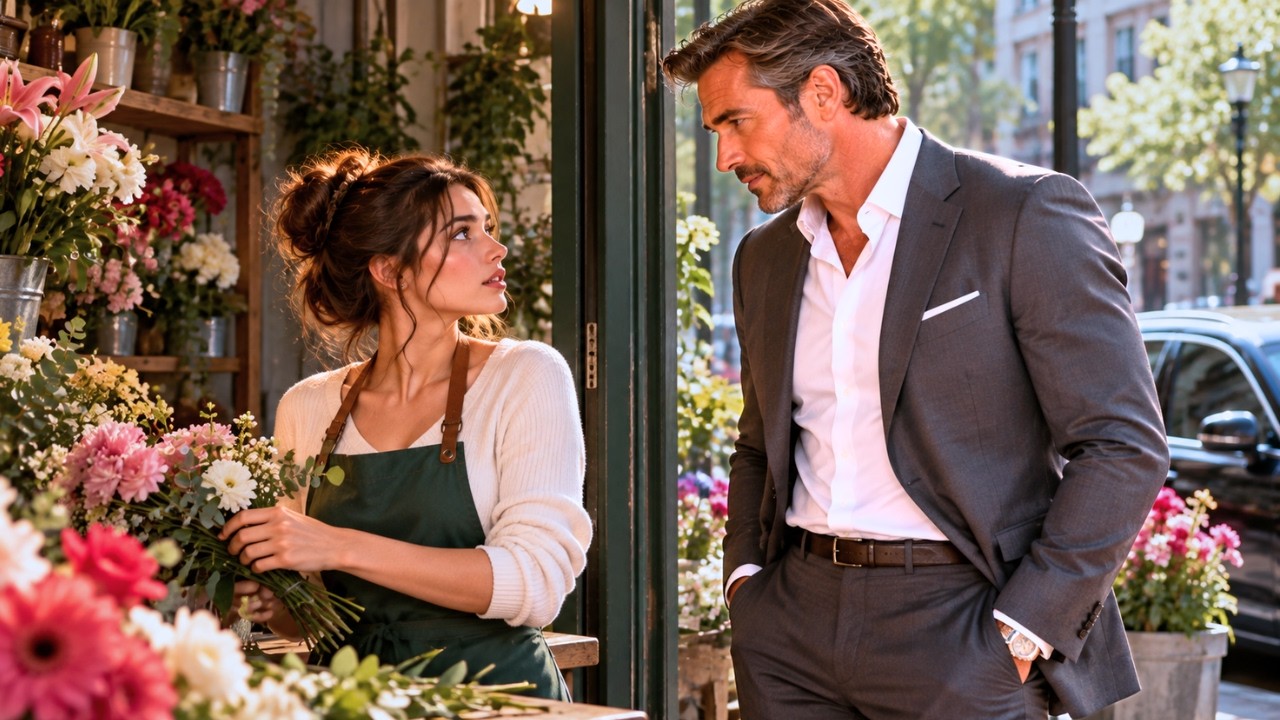
"If I were younger, I’d ask you to dinner." Graham Whitmore said it almost as a joke. At 49, the millionaire had spent his whole life building an empire and putting love off for later, until the day he walked into a small flower shop by chance and met Lucy Harper, a 32-year-old woman who had no idea who he was.
That night, when Graham finally let slip what he really thought of her, he expected Lucy to just smile and change the subject. But she didn’t. Lucy held his gaze for a few seconds, leaned closer across the counter, and said something that left the millionaire completely speechless. And the very next morning, Graham went back to that flower shop for a reason that had absolutely nothing to do with flowers.
Graham Whitmore had built his fortune the way some men build walls, one brick at a time, never stopping to ask what he was keeping out. At 49, he owned a logistics company that moved goods across three continents, a penthouse with a view most people only saw on postcards, and a calendar so full that his assistant joked it needed its own assistant.
What he didn’t have was harder to name. He had never married. The few women who had come close to mattering eventually drifted away, tired of canceled dinners and phone calls that always ended with, "I’m sorry. Something came up." Something always came up, and Graham had always let it.
That Thursday afternoon, the city seemed determined to test what little patience he had left. His car sat motionless in traffic, wedged between a delivery truck and a taxi whose driver had been leaning on the horn for five straight minutes.
"How far are we from the crane building?" Graham asked.
His driver, Martin, glanced at the GPS. "About 6 blocks, sir, but at this rate, maybe 25 minutes."
Graham checked his watch. The board meeting started in 30. He hated being late almost as much as he hated wasting time.
"I’ll walk," he said, already reaching for the door.
"Sir, it looks like rain."
"Then I’ll walk fast."
The air outside smelled of wet pavement and roasted coffee from a cafe on the corner. Graham buttoned his charcoal suit jacket and moved through the crowd with the steady, purposeful stride of a man who had spent decades knowing exactly where he was going.
Then he passed the flower shop. It was small and easy to miss, tucked between a bookstore and a tailor, with a faded wooden sign that read Harper’s Blooms in handpainted letters. The front window overflowed with color. Sunflowers, peonies, bundles of lavender, roses so deep a red they looked almost velvet.
But it wasn’t the flowers that made him slow down. Inside, a woman stood on her tiptoes stretching toward a ceramic vase on the highest shelf. She wore a mustard yellow sweater with the sleeves pushed up to her elbows, and her chestnut hair was twisted into a messy knot, held in place by what looked suspiciously like a pencil, and she was talking, not to a customer, not on the phone, to the flowers.
Graham couldn’t hear the words through the glass, but he could see her lips moving, see her pause, and shake her head at a bucket of tulips, as if they had just said something ridiculous. Then she laughed, a real laugh, head tipped back, and finally caught the vase with her fingertips.
Graham smiled. He felt it before he understood it. The strange stretch of muscles he hadn’t used much all day. Since 7 that morning he had been surrounded by spreadsheets, quarterly projections, and men in expensive suits who smiled only when the numbers were good. This was different. This was unguarded.
He kept walking. One step, two, 10. He was nearly at the corner when he stopped in the middle of the sidewalk, causing a man with a briefcase to mutter something unkind as he swerved around him.
"What are you doing?" Graham asked himself. He didn’t have an answer. He only knew that he turned around.
A small bell chimed above the door as he stepped inside, and the scent hit him all at once. Damp earth, sweet roses, something sharp and green like freshly cut stems. The shop was warm, crowded with buckets and ribbons and handwritten price tags. Soft music played from an old radio behind the counter.
The woman turned, still holding the vase against her hip. "Oh, hi. Sorry I didn’t hear you come in. I was in the middle of a very important negotiation with the tulips."
Graham raised an eyebrow. "Did you win?"
"Absolutely not. They refused to open before Saturday, and I have a wedding order due Friday." She set the vase down and wiped her hands on her apron. "So, what can I help you find?"
Graham opened his mouth, and for a moment, the man who had once talked a Japanese conglomerate into a 9-f figure merger had nothing to say.
"Flowers," he said finally.
She stared at him. Then her lips twitched. "Well," she said slowly, gesturing around the room. "You came to the right place."
He laughed. A short surprise sound. "I suppose that was obvious."
"A little, but don’t worry, I won’t charge you extra for it." She tilted her head, studying him with warm brown eyes. "Are they for someone special? Birthday? Apology? I forgot our anniversary and I need a miracle."
"None of the above."
"Ah, flowers just because. Those are my favorite kind." She walked past him toward a bucket of pale pink ranunculus, and Graham caught the faint scent of her perfume, something light like oranges and vanilla. "I’m Lucy, by the way," she said over her shoulder.
"Graham."
"Nice to meet you, Graham. Do you have a favorite color?"
He hesitated. No one had asked him that since he was a child. "I don’t think I do."
Lucy turned and looked at him as if he’d just confessed something tragic. "Everyone has a favorite color."
"I’ve been busy."
"For how long?"
"About 30 years." She laughed. But there was something softer in her eyes now. A flicker of curiosity, maybe even concern.
"Then let’s fix that. Close your eyes."
"I’m sorry?"
"Close your eyes," she repeated gently, as if speaking to a nervous customer was the most natural thing in the world. "Trust me."
Graham glanced at the window, half expecting someone from his board to be staring in at him. Then feeling utterly absurd, he closed his eyes.
"Now smell this," Lucy said.
Something soft brushed near his face. Sweet, rich, a little wild. "Garden rose," she said. "And this one, lighter, almost like honey. Freesia."
When he opened his eyes, she was holding both, watching his reaction carefully. "The second one," he admitted.
Lucy smiled, satisfied. "I knew it. You look like a freesia man pretending to be a rose man."
"Is that a compliment?"
"It’s an observation." She began building an arrangement with quick, confident hands, freesias, a few sprigs of eucalyptus, delicate white stock, talking the entire time. She told him about the elderly customer who bought daisies every Monday for a wife who had passed away years ago, about the time a groom cried in her shop because he couldn’t decide between peonies and lilies, about her dream of someday expanding into the empty space next door.
She didn’t ask what he did for a living. She didn’t recognize his face from the business magazines. She didn’t glance at his watch, the one that cost more than her shop’s yearly rent. She simply talked to him like he was anyone. And Graham realized he hadn’t felt this relaxed in years.
"There," Lucy said, tying a purple ribbon around the stems. "What do you think?"
He looked at the flowers, then at her. "It’s beautiful."
"$38."
He handed her a card, and as she ran it through the machine, his phone vibrated in his pocket. Once, twice, three times. He ignored it.
"Thank you, Graham," Lucy said, handing him the bouquet. "I hope whoever gets these knows how lucky they are."
"They’re for me," he said before he could stop himself.
Lucy paused. Then she smiled slow and genuine. "Then I hope you know how lucky you are."
The bell chimed again as he stepped outside. Only then did he check his phone. Four missed calls, six messages, and the time. He had been inside for almost 20 minutes.
Graham called Martin, who had finally escaped traffic, and slid into the back seat a few minutes later, setting the flowers carefully beside him. Raindrops began to tap against the window.
"Sir, the board’s been asking for you," Martin said.
"I know."
The car pulled away. Graham stared at the freesias, at the purple ribbon, at the small handwritten tag Lucy had tucked between the stems. Harper’s Blooms. Come back anytime.
He told himself he was thinking about the meeting, about the numbers, about the merger. But it was her laugh he kept hearing, and somewhere between the third and fourth block, Graham Whitmore began to wonder how soon was too soon to need flowers again.
2 days later, Graham told Martin to take a different route to the office. "Sir, Fifth Avenue is faster," Martin said, glancing at him in the rear view mirror.
"I know. And this way adds about 8 minutes. I know that too."
Martin wisely said nothing else. But when the car slowed near the corner of Bellman Street and Graham asked to be let out, the driver’s eyebrows climbed so high they nearly disappeared into his hairline. Graham pretended not to notice.
The bell above the door chimed exactly the way he remembered. Lucy was behind the counter this time, wearing a raspberry red cardigan, trimming stems with a pair of shears, and humming something off key. She looked up, and recognition lit her face.
"The freesia man," she said. "You came back."
"I did."
"Did your flowers survive?"
Graham thought of the bouquet sitting on his kitchen island, the only living thing in a penthouse decorated by a designer he’d met twice. He had changed the water himself that morning, carefully, as if it mattered. "They’re thriving," he said.
"Good. So, what brings you in today?"
He had rehearsed this in the car, in the elevator, twice in the shower, which he would never admit to anyone. "One of my employees has a birthday," he said. "I’d like to get her something."
"How thoughtful. What does she like?"
Graham paused. "She’s efficient."
Lucy set down her shears. "Efficient, very organized, punctual. Those are lovely qualities in a spreadsheet, Graham. What does she like?"
He opened his mouth, closed it, and Lucy pressed her lips together in a way that suggested she was working very hard not to laugh. "Okay," she said, coming around the counter. "New plan. You’re going to choose every single flower yourself, and I’m going to supervise."
"I don’t think that’s wise."
"Neither was wearing that tie with that shirt, but here we are."
He glanced down at his tie. It was navy silk. It cost $400. He had never once questioned it. "What’s wrong with my tie?"
"Nothing. It’s just very serious, like it has a mortgage." She handed him a small wicker basket. "Go on, pick something."
Graham reached for a cluster of yellow carnations. "Rejection," Lucy said. He froze.
"Excuse me?"
"Yellow carnations traditionally mean disappointment. Rejection. Unless you want your employee to think she’s being fired, I’d put those back."
He put them back. He reached for something purple and delicate. "Lilac," she said, softer now. "First feelings of love." His hand stopped midair.
Lucy was watching him, head tilted, and for a moment neither of them spoke. Then she cleared her throat and looked away. "Probably not ideal for a coworker either," she added.
"Probably not."
They moved slowly through the shop. Lucy explained that pink roses meant gratitude, that daisies stood for innocence, that sunflowers meant loyalty and warmth. She talked with her hands, and every so often she touched a petal as if checking on an old friend.
Graham heard maybe a third of it. He was too busy noticing other things. The way she bit her lower lip when she was thinking. The small scar near her thumb, probably from the shears. The faint smudge of pollen on her cheek that she clearly didn’t know was there.
"Graham."
He blinked. "Yes?"
"I just asked you a question."
"Of course, and my answer is yes."
Lucy crossed her arms. "I asked if she’s allergic to lilies."
"Then my answer is definitely no."
She laughed, a bright, startled sound, and something in his chest loosened. The finished bouquet was pink roses and white daisies, grateful and innocent, safe. He paid, thanked her, and walked out feeling oddly victorious, though he couldn’t have explained what he’d won.
His assistant, Diane, received the flowers that afternoon with an expression of pure bewilderment. "My birthday was in March, Mr. Whitmore."
"Consider it belated."
The following Wednesday he was back. "The reception area in my office," he announced, "needs an arrangement."
Lucy looked up from a bucket of tulips, the same stubborn tulips that had finally opened, and set her hands on her hips. "Doesn’t your company have someone for that?"
Diane had been ordering the lobby flowers for 11 years from a very expensive florist uptown. "We’re making a change," Graham said.
"Uh-huh." Lucy studied him with narrowed, amused eyes. "And the efficient birthday girl, did she like her flowers?"
"Very much."
"Wonderful. So, tell me something, Graham." She leaned against the counter, chin resting on her palm. "How many more people at your company have birthdays coming up just so I can order enough stock?"
Graham Whitmore had negotiated with senators. He had faced hostile shareholders and journalists who wanted his head. He had never, not once, in his professional life, been caught without an answer. He felt heat crawl up the back of his neck. "There are a lot of employees," he said.
"Mhm, it’s a large company. I’m sure statistically someone is always having a birthday."
Lucy lost it. She laughed so hard she had to grip the edge of the counter, and Graham stood there, red-faced and 50, one-year-old, feeling about 16. "I’m sorry," she gasped. "I’m sorry. It’s just you should see your face."
"I’d rather not."
"No, it’s sweet," she wiped her eyes. "It’s genuinely sweet."
He wasn’t sure what to say to that, so he said nothing. And Lucy, still smiling, went to work on the arrangement without asking another question.
After that, he stopped needing excuses. Sometimes he came on Tuesdays, sometimes Fridays. Once on a gray Monday morning, he appeared without buying anything at all, and Lucy didn’t comment. She simply disappeared into the back room and returned with two chipped mugs.
"It’s terrible," she warned, handing him one. "I’ve owned that coffee machine for 6 years, and it hates me."
Graham took a sip. It tasted like burnt cardboard and regret. "It’s wonderful," he said.
"You’re a liar."
"I’m a diplomat."
"Same thing, better suit."
He laughed and Lucy watched him over the rim of her mug. "You know," she said, "the first time you came in, I thought you were one of those men who never smile like it would cost you money. And now, now I think you smile all the time. You just do it on the inside where nobody can bill you for it."
He considered that. "That’s very perceptive."
"I talk to flowers all day. I’ve developed instincts."
They sat on two wobbly stools in the back of the shop, surrounded by ribbon spools and empty buckets, and talked about nothing. About a customer who tried to return a cactus because it seemed unfriendly. About the worst business advice Graham had ever received. About why Lucy refused to sell carnations dyed neon orange.
"Some things," she said gravely, "are just unnatural. Like my tie."
"Exactly like your tie."
Halfway through their conversation, his phone buzzed against his chest. Graham glanced down, then without reading the screen, slipped it deeper into his jacket pocket. Lucy noticed. He could tell by the way her expression shifted just slightly into something quieter.
"You can answer that," she said.
"I know."
"It might be important."
He looked at her, at the pollen dusted apron, the steam curling from her mug, the faint crease between her brows. "It isn’t," he said.
That night, alone in his study, Graham opened his calendar. Meetings, calls, a charity gala he didn’t want to attend. A flight to Chicago he’d rescheduled twice. Every hour of every day was accounted for, labeled colorcoded, except one. Nowhere in that perfect grid was there a single entry that said Harper’s Blooms. Nowhere did it mention terrible coffee or wobbly stools or a woman in red laughing at his tie.
And yet it was the only appointment he truly looked forward to. He closed the laptop and sat in the dark for a long moment listening to the city hum beneath his window. Then he wondered, not for the first time, whether Lucy Harper ever looked toward the door on the days he didn’t come.
The delivery truck was supposed to arrive at 4:00. At 6:30, Lucy was still standing in the doorway of Harper’s Blooms, arms crossed against the evening chill, glaring down the empty street as if she could summon the driver by sheer willpower. Her plum-colored sweater was dusted with soil. Her feet ached, and the closed sign had been flipped for almost an hour.
"If you don’t show up in 5 minutes," she muttered to no one, "I’m giving all your roses to the pigeons."
Headlights swung around the corner. A white truck groaned to a stop at the curb and a young driver hopped out, already apologizing. "Accident on the bridge, Miss Harper, I’m so sorry."
"It’s fine, Danny. Just help me get them inside."
But Danny had three more stops and a dispatcher yelling through his radio. Within minutes, he had stacked eight heavy boxes on the sidewalk, waved an apologetic goodbye, and disappeared into traffic. Lucy stared at the boxes. The boxes stared back.
"Of course," she sighed.
"Need a hand?" She turned. Graham was standing a few feet away, hands in the pockets of his dark overcoat, the street light catching the silver at his temples. Lucy felt her heart do something small and inconvenient.
"What are you doing here? It’s almost 7."
"I was passing by."
"You’re always passing by."
"It’s a very convenient street."
She shook her head, but she was smiling. "These are heavy, Graham. Like really heavy. I don’t want you throwing out your back on my sidewalk."
He gave her a long, unimpressed look. Then he slipped off his overcoat, folded it over the bench outside the shop, and removed his suit jacket, too. Lucy watched slightly mesmerized as he unbuttoned his cuffs and rolled his white sleeves up to his elbows, revealing strong forearms she had absolutely never thought about before. She was thinking about them now.
He lifted the first box without much effort and raised an eyebrow at her. "Where do you want it?"
"I…" Lucy blinked. "Back room by the cooler."
He carried it in, came back, picked up another. Lucy finally grabbed one herself, trailing after him. "Well, look at that," she said. "After all these weeks, I finally found a use for you."
"I’m deeply flattered."
"You should be. Most of my customers just buy things and leave."
"Most of your customers don’t drink your coffee."
"Most of my customers have survival instincts."
He laughed low and warm, and the sound filled the narrow back room in a way that made it feel smaller, safer. It took them 20 minutes to bring everything inside. By the end, Graham’s shirt clung slightly to his back. There was a streak of dirt across one sleeve, and a single eucalyptus leaf had somehow gotten caught in his hair.
Lucy reached up without thinking and plucked it free. Her fingers brushed his temple. They both went very still.
"Leaf," she said quickly, holding it up like evidence.
"Thank you."
The doorbell chimed, breaking the moment. A delivery boy stood outside holding a paper bag stamped with the logo of the Thai place down the street. "Oh, thank God," Lucy said. "I ordered dinner an hour ago. I was starting to think I’d have to eat a peony."
She paid, then hesitated, glancing at Graham. "There’s way too much food in here for one person," she said. "Pad Thai, spring rolls, and something spicy I can’t pronounce. You’re welcome to stay if you want."
He should have said no. There was a call with Singapore at 9, a contract he hadn’t finished reviewing. "I’d like that," he said.
They sat on the floor beside the front window, backs against the wall. The containers spread between them on a flattened cardboard box. Outside, the city glowed with tail lights and neon. Inside, the shop smelled of roses, damp soil, and lemongrass.
Lucy handed him a pair of chopsticks. "Please tell me you know how to use these."
"I spent 2 years doing business in Tokyo, so that’s a yes." That’s a… "Please don’t watch me too closely."
She grinned and tucked her legs beneath her. For a while they ate in comfortable quiet, passing containers back and forth, trading complaints about the spice level. Graham dropped a noodle on his shirt. Lucy laughed so hard she nearly choked on a spring roll. Then slowly the conversation changed.
"Can I ask you something?" Lucy said.
"You can ask."
"Why are you always alone?"
He looked at her. She didn’t look away. "I mean it," she said softly. "You come here at lunchtime, at closing time, on Saturdays. And you never mention anyone. No wife, no kids, not even a friend you’re meeting later."
Graham set down his chopsticks. "When I was 23," he said, "I started my first company in a rented garage with money I borrowed from people who probably shouldn’t have trusted me. I told myself I’d work hard for 5 years, just five. Then I’d slow down, find someone, build a life."
"What happened?"
"5 years became 10, 10 became 20." He stared out the window. "And then one day, I went to a friend’s 50th birthday party. His kids gave speeches. His wife cried. People told stories about vacations and holidays and family dinners I’d been invited to and never attended."
Lucy listened without interrupting. "And I realized," Graham went on quietly, "that everyone I knew had spent those years building lives, and I’d spent them building companies."
The radio behind the counter played something soft and slow. Lucy wrapped her arms around her knees. "Do you regret it?" she asked.
Graham took a long time to answer. "No," he said. "I never did. Not once." He turned and looked at her. "Until recently."
The silence that followed was different from any silence that had ever existed between them. It wasn’t comfortable anymore. It was charged, alive, full of things neither of them had said.
And in that silence, Lucy finally understood. It wasn’t the flowers. It had never been the flowers, not the birthday bouquets or the reception arrangements or the terrible coffee. It was her. He had been coming back for her.
Her pulse quickened. She held his gaze, waiting. Graham opened his mouth, closed it, looked down at his hands, then back at her face, and something uncertain crossed his expression, something she’d never seen there before.
"If I were younger," he said quietly, "I’d ask you to dinner."
Lucy didn’t smile, didn’t laugh, didn’t change the subject. She leaned slightly closer. "How much younger?"
Graham blinked. "What?"
"How many years exactly?" Lucy asked. "Would you need to lose before you found the courage?"
He stared at her completely disarmed. "I’m 49, Lucy."
"I know how old you are. You told me you’ve been busy for 30 years. I did the math. And you’re 32?" She tilted her head. "So that’s a difference of 17 years."
"Exactly."
A slow smile spread across her face. "Then you’d better ask me now," she said, "because I’m not waiting 17 years."
For a moment, Graham Whitmore, who had never been at a loss in a boardroom in his life, simply sat there on the floor of a flower shop with a noodle stain on his shirt, looking at her as if she’d just rearrange the entire universe.
"Lucy," he said slowly. "Would you have dinner with me?"
"Saturday," she replied, "and don’t you dare cancel."
He walked to the car instead of calling Martin. 12 blocks in the cool night air, his jacket slung over his shoulder, his sleeve still rolled up. He passed a couple arguing outside a bar, a man walking three dogs, a street musician playing saxophone near the subway, and he smiled at all of them.
He was still smiling when he reached his building, still smiling in the elevator, still smiling as he stood in his silent kitchen, looking at the freesias, now beginning to wilt. Saturday, 8:00.
Then a new thought crept in, sharp and unfamiliar. He had planned billion dollar deals down to the minute. He had absolutely no idea how to plan a date.
Graham’s assistant had made a reservation at Lamirage. It was the most exclusive restaurant in the city, the kind of place with a 3-month waiting list, a wine cellar carved into old stone, and waiters who spoke in hushed tones as if every meal were a religious ceremony.
Diane had secured a private table with a single phone call. "They’re expecting you at 8, Mr. Whitmore," she said proudly. Graham thanked her, then alone in his office, he stared at the confirmation for a long time.
He pictured Lucy walking into that dining room, the crystal chandeliers, the silver cutlery lined up like surgical instruments, the menu with no prices because people who ate there weren’t supposed to ask. He imagined her smiling politely, sitting very straight, pretending she wasn’t uncomfortable, and he realized he didn’t want to impress her. He wanted her to be herself.
He canceled the reservation and spent 40 minutes searching for something else.
"He finally found it on a quiet side street near the river, a small Italian restaurant called Rosalia’s with only 11 tables, warm lamplight, and an owner who still made the pasta by hand every morning. When he called, a woman with a thick accent answered, "For two Saturday?" "Of course, sweetheart. I give you the table by the window. Very romantic." Graham hung up, feeling strangely pleased. He arrived 25 minutes early. That had never happened before.
In 30 years of business, Graham had walked into negotiations worth hundreds of millions of dollars with exactly the right amount of time to spare. Never late, never anxious. Tonight he checked his watch at 7:41, then 7:44, then 7:46. He straightened the napkin on the table, moved his water glass an inch to the left, moved it back, rehearsed an opening line, decided it sounded ridiculous, and abandoned it entirely.
Rosalia herself, a tiny woman in her 70s with silver hair pinned into a bun, came by twice to refill his water, studying him with open amusement. "First date?" she asked. "Is it that obvious?" "You have looked at the door 11 times." She patted his shoulder. "Relax. If she is smart, she will come."
At 7:58, the door opened, and Graham forgot how to breathe. Lucy wore a dress the color of dusty roses, soft and flowing, falling just below her knees. The neckline was simple, the sleeves delicate, and her hair, which he had only ever seen twisted into a messy knot, fell in loose waves past her shoulders. She wore small gold earrings and a touch of red on her lips.
She looked around, found him, and smiled. Graham stood up so quickly he nearly knocked over his chair. For several seconds, he simply stared. He knew he should say something. Hello. Good evening. You found it. Anything. Instead, he said nothing at all.
Lucy reached the table and raised an eyebrow. "Is something wrong? Do I have soil on my face again?" "No," he managed. "You look," he stopped, searched for the word. "Breathtaking," he finally said quietly, and meant it more than he had meant anything in years.
Color rose in her cheeks. "You clean up pretty well yourself, Mr. Whitmore." He pulled out her chair. As she sat, he caught the faint scent of her perfume, oranges, and vanilla, and had to remind himself to walk back to his own seat.
The food was simple and extraordinary. Fresh bread with olive oil, handmade ravioli filled with ricotta and lemon, a bottle of red wine that Rosalia chose for them without asking. "I love this place," Lucy said, looking around at the photographs covering the walls, the mismatched chairs, the old couple laughing at the next table. "How did you find it?" "Research, of course, you researched our date." "I research everything." "I know."
She swirled her wine. "So, let me ask you something real. What did you want to be when you were a kid?" Graham smiled smoothly. "Profitable." "Graham. I’m serious." "I was a very practical child." "Okay. What’s your favorite memory?" "The day we acquired our first international port."
Lucy set down her glass and leaned back, studying him with a look so knowing it made him shift in his seat. "You do it every time," she said gently. "Do what?" "Every time I ask you something personal, you turn it into a business answer, like you’re handing me a quarterly report instead of a piece of yourself."
He opened his mouth to deny it, then closed it. "It’s safer," he admitted. "Safer than what?" "Than being boring or disappointing."
Lucy reached across the table and laid her hand over his. Her fingers were warm and slightly rough from years of thorns and stems. "You’re not boring to me," she said. "Not even a little. So, let’s try again. When was the last time you did something without planning it first?"
Graham looked down at her hand on his, then up at her face. "When I walked into your flower shop," Lucy’s breath caught. For a moment, the clinking of glasses and murmur of voices around them seemed to fade into nothing. "That’s a good answer," she whispered. "It’s the only true one I’ve got."
When the plates were cleared and the bill was paid, neither of them stood up. Rosalia brought two small glasses of lemonello, compliments of the house, and winked at Lucy as she walked away. They drank slowly, then slower. Finally, Lucy said, "I don’t want to go home yet." "Neither do I."
So, they walked. There was no destination. They followed the river path under strings of cafe lights, then wandered through narrow streets lined with closed bakeries and darkened bookshops. The night was cool, and Graham offered Lucy his jacket. She wrapped it around her shoulders swimming in it.
They talked about everything. Lucy confessed she had almost become a nurse, but fainted during her first anatomy class. Graham admitted he had once wanted to play the piano and still owned one he hadn’t touched in 15 years. She told him about her grandmother, who had first opened Harper’s Blooms in 1978. He told her about his father, who had worked the docks for 30 years and never once taken a vacation.
"Maybe that’s where you learned it," Lucy said softly. "Learned what?" "That rest is something you have to earn." Graham didn’t answer, but he didn’t change the subject either.
At a crosswalk, a cyclist swept around the corner faster than either of them expected. Without thinking, Graham placed his hand on the small of Lucy’s back and guided her gently forward. The touch lasted only a few seconds, but they both felt it. Lucy glanced up at him. Graham kept his eyes on the street. Neither of them said a word as they reached the other side. His hand stayed there one heartbeat longer than necessary before he slowly let it fall. The air between them suddenly felt warmer.
Lucy lived in a narrow brick building above a laundromat. The front steps were lined with potted geraniums. "Of course," Graham said, nodding at them. "I’m a professional. I can’t have sad plants on my own doorstep."
She slipped off his jacket and handed it back. Then they stood there under the yellow glow of the porch light, neither moving. A strand of her hair had fallen across her cheek. Graham reached out and tucked it carefully behind his ear, his fingers lingering against the soft curve of her jaw.
He leaned closer. Then he stopped. A thousand thoughts crowded his mind. Too soon, too old, too much. What if he ruined this? Lucy watched the hesitation flicker across his face and she smiled. "You think too much," she whispered. Then she rose onto her toes and kissed him.
It was brief, soft, barely more than a breath. But when she pulled away, Graham felt as if the ground beneath him had shifted. "Good night, Graham," she said, and she disappeared inside before he could find his voice.
He sat in the back of the car for a long time without telling Martin to drive. He had built a life on certainty, on control, on knowing exactly what came next. One kiss, 3 seconds long, had just shaken every bit of it. And as the car finally pulled away, Graham touched his lips and realized he was terrified of how badly he wanted another.
After the kiss, the excuses stopped. There were no more mysterious birthdays, no more reception arrangements, no more employees who suddenly needed sympathy bouquets. Graham simply showed up. And when Lucy raised an eyebrow, he raised one right back as if daring her to ask. She never did.
On Tuesday, he arrived at 7:30 in the morning, holding two paper cups from the bakery on the corner. "What’s this?" Lucy asked, still unlocking the front door, her purple scarf wrapped twice around her neck against the cold. "Coffee. I make coffee. You make something," Graham said, handing her a cup. "I’m not convinced it’s coffee."
She took a sip and closed her eyes. It was rich and smooth with just a little cinnamon, exactly the way she liked it. She had mentioned that once weeks ago, in passing. "You remembered," she said quietly. "I remember everything you say."
He said it simply without flourish, the way someone might mention the weather. Then he walked past her into the shop as if he hadn’t just made her heart stumble over itself.
On Thursday, Lucy came back from the bank to find a man in a $3,000 suit hauling a £40 bag of potting soil across her floor. "Graham, put that down." "I’ve got it." "You’re going to ruin your suit." "I own 11 suits."
He dropped the bag beside the back counter with a grunt and brushed dirt off his sleeves. "How do you do this alone every day?" "Very carefully." "You need to hire someone." "With what money?" "I could don’t," she said, pointing a warning finger at him. "Don’t even finish that sentence."
He held up both hands in surrender. But later, when she wasn’t looking, he rearranged the heavy buckets on the lower shelves so she wouldn’t have to lift them so high. She noticed. She didn’t say anything. She just smiled at the shelves for a long time when she found them.
By the following week, something strange had begun to happen. Lucy started recognizing the sound of his car. It was a low, quiet engine, smoother than the delivery trucks and taxis that rattled down Belmont Street. She would be wrapping a bouquet or answering the phone, and she would hear it slow near the curb, and before she even realized it, she was smiling every single time.
One afternoon, her friend Megan was visiting the shop when it happened. "Who’s that?" Megan asked, watching Lucy’s face light up before the door even opened. "Nobody." "Lucy Harper." "You just smiled at a car." "I did not."
The bell chimed. Graham walked in. Lucy smiled again wider. Megan looked from one to the other and slowly sipped her tea. "Oh, honey," she murmured. "You’re in so much trouble."
On Friday evening, Graham invited her to his home. "I’ll cook," he said. Lucy stared at him across the counter. "You cook?" "Why does everyone always sound so surprised?" "Because you’re you." "I assumed you had a personal chef, possibly two." "I do," he admitted. "But I’m giving him the night off."
His penthouse was exactly what she expected, and nothing like it at the same time. Floor to ceiling windows, marble countertops, art she was afraid to stand too close to. It was beautiful and spotless and so quiet it almost echoed. But on the kitchen island sat a small glass vase with three wilting freezers, the first flowers she had ever sold him.
Lucy stopped walking. "You kept them," she said. Graham glanced at the vase, then away, suddenly very interested in a cutting board. "I didn’t have the heart to throw them out." She didn’t trust herself to answer.
He cooked with his sleeves rolled up and a dish towel thrown over one shoulder. Garlic chicken, rosemary, potatoes, a simple salad with lemon and olive oil. He moved around the kitchen with surprising ease, chopping quickly, tasting sauces, adjusting heat without measuring anything.
Lucy sat on a stool and watched, chin propped on her hand. "Where did you learn all this?" "When I was 22, I had a tiny apartment above a hardware store and exactly enough money for rent and groceries. Restaurants weren’t an option, so I bought a secondhand cookbook and taught myself."
He flipped the chicken. "This was the first recipe I ever got right." "What happened to the cookbook?" "It’s in the drawer over there. The spine is broken and there’s sauce on half the pages." "You kept that, too?" He smiled faintly. "So, apparently I’m sentimental about things nobody knows I care about."
Lucy slid off the stool. She walked quietly across the kitchen, and before she could talk herself out of it, she wrapped her arms around his waist from behind and rested her cheek against his back.
Graham froze, the wooden spoon suspended above the pan. For a moment, he didn’t move at all. He just stood there, feeling the warmth of her against him, the soft pressure of her arms, her breath through the cotton of his shirt. It was such a small thing, a simple ordinary gesture that millions of couples shared in millions of kitchens every night, and no one had ever done it to him before.
"Lucy," he said, his voice rougher than usual. "The chicken is going to burn," she laughed into his shoulder blades. "Then let it burn."
He did not let it burn, but he cooked the rest of the meal with one hand, the other resting over hers on his stomach, and neither of them mentioned it.
After dinner, they moved to the couch. The city stretched beneath the windows, a carpet of glittering lights. Lucy kicked off her shoes and stretched her legs across his lap without asking, her red skirt falling just above her knees. Graham didn’t seem to mind. His fingers found hers and began tracing slow absent circles across her knuckles.
They talked about small things, her terrible taste in movies, his inability to whistle. The neighbor who had complained about his piano that he never played. But somewhere along the way, Lucy noticed something. Every few seconds, Graham’s eyes dropped, then lifted, then dropped again. She bit back a smile. "You know you keep doing that, right?" "Doing what?" "Looking at my mouth."
A few weeks ago, he would have laughed it off, made a clever remark, changed the subject to something safe. This time, he didn’t. He looked at her for a long moment, completely serious, his thumb going still against her hand. "Yes," he said quietly. "I know."
He reached up and cupped her face, his palm warm against her cheek. He moved slowly, giving her every chance to pull away. She didn’t. The kiss was nothing like the one on her doorstep. It wasn’t quick or tentative. It was deep and unhurried and certain, the kiss of a man who had finally stopped asking himself whether he was allowed to want this.
Lucy’s fingers curled into his shirt. Graham’s hand slid into her hair. The world outside those windows could have collapsed, and neither of them would have noticed.
When they finally drew apart, Lucy didn’t move away. She settled against his chest, her head tucked beneath his chin, her legs still draped over him. Graham pressed a kiss to her forehead and let it linger there. Neither of them spoke. There was nothing to say, just the slow rhythm of their breathing, the distant hum of traffic far below, the comfortable weight of her body against his.
And in that quiet, Graham understood something that frightened him more than any business deal ever had. He didn’t just want Lucy. He wanted Saturday mornings with her, Tuesday nights, burnt dinners and stolen blankets and toothbrushes side by side. He wanted her in his life, and he had absolutely no idea whether a man like him knew how to keep something like that.
It happened so gradually that Graham didn’t notice at first. A purple hair tie on his bathroom sink, a paperback novel with a folded corner on his nightstand, a jar of the cinnamon she liked, sitting in his kitchen cabinet beside spices his chef had arranged alphabetically. Lucy didn’t move into his life all at once. She simply drifted into the spaces he had always kept empty, and somehow they stopped feeling empty at all.
One Wednesday, she showed up at his office. Diane looked up from her desk as Lucy stepped out of the elevator, holding a paper bag and wearing a sunflower yellow coat that made her look like Spring had personally decided to visit the 42nd floor. "Can I help you?" Diane asked in the polite tone she reserved for unexpected visitors. "I’m here to see Graham. I’m Lucy."
Dian’s eyes widened just slightly. "The Lucy from the flowers?" "That depends. What has he said about me?" "Nothing," Diane said, then lowering her voice, "which is exactly how I knew it was serious."
Graham’s office was enormous and cold, all glass, steel, and leather chairs that looked expensive and uncomfortable. He was on the phone when she walked in, pacing in front of the window. He saw her, stopped mid-sentence, and smiled in a way that made the man on the other end of the line say, "Graham, are you still there?" "I’ll call you back," Graham said and hung up.
Lucy held up the bag. "Lunch because Diane told me on the phone last week that you eat almonds out of a desk drawer and call it a meal." "Diane talks too much." "Diane is my new favorite person."
She wandered around the office while he unpacked the sandwiches, running her fingers along the bookshelves, peering at framed awards and photographs of ribbon cutting ceremonies. "You don’t have a single picture of a person you actually like," she observed. "I like the mayor." "You shook his hand once in 2016." "It was a firm handshake."
She turned and fixed him with a look. Then, before he could stop her, she took a small potted violet out of her coat pocket and set it on the corner of his desk. "There," she said. "Now something in here is alive besides you." He looked at the little plant for a long moment. He didn’t move it. It was still there 3 months later.
She began teasing him about work gently at first, then with growing determination. One night, over dinner at his place, his phone buzzed for the fourth time. Graham glanced down, then flipped open his laptop beside his plate. "Just one second," he said. "It’s the Hamburg contract."
Lucy put down her fork. She watched him type for exactly 10 seconds. Then she reached across the table and calmly closed the laptop. Graham stared at her. "I was in the middle of a sentence." "I know. So was I about 40 minutes ago."
"Lucy, this is a $12 million and I’m a 32-year-old woman sitting across from you with lasagna getting cold." She tilted her head. "Hamburg will still exist in the morning. Will I?"
She said it lightly, but the words landed somewhere deep. Graham pushed the laptop aside. He picked up his fork, and for the rest of the night, his phone stayed face down on the counter, buzzing into silence.
In return, Graham started spending Saturdays at the flower shop. He swept floors. He carried buckets. He learned to strip thorns from rose stems without bleeding all over the counter, though it took several bandages. Customers began recognizing him. "Mrs. Abernathy, who bought daisies every week for her late husband, started bringing him homemade shortbread. "Your young man is very handsome," she whispered to Lucy one morning. "He’s not that young," Lucy whispered back. "Neither was my Harold. That’s what made him interesting."
One Saturday afternoon, Lucy was preparing an order when she reached for a cluster of small white flowers and paused, searching for the name. "A scilla," Graham said from across the room without looking up. She turned slowly. "What did you say?" "A scilla." "And those beside them are ranunculus. The pink ones are sweet peas, and the ones you hate because they drop pollen everywhere are lilies."
Lucy set down the shears. "When did you learn all that?" He shrugged, suddenly self-conscious. "You talk about them a lot, and you get this look when you do." He paused. "I just liked listening. Eventually, the names stuck."
Lucy didn’t say anything. She just walked across the shop, took his face in both hands, and kissed him right there between the buckets of tulips, while Mrs. Abernathy applauded from the doorway.
The following Thursday was brutal. A wedding order fell apart when the bride changed her mind about everything 3 hours before the ceremony. Two coolers broke down. Her delivery van backed into the shop’s awning. By the time Lucy dragged herself up the steps to her apartment at 9:30, her hands were scratched. Her red blouse was stained with pollen, and she wanted nothing but a shower and 12 hours of sleep.
Graham was sitting on her front steps. He stood when he saw her, and Lucy knew instantly that something was wrong. It wasn’t anything obvious. He was dressed perfectly as always. He smiled at her, but his shoulders were tense, and his eyes had that distant shadowed look she had seen only once before, the night he talked about building companies instead of a life.
"Hey," she said softly. "What happened?" "Nothing. I just wanted to see you," "Graham."
He started to say he was fine. She saw the words forming, saw him reach for the familiar armor, then he stopped. He sat back down on the step, elbows on his knees, and stared at the geraniums. "Today was my sister’s anniversary party," he said. "25 years. Her kids gave speeches. Her husband cried. I sat in the back and realized I don’t know how to do any of that."
Lucy sat beside him. "I’ve been alone for so long, Lucy. Every decision I’ve ever made, I made by myself. Every problem I solved by myself." His voice dropped. "What if I’ve forgotten how to share a life with someone? What if I don’t know how to build something with two people in it? What if I fail you and I don’t even realize I’m doing it?"
The street light hummed above them. A dog barked somewhere down the block. Lucy reached over and took his hand. "I don’t need you to know everything," she said. "I don’t need you to be perfect at this. Nobody is." She squeezed his fingers. "I just need you to want to learn with me."
Graham looked at her as if she had handed him something fragile and priceless. He leaned in and kissed her slowly at first, then deeper with a tenderness that made her throat tighten. Her hand slid up to his neck, his arm wrapped around her waist, pulling her close as if he had finally stopped being afraid of how much he needed her.
When they parted, foreheads touching, Lucy whispered, "Stay!" "Are you sure?" "I’ve never been more sure of anything."
That night, there was no rush, no performance, just two people who had spent years guarding their hearts, finally letting the walls come down. Every touch was careful. Every word was soft. What passed between them was less about passion and more about trust. The quiet, astonishing feeling of being completely seen and completely wanted at the same time.
Lucy woke to sunlight spilling across the floor and the smell of coffee. She was wearing one of Graham’s white dress shirts, the sleeves falling well past her fingertips. She padded barefoot into the tiny kitchen. Graham was standing at her ancient stove, wrestling with her temperamental coffee maker.
When he heard her, he turned and then he just stopped. He stood there with the coffee pot in his hand, staring at her, her tangled hair, his shirt hanging off one shoulder, her sleepy smile. Something shifted in his face, as if he were looking at a picture he had never once allowed himself to imagine.
Lucy walked up and wrapped her arms around him. "You’re very quiet this morning," she murmured against his chest. "Why?" Graham held her tightly, his chin resting on her head. "Because I think," he said softly. "I spent too long not knowing what I was missing."
Lucy closed her eyes and smiled, but neither of them noticed his phone on the counter, quietly lighting up with an invitation to an event that would change everything.
Graham Whitmore was in love. He knew it the way he knew the sun would rise, with a quiet absolute certainty that lived somewhere beneath his ribs. He knew it every time Lucy laughed at her own jokes before finishing them. Every time she stole the blanket in the middle of the night. Every time she said his name in that soft, sleepy voice that made the whole world slow down.
But he had never said it out loud. The word sat on his tongue a dozen times a day, and every time he swallowed it, not because he doubted it, because he had never said it to anyone before, and some part of him was afraid that once he did, there would be no way to take it back.
And the more he loved her, the more something else began to grow alongside that love. Something cold, something quiet, something that sounded a lot like fear.
The invitation that had lit up his phone that morning in Lucy’s kitchen was for the Harrington Foundation Gala, the most important charity event of the year. Every major investor in the city would be there. Graham had attended for 15 years straight, always alone. This year, he asked Lucy to come.
"me," she said, nearly dropping a bucket of peonies "at a gala with people who own yachts." "Most of them only own one yacht." "Oh, well then," very humble crowd, but she said yes.
And on Saturday night, she walked down the steps of her building in a deep burgundy gown that hugged her waist and fell in soft folds to the floor, her hair swept up, a delicate gold necklace resting against her collarbone. Graham stood beside the car and forgot every word he knew. "Say something," Lucy laughed nervously. "Is it too much?" "It’s perfect," he said. "You’re perfect."
The ballroom glittered with crystal chandeliers and champagne towers. Lucy held his arm tightly at first, overwhelmed. But within an hour, she was in her element, charming a retired judge with stories about her flower shop and convincing a hotel guest that orchids were wildly overrated.
Graham watched her from across the room with a pride he didn’t fully understand. Then Richard Castelliano appeared at his side. Richard was a shipping magnate Graham had known for 20 years. A jovial, loud man with a silver beard and a habit of saying exactly what he thought. He clapped Graham on the shoulder and nodded toward Lucy. "Well, look at you, Whitmore. Finally brought someone."
He squinted across the room. "Is that your niece? Lovely girl."
"Your sister’s daughter, right?" Graham felt the air leave his lungs. "No," he said slowly. "She’s not my niece." Richard looked again, then back at Graham, and Graham watched the realization land on his face, followed by an awkward, apologetic chuckle. "Oh, oh, my mistake. She just looks so well young." Richard cleared his throat. "Good for you, old man." He wandered off toward the bar, completely unaware of what he had just done.
A few minutes later, Lucy found Graham standing alone near the terrace doors. "There you are," she said, slipping her hand into his. "I’ve been looking everywhere. What’s wrong?" "Nothing. You look like someone just told you the stock market crashed."
"Richard Castelliano thought you were my niece." Lucy blinked. Then she laughed. "Your niece? Seriously? Well, I’ll take that as a compliment to my skincare routine."
"Lucy Graham, he’s a 60-year-old man who’s had four glasses of champagne. He also called the mayor Steve. The mayor’s name is Patricia." She squeezed his hand. "It doesn’t matter." He smiled for her. He nodded. He even laughed. But for the rest of the night, Graham barely spoke.
The silence followed him home. It stayed with him through Sunday, through Monday’s meetings, through Tuesday afternoon when he stopped by the flower shop and found Lucy kneeling on the floor beside two small children. They belonged to a regular customer, a young mother named Clara, who was busy choosing centerpieces for her parents’ anniversary.
The children, a boy of about five and a girl a little younger, had grown bored, and Lucy had taken it upon herself to entertain them. She was making crowns out of daisies. "Now you’re a queen," she announced, placing one on the little girl’s head. "And you," turning to the boy, "are a very brave knight."
"Nights don’t wear flowers," the boy protested.
"The bravest ones do."
The boy considered this. Then he lowered his head solemnly and let her crown him. Graham stood in the doorway watching. Lucy was laughing. The little girl had wrapped her arms around Lucy’s neck. The sunlight caught the loose strands of her hair, and her whole face was glowing with an easy, natural tenderness he had never seen before, and suddenly, without warning, the math began.
Lucy was 32. If she wanted children, she could have them. She had time. In 10 years, she’d be 42, still young, still full of life. He would be 59. In 20 years, she’d be 52. He would be 69. He imagined school plays he’d be too tired to attend. Long walks he couldn’t take. Hospital waiting rooms. Lucy, still vibrant and beautiful, spending her best years caring for an old man. Was that what he was offering her?
Graham.
Lucy looked up and spotted him, her face brightening. "Come meet the royal family." He smiled and stepped inside, but something in him had already begun to pull away.
It started with small things. Messages that used to come every morning arrived only at night. Then not at all some nights. Dinner on Thursday was postponed because of a conference call. Saturday at the shop was canceled because of a board emergency. "Sunday brunch became next week, I promise." Lucy noticed everything.
At first she told herself he was busy. He ran an enormous company. Things happened. But she also remembered a man who had once moved a meeting with investors from Tokyo just to help her carry boxes. A man who had left his phone face down for an entire weekend because she had asked him to. That man wasn’t busy. That man was hiding.
On Wednesday evening, she finally called him. "Hi," she said when he answered. "Hi. Sorry, I’ve been meaning to call. Have you?" A pause. "It’s been a crazy week."
"It’s been a crazy 2 weeks, Graham. I know there’s a lot going on with the Hamburg deal."
"And stop." Her voice was quiet but firm. "Please don’t do that. Don’t hand me a business answer." Silence filled the line.
"Something changed after the gala," Lucy said. "I’m not stupid. I can feel it. You’re pulling away from me and I don’t know why."
"Nothing changed. I’m just busy." Lucy closed her eyes. She knew every shade of his voice now. She knew how it softened when he was happy and how it went flat and careful when he was afraid. Right now it was very, very careful.
"Okay," she said finally. "Good night, Graham." She hung up before he could hear her voice break.
That night, Lucy sat on her bed in the dark and stared at her phone. What hurt wasn’t the distance itself. It was that it came now, after he had let her see him. After the kitchen, the late-night confessions, the morning he had looked at her in his shirt as if she were a miracle.
He had opened the door, let her all the way in, and now he was slowly, quietly closing it again.
Across the city, Graham sat in his study, staring at the little violet she had placed on his desk. He told himself he was doing the right thing, that he was protecting her. That loving someone meant wanting what was best for them, even if what was best wasn’t him.
He didn’t see that he was doing exactly what he had always done, using logic as armor, using work as an escape, running from the one thing he couldn’t negotiate, control, or schedule.
Lucy wiped her eyes and set down her phone. She had spent weeks being patient, weeks letting him come to her in his own time. But she would not sit quietly and watch the man she loved destroy the best thing that had ever happened to either of them because of a future that hadn’t even arrived yet.
"Tomorrow," she texted. She decided he was going to hear the truth. Whether he was ready for it or not.
The message arrived at 6:12 on Friday evening. "Something came up at work. I’m so sorry. Can we reschedule dinner? G."
Lucy read it standing in the middle of her kitchen, still holding the bottle of wine she had bought on the way home. The good one. The one she had saved because tonight was supposed to be their first real dinner in nearly 2 weeks. She read the message again. "Something came up."
Graham had once told her those were the three words that had ended every relationship he’d ever had. He had said it with a rueful smile, as if describing a bad habit he’d long since outgrown.
Lucy set the wine down on the counter. She grabbed her rose-colored coat from the hook by the door. She did not reschedule.
The doorman at Graham’s building recognized her and waved her through without calling up. The elevator ride to the top floor felt endless. She watched the numbers climb and rehearsed what she would say, and then threw every word away because none of them sounded right. She knocked twice.
When the door opened, Graham stood there in gray slacks and an unbuttoned collar. No tie, no jacket. Behind him, the living room was dark except for the glow of his laptop on the coffee table. Not a board emergency, not a conference call, just a man alone in a dim apartment. His face went pale.
"Lucy, something came up?" she asked quietly.
"I… Yes, there’s a situation with the…"
"Don’t." She stepped past him into the living room and turned to face him. "Please, I’m asking you, Graham. Don’t lie to me. Not tonight." He closed the door slowly. For a long moment, neither of them moved.
"I’m not lying," he said. "I’ve been busy."
"You’ve been hiding." Her voice shook, but she held his gaze. "You’re hiding behind your schedule, behind meetings and contracts and time zones. And I know you, Graham. I know exactly what that looks like now. It’s what you did for 30 years." He flinched as if she had struck him.
"So I’m going to ask you one more time," Lucy said, softer now. "What happened?" Graham walked to the window. The city glittered below, indifferent. He stood with his back to her, hands shoved into his pockets. And when he finally spoke, his voice was so low she barely heard it.
"17 years, Lucy. I think about it constantly. Every day since the gala, since Richard, since I watched you with those children in the shop." He turned around, and the look on his face nearly broke her. "You were so happy, Lucy. So natural. And all I could think was, ‘She’s 32. She has a whole life ahead of her. And I’m 49. I know how old you are. Do you know how old I’ll be when you’re 40? When you’re 50?’" He shook his head. "You’ll still be young. You’ll still have so much to give. And one day, you’ll look at me and realize you spent your best years taking care of an old man, and you’ll regret it. Maybe not now, maybe not for a long time, but someday."
"So you decided to leave first."
"I decided to let you go before it hurt more."
Lucy stared at him. Then she let out a breath that was almost a laugh, but there was no humor in it. "Graham, you talk like your life is already over, like 49 is the end of something." She took a step toward him. "Why? Who told you that? You’re not dying. You’re not done. You just started living a few months ago. I was there. I watched it happen."
"That’s not the point."
"Then what is?"
"The point is that I want what’s best for you."
The words echoed through the empty apartment. Graham had never raised his voice to her before. He looked almost shocked that he had. Lucy didn’t step back. She didn’t look away. "And who decides what’s best for me?" she asked.
"You?" He opened his mouth. Nothing came out.
"You sat in this apartment," Lucy went on, her voice trembling now, "doing math about my life, about my future, my children, my regrets, and not once did you ask me what I wanted." She shook her head slowly. "That’s not love, Graham. That’s control."
The word hung in the air between them. Graham looked like a man who had just seen his own reflection for the first time in years and didn’t like what was staring back. Lucy’s eyes filled with tears. She didn’t wipe them away. She didn’t beg. She stood straight, chin lifted, and let him see every bit of it.
"You’ve spent your whole life deciding everything alone," she said. "Every risk, every choice, every door you opened, and everyone you closed." Her voice broke on the last words, but she kept going. "But you don’t get to decide for me who I’m allowed to love."
"Silence!" Graham went perfectly still.
The words reached him slowly, the way thunder follows lightning. Who I’m allowed to love. She had never said it before. He had never said it either. All those weeks of swallowing the word, of being too afraid to speak it first, and Lucy had just said it, not softly in a moment of passion, not whispered in the dark, but here now with tears on her face, in the middle of the hardest conversation of their lives.
"Lucy," he breathed.
He crossed the room toward her and reached for her face. She stepped back. The small movement stopped him cold.
"No," she said gently. "Not like this. I just… I know. And I want you to kiss me. I want it so much it hurts." She swallowed hard. "But not now. Not to make this stop. I won’t let a kiss be the thing we use to avoid finishing this conversation."
His hand fell slowly to his side. Lucy wiped her cheek with the back of her wrist and took a steadying breath. "I don’t want some younger version of you, Graham. I never did. I don’t want the man you think you should be."
She looked at him, really looked, the way she always had from the very first day. "I want you. The 49-year-old you. The one who can’t whistle. The one who keeps wilted flowers because he doesn’t have the heart to throw them away. The one with the little lines by his eyes when he laughs. The stubborn one. The scared one."
Her voice softened even more. "I want all of it. Every year, every scar, every single thing that made you who you are, because that’s the man I fell for. Not in spite of all those years, Graham. Because of them."
He couldn’t speak. His throat had closed completely. Lucy walked to the door. She rested her hand on the handle and turned back one last time. "I don’t need you to be younger," she said quietly. "I just need you to be brave enough to choose what you feel."
She opened the door. "When you figure out whether you can do that, you know where to find me." The door clicked shut behind her.
Graham stood in the center of his living room, listening to the faint hum of the elevator carrying her away. The apartment had never felt so large, so silent. He looked at the laptop glowing on the coffee table, the spreadsheet he had been pretending to read for 3 hours. He looked at the little violet in its pot by the window, the one she had placed on his desk, and he had brought home weeks ago without telling anyone.
And slowly, painfully, the truth settled over him. If he lost her, it wouldn’t be because of 17 years. It wouldn’t be because of Richard Castelliano, or children, or calendars, or any future he had carefully calculated in the dark. It would be because he was still trying to manage love the same way he managed his business. Predict it, control it, protect it from every possible risk.
And love, he was beginning to understand, was the one thing that could never be controlled.
Graham sank onto the couch and buried his face in his hands. For the first time in 30 years, he had no strategy, no plan, no idea what to do next. He only knew one thing for certain. He could not let her walk away believing he hadn’t chosen her.
The silence began the moment the door closed.
On Saturday, Graham woke at 6 out of habit and reached across the bed before he remembered. The sheets on the other side were cool and smooth. No tangled hair on the pillow. No warm body stealing the blanket. Just an empty space shaped exactly like the life he used to have.
He made coffee. It tasted wrong. It took him three cups to understand why. There was no cinnamon. The jar Lucy had left in his cabinet was still there, but he couldn’t bring himself to open it. Using it felt like pretending she would walk in any minute and complain that he’d put in too much.
On Sunday, the apartment felt enormous. He wandered from room to room, noticing things he hadn’t seen in weeks. The paperback on the nightstand with its folded corner, a purple hair tie on the bathroom sink, a scribbled grocery list in her handwriting stuck to the refrigerator: eggs, lemons, something chocolate. Don’t let Graham buy the expensive butter again.
He stood in front of that list for a long time.
On Monday, Martin turned onto Belmont Street out of habit, and Graham’s whole body went rigid. "Take Fifth Avenue," he said quietly. Martin met his eyes in the mirror. He said nothing. He simply turned the wheel.
Across the city, Lucy was learning that silence could be loud. She opened the shop every morning and listened for the low hum of an engine that never came. She caught herself glancing at the door every time the bell chimed. Twice she started making two cups of coffee before she remembered.
Mrs. Abernathy noticed on Tuesday. "Where’s your young man, dear?" Lucy kept her eyes on the daisies she was wrapping. "He’s figuring some things out." The old woman studied her for a moment, then patted her hand. "Harold needed a week once. Took him three. Men are slow, sweetheart, but the good ones get there."
Lucy smiled, but she didn’t trust her voice to answer.
By Wednesday, Graham had started making plans, old plans, familiar ones. He opened his laptop and searched for the most exclusive florist in the country. He could fill her entire shop with roses, hundreds of them, thousands. He looked at jewelry, a bracelet with tiny gold flowers that would catch the light on her wrist. He thought about buying the empty space next to Harper’s Blooms, the one she dreamed of expanding into, and handing her the keys.
His cursor hovered over the purchase button. Then he stopped.
He thought about the night she had refused to let him finish the sentence about paying for help, the way she had looked around Lamirage’s website, the one he never showed her, and said she’d be terrified to sit in a place like that, the way she’d lit up over a secondhand cookbook with a broken spine. Lucy had never wanted his money, not once. She had wanted his time, his attention, his presence. She had wanted him.
And every grand gesture he could buy would only prove that he still didn’t understand that. Graham closed the laptop.
On Thursday morning, he called Diane into his office. "I need you to clear my Saturdays," he said. "Permanently." Diane blinked. "Permanently?" "And no calls after 7 in the evening unless the building is literally on fire. Mr. Whitmore, the Hamburg team…" "The Hamburg team has my number. They also have Jonathan, who is perfectly capable and has been begging for more responsibility for 2 years." He leaned back in his chair. "It’s time I gave it to him."
Diane stared at him as if he had grown a second head. Then slowly a smile spread across her face. "Is this about Lucy?" Graham hesitated. Then he nodded.
"Good," Diane said softly. "It’s about time."
That afternoon, he sat through a three-hour board meeting and announced a restructuring that would delegate a significant portion of his daily responsibilities. Some board members applauded. Others looked worried.
Richard Castelliano of all people stopped him in the hallway afterward. "Heard what you’re doing," Richard said. "Smart man. I worked until 65 before I figured out my grandkids didn’t know my face." He paused awkwardly. "And Whitmore, sorry about the niece thing. Open mouth, insert foot." Graham almost laughed. "Apology accepted."
That night he went home and did something he hadn’t done in 15 years. He lifted the cover of the piano in his living room and sat down. His fingers were stiff. The notes came out clumsy and broken. But he kept playing until midnight, a little song he barely remembered. And for the first time in a week, the apartment didn’t feel quite so empty.
He wasn’t doing it for Lucy. Not exactly. He was doing it because she had made him remember that his life was something worth living now. Not someday. Not when there was time left over. Now.
On Sunday morning, he went back to the flower shop. It was closed. But Mrs. Abernathy was sitting on the bench outside, feeding pigeons from a paper bag. "She’s not here, dear," she said before he could ask. "Sundays she goes to the community garden on Maple Street, her grandmother’s old plot."
"Thank you, Graham." The old woman’s eyes were sharp. "Don’t bring her anything. Just bring yourself."
The community garden was a riot of color, hidden behind an iron fence between two apartment buildings. Raised beds overflowed with tomatoes, marigolds, sunflowers taller than a man. Lucy knelt in the far corner, wearing an old lavender sweatshirt and gardening gloves, pulling weeds from a bed of zinnias. She looked up when the gate creaked.
She didn’t stand. She didn’t smile. She just watched him walk toward her empty-handed, his sleeves rolled to the elbow. No jacket, no tie. He stopped a few feet away. "I didn’t bring flowers," he said. "I can see that. I thought about it. Thousands of them. Jewelry. The space next to your shop." He shook his head. "But you never wanted any of that, and I finally understood that buying you something would just be another way of avoiding saying what I came here to say."
Lucy slowly pulled off her gloves. She rose to her feet. "I’m listening."
Graham took a breath. "My whole life I believed that loving something meant protecting it from risks, from mistakes, from anything I couldn’t control." His voice was steady, but his hands weren’t. "I protected my company that way, my money, my reputation. And when I fell in love with you, I tried to protect you the same way, even from me."
Lucy’s eyes shimmered. "But you were right," he went on. "That wasn’t love. That was fear dressed up as responsibility. And I finally realized that sometimes loving someone isn’t about protecting them from the risk." He swallowed. "It’s about being willing to take the risk together."
"Graham, I’m scared," Lucy said. "I’m not going to pretend I’m not. I can’t promise you you’ll be younger. I can’t promise I know what the next 20 years will look like. I don’t know how many of them I’ll get." He took one step closer. "But I can promise you this. I won’t waste a single day we have trying to predict everything that might go wrong. I won’t spend our present afraid of our future." His voice dropped to almost nothing. "Not anymore."
For a long moment, Lucy said nothing at all. The wind rustled through the sunflowers. A bird sang somewhere above them. Then she lifted her hand and gently touched his face.
Graham closed his eyes. He covered her hand with his own and pressed it against his cheek, holding it there as if it were the only thing keeping him standing. When he opened his eyes again, they were wet. "I love you," he said. Three words. Simple, terrifying. 30 years too late and exactly on time.
Lucy let out a shaky breath that was half laugh, half sob, and then she kissed him first. This time, Graham didn’t hesitate. He wrapped his arms around her waist and pulled her against him, holding her as if he had finally stopped being afraid of how much he needed her.
The kiss didn’t erase his fears. They were still there, quiet, waiting. But now he knew she was worth facing them.
When they finally parted, foreheads resting together, Lucy whispered, "Took you long enough. I’m a slow learner."
"Mrs. Abernathy warned me." He laughed against her hair, and somewhere behind them, a pigeon fluttered onto the iron fence, watching two people stand in a garden of flowers, holding on as if the world had just started over.
But Graham still had one more thing he needed to do. And this time, it couldn’t be rushed.
Autumn had settled over the city by the time it happened. The air on Belmont Street smelled of roasted chestnuts and fallen leaves, and the window of Harper’s Blooms had changed with the season. Deep orange dahlias, burgundy chrysanthemums, bundles of dried wheat tied with twine. Lucy had spent the whole afternoon arranging it, humming to herself, occasionally scolding a stubborn stem that refused to stand straight.
At a quart 6, she flipped the sign on the door to closed and began dragging the last buckets in from the sidewalk. That was when she saw him.
Graham was standing on the other side of the glass, not walking past, not reaching for the door, just standing there, hands in the pockets of his charcoal overcoat, watching her through the window, exactly the way he had on that gray Thursday afternoon months ago, when he was a stranger in a hurry, and she was a woman talking to tulips.
Lucy straightened slowly, a bucket of eucalyptus still in her arms. He smiled. She set the bucket down, wiped her hands on her apron, and opened the door. The little bell chimed above them. "Well, well," she said, leaning against the doorframe. "Let me guess. Another mysterious birthday at your company."
"Because I have to tell you, Mr. Whitmore, your employees are aging at a medically concerning rate." Graham laughed. The warm, easy laugh that used to be so rare and now came as naturally as breathing.
"No birthdays," he said. "I finally ran out of excuses." "That’s a first." "I know it’s very unsettling."
He nodded toward the sidewalk. "I came to help you bring in the rest of the pots." "You came to help?" "That’s all." Lucy narrowed her eyes, studying him with open suspicion. He held her gaze with an expression of complete innocence that she did not believe for one second.
"Fine," she said, stepping aside. "But if you break my terra cotta, you’re paying for it. I’ll put it on my tab." "You don’t have a tab." "Then I’d like to open one."
They worked side by side in the fading light. Graham carried the heavy planters while Lucy stacked the smaller pots beneath the counter. He knew exactly where everything went now. Which shelf held the ribbons. Which cooler stuck if you didn’t lift the handle just right. Which bucket of lilies to keep far away from the counter so the pollen didn’t stain the order slips.
At one point, Lucy reached for a box on the top shelf, stretching on her toes the way she had that very first day. Before she could get it, Graham’s hand appeared above hers and lifted it down effortlessly. "Show off," she muttered.
"You talk to the flowers when you’re struggling," he said, setting the box in her arms. "Did you know that? The very first time I saw you, you were arguing with a vase. I was encouraging the vase. You looked like you were losing." She swatted his arm. He caught her wrist, pulled her gently around the end of the shelf, and kissed her quick and soft right there between the dahlias and the dried lavender.
"Graham," she laughed against his mouth, "someone might see." "The sign says closed. The window is glass." "Then let them watch." She shook her head, smiling, and went back to work.
But a few minutes later, as she passed him with an armful of empty buckets, she paused just long enough to steal a kiss of her own, then kept walking as if nothing had happened. That was how it was between them now. Hands that found each other without thinking, his fingers brushing her lower back as he slipped past her in the narrow aisle, her head resting against his shoulder for a moment while she wrote out tomorrow’s orders. Little jokes that turned into soft smiles, teasing that ended in silence of the best kind.
Months ago, Graham would have thought a life like this belonged to other men, men with time, men who hadn’t already missed their chance. Now he knew better.
On Saturdays, he worked in the shop. On Sunday mornings, they planted bulbs in her grandmother’s garden plot. Twice a week, he left the office at 6 sharp, and the company had not collapsed. Jonathan was thriving. Diane had started leaving work on time, too, and swore she had never been happier.
And on a quiet evening the week before, Lucy had walked into his living room and found him at the piano playing something slow and imperfect. She hadn’t said a word. She had just sat beside him on the bench and leaned her head on his shoulder until the song ended.
When the last pot was in place, Lucy went to the register to close out the day. She counted the bills twice, tallied the receipts, wrote the total in the old leather ledger her grandmother had used for decades.
When she finally looked up, she expected to find Graham sitting on his usual wobbly stool, scrolling through messages or stealing a cookie from the tin Mrs. Abernathy had left. Instead, he was standing by the door. His coat was buttoned, his hands hung at his sides, and on his face was an expression she hadn’t seen in months, a little tense, a little uncertain, the same nervous look he had worn that night at Rosalia’s, checking his watch over and over before she arrived.
Lucy slowly closed the ledger. "Did you come to pick something up?" she asked.
Graham took a breath. Then he held out his hand. "You," he said. "For dinner."
For a moment, Lucy didn’t move. Then she remembered. "If I were younger, I’d ask you to dinner." The floor of this very shop, Thai takeout on a flattened cardboard box, a man who had built an empire but couldn’t find the courage to ask a woman out without apologizing for his age first.
He wasn’t apologizing now. Lucy walked around the counter, untied her apron, and hung it on the hook. Then she crossed the room and placed her hand in his. "Well," she said, a teasing smile tugging at her lips, "you certainly took your time working up the courage."
Graham drew her in by the waist. He pressed a soft, lingering kiss to her forehead. "49 years," he murmured. Lucy burst out laughing. He kissed her while she was still laughing, her laughter warm against his lips, her fingers curling into the front of his coat, and Graham thought it might be the most perfect sound he had ever heard.
They locked the door together. Outside, the street lights had flickered on, painting the sidewalk in gold. Leaves skittered past their feet. Somewhere down the block, a saxophone played the same lazy melody Graham had heard the night of their first dinner invitation.
Lucy slipped her hand into his as naturally as breathing. He laced their fingers together. "Where are we going?" she asked. "Rosalie’s. She says she’s been saving our table." "She told you that?" "She called me last week to ask why we hadn’t been back. She said she was worried I’d ruined everything." "Did you tell her you almost did?" "I told her I’m a slow learner."
Lucy laughed and leaned into his shoulder as they walked, and somewhere between the flower shop and the corner, Graham Whitmore realized something that settled over him like a quiet blessing.
He had spent months mourning the years he’d lost, the decades buried in boardrooms, the life he’d postponed, the love he’d never let himself have. But he didn’t need to get any of those years back. He only needed to stop wasting the ones still ahead of him.
Lucy squeezed his hand and he squeezed back. The night stretched open before them, full of street lights and possibility. And as they turned the corner, Graham reached into his coat pocket, his fingers closing around something small and velvet that he had been carrying for a week, waiting for exactly the right moment.