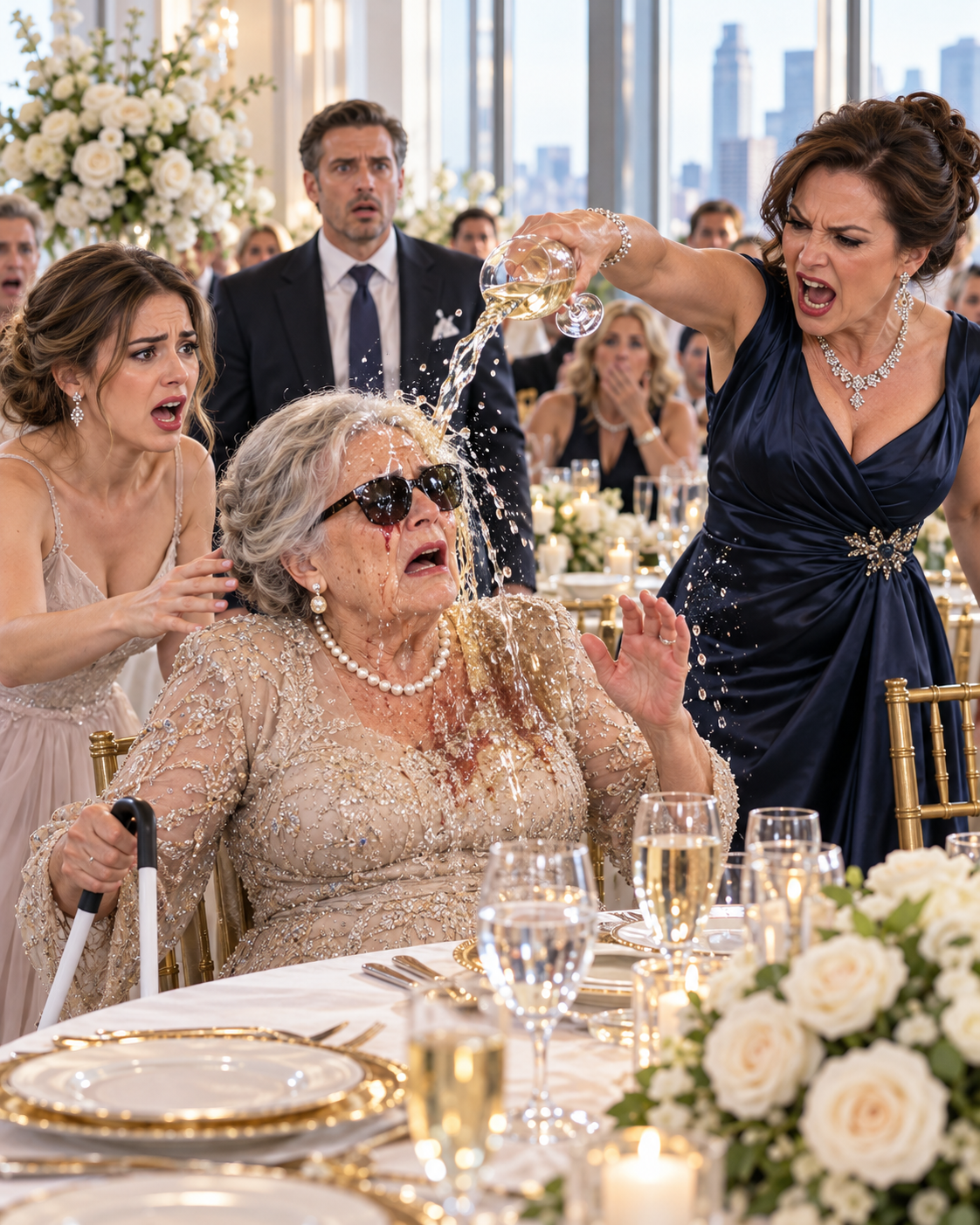

“Do you seriously expect my son to marry into a family that will be responsible for a blind woman for the rest of their lives?”
Victoria Whitmore’s words struck the dinner table like a slap.
Emily felt a chill sweep through her body. Beside her, her mother, Grace, sat quietly with her hands folded in her lap, dark sunglasses covering her eyes. Her white cane leaned against her chair.
It was the first time the two families had come together to formally discuss Emily’s upcoming marriage to Ryan.
Victoria had insisted on meeting at an upscale restaurant in Manhattan, New York City. From the moment they arrived, she had constantly drawn attention to her expensive watch, her family’s properties, and the multimillion-dollar projects managed by Whitmore Construction, the company her husband, Richard, operated.
David, Emily’s father, had arrived in an ordinary gray blazer and understated shoes. When Victoria asked what he did for work, he answered without making a fuss.
“I have a few businesses in logistics and investment management.”
Victoria smiled condescendingly.
“Oh… so you run a little company.”
David didn’t bother correcting her.
Ryan remained silent too.
And that was what troubled Emily the most.
Whenever his mother made another insulting comment, Ryan either stared at the table or awkwardly tried to steer the conversation elsewhere.
Grace had lost her eyesight completely three years earlier after a rare illness that began with an extremely high fever. Since then, she’d learned to navigate independently, prepare meals, use accessible technology, and maintain an active, self-sufficient life.
But Victoria seemed incapable of seeing her as anything other than a liability.
When a waiter politely told Grace that her hot drink was directly in front of her, Victoria laughed loudly.
“See what I mean? She even needs someone to tell her where her cup is. Ryan, think carefully. Before you know it, you’ll be paying everyone’s bills.”
“Mrs. Whitmore,” Emily said, “my mother doesn’t need anyone to provide for her.”
“Oh, stop being so touchy. I’m only thinking about my son’s future.”
A few minutes later, Grace’s cane slipped from beside her chair and fell onto the floor.
Emily bent down to retrieve it, but Victoria shoved it away with her high heel.
“Someone get that thing out of my way.”
The cane slid across the floor and stopped near a corner.
David slowly laid down his silverware.
“I would appreciate it if you treated my wife with some basic respect.”
Victoria lifted an eyebrow.
“Respect? I’m simply being realistic. My son belongs to a family with a certain social standing. We can’t pretend every family belongs in the same circle.”
Grace raised her chin.
“I don’t need eyesight to recognize the kind of person you are.”
Victoria’s expression hardened.
“Are you judging me?”
“I’m trying to understand the sort of family my daughter would be joining.”
Richard reached for his wife’s arm.
“Victoria, enough.”
But Victoria grabbed her wineglass instead.
“Who does this woman think she is, coming here to teach me manners?”
Emily cried out:
“Don’t you dare!”
But she was too late.
Victoria flung the white wine straight into Grace’s face.
It streamed over her sunglasses, down her cheeks, and onto the front of her dress.
For a few seconds, everyone at the table seemed frozen.
“Mom…”
Emily rushed to her mother’s side, tears spilling down her face.
Victoria placed the empty glass on the table and muttered:
“Oh, please. It’s hardly a tragedy. She can’t even see what happened.”
That was when Emily noticed something that hurt even more.
Ryan hadn’t moved from his chair.
“Em… just calm down,” he murmured. “You know what my mother is like when she loses her temper.”
Emily stared at him as though he were a complete stranger.
Slowly, she slipped off her engagement ring and set it on the white tablecloth.
“We’re done.”
“What?”
“I’m not going to marry you.”
Victoria gave an outraged laugh.
“You’re canceling the wedding? Do you have any idea who you’re dealing with?”
David walked over, retrieved his wife’s cane, and carefully placed it in her hand before turning toward Victoria.
He didn’t shout.
Somehow, his calmness made what he said even more unsettling.
“I’ve learned a great deal about your family tonight. And I promise you, it won’t be long before you learn something about me.”
He gently took Grace’s arm.
Emily followed her parents out without turning around.
Nobody sitting at that table had the slightest idea what the man in the inexpensive jacket had just decided to do.
And they certainly didn’t know who he really was.
PART 2
The moment they reached the parking garage, Emily broke into tears.
“I’m so sorry. I’m the reason those horrible people came into our lives.”
Grace reached up, found her daughter’s cheeks, and gently caressed them.
“You haven’t done anything wrong. Today, you discovered who Ryan truly is before you married him. That is worth more than any wedding ceremony.”
Emily stared at the stains covering her mother’s dress.
“They treated you like that because of me.”
“No, sweetheart. Being humiliated doesn’t make someone less worthy of respect. The disgrace belongs to the person who chooses to hurt others.”
David listened without interrupting.
After both women climbed into the car, he remained outside and made a phone call.
“Michael.”
The man on the other end answered at once.
“Yes, Mr. Bennett.”
“I want a thorough review of Whitmore Construction. Every active contract, outstanding debt, financial guarantee, contractual violation, and connection to our projects. I want the complete picture.”
There was a brief silence.
Michael had served as David’s corporate secretary for fifteen years, and he recognized that tone immediately.
“Has something happened, sir?”
David looked through the window at his wife.
“Someone threw wine into Grace’s face tonight because she can’t see.”
The next morning, ten senior executives gathered on the forty-second floor of Bennett Holdings, one of the largest privately owned business groups in the United States.
Their findings were surprising.
Whitmore Construction projected an image of tremendous wealth, but its finances were dangerously unstable. Nearly sixty percent of its income came directly or indirectly from projects associated with Bennett Holdings. The company had also expanded aggressively using borrowed money, with several major credit facilities approaching their repayment deadlines.
David gave his instructions carefully.
“I don’t want special favors, intimidation, or anything that violates the law. Examine every agreement properly. If they’re entitled to keep a contract, they keep it. If they’ve violated its terms, enforce the provisions exactly as written.”
The deeper the executives investigated, the worse Richard’s situation appeared.
Three major projects were behind schedule without valid justification. Two had insufficient financial guarantees. Another agreement permitted the suspension of future awards if the contractor’s liquidity dropped below specified levels.
Bennett Holdings simply stopped making exceptions for them.
And the entire structure began falling apart under its own weight.
Three days later, Richard received formal notice that two contracts had been suspended.
Soon afterward, a supplier refused to deliver additional steel until overdue invoices were paid.
Then the bank informed him that, because of the company’s worsening financial position and recent contract losses, a substantial line of credit expiring that month would not be automatically renewed.
Richard’s confidence turned into panic.
“There’s no way all of this is happening at the same time.”
Victoria tried to calm him.
“I’m sure it’ll blow over.”
But Richard couldn’t stop remembering one sentence.
“It won’t be long before you learn something about me.”
He brought in financial consultants.
Four days later, one of them entered his office looking shaken.
“Sir… we’ve identified the person who controls the companies behind the consortiums that stopped working with us.”
“Who is it?”
The consultant laid a folder on Richard’s desk.
Printed across the cover were two words.
BENNETT HOLDINGS.
Richard frowned.
Almost everyone in the American business world knew the name. Transportation networks, logistics facilities, industrial developments, infrastructure projects, commercial real estate.
“What does that have to do with us?”
The consultant swallowed nervously.
“The chairman of Bennett Holdings is David Bennett.”
Richard let the folder slip from his hands.
Victoria refused to accept it.
“That can’t be the same David. The man we met was wearing cheap, worn-out shoes.”
But it was.
David rarely appeared in public interviews or high-profile events, so corporate photographs of him were uncommon. Nevertheless, the evidence was unmistakable.
The family Victoria had dismissed as “poor nobodies” controlled a fortune several times larger than her own family’s wealth.
Two weeks later, Whitmore Construction filed for bankruptcy protection and began restructuring its debts under court supervision. Creditors demanded payment and additional security, forcing Richard to sell properties to meet his personal financial obligations.
Desperate, Richard, Victoria, and Ryan went to the headquarters of Bennett Holdings.
They requested an appointment.
They were refused.
They returned the next morning.
And again the day after.
Eventually, Michael came down to meet them in the lobby.
“The chairman has agreed to see you tomorrow. You’ll have ten minutes.”
At exactly nine the following morning, they entered an enormous executive office overlooking Manhattan.
A man sat behind the desk, his chair turned toward the windows.
Victoria clasped her hands together.
“Mr. Chairman, please. We don’t understand what we’ve done to upset you, but I’m begging you to show some compassion. Our family is about to lose everything.”
Silence filled the office.
Then a familiar voice answered.
“How interesting to hear you asking for compassion, Mrs. Whitmore.”
Victoria’s face went white.
She knew that voice.
The executive chair slowly turned around.
And when she saw the man sitting behind the desk, her knees almost buckled.
PART 3
“No… that isn’t possible.”
Victoria stumbled backward and nearly fell against a chair.
David was sitting in front of her.
The same man she’d mocked for owning a “tiny business.”
The same man whose modest jacket she’d regarded with contempt.
The husband of the blind woman she’d deliberately splashed with wine.
Richard glanced at the polished metal nameplate on the desk.
DAVID BENNETT
EXECUTIVE CHAIRMAN
He lifted a trembling hand to his mouth.
“Mr. Bennett… I…”
“Don’t pretend we’re old friends,” David interrupted. “Whatever connection our families once had ended that evening.”
Victoria began to cry.
“Please forgive me. I had no idea who you were.”
David watched her quietly for several seconds.
“And that’s precisely what’s wrong.”
She stopped speaking.
“You haven’t said, ‘I didn’t realize I was being cruel.’ You’ve said, ‘I didn’t know who you were.’ Which means that if you’d known how wealthy I was, you would have treated my wife differently.”
Victoria shook her head frantically.
“No, that’s not true. I was upset…”
“During dinner, I watched you answer a call from a businessman. Your entire manner changed. You were almost excessively polite. Yet five minutes earlier, you’d been insulting a waiter because he hadn’t refilled your glass quickly enough.”
Victoria stared at the floor.
David continued.
“You don’t respect human beings. You respect their position in society.”
Richard stepped forward.
“Mr. Bennett, what my wife did was unforgivable. I should have intervened, and I accept responsibility for not doing so. But our company supports employees, suppliers, and families who have nothing to do with what happened.”
“Which is exactly why every decision has followed existing contracts and the law,” David replied. “I haven’t ordered anyone to manufacture debts or invent violations. Your company remained afloat because other businesses overlooked delays and accepted unnecessary risks to preserve their relationship with you. We stopped making those exceptions.”
Richard didn’t move.
He knew David was telling the truth.
For years, he’d bragged about his construction empire while ignoring how heavily its growth depended on loans, advance payments, and projects provided by companies with far greater financial strength.
Bennett Holdings hadn’t needed to destroy his business.
It had simply stopped supporting it.
Ryan, who had remained near the doorway, finally stepped forward.
“Mr. Bennett… could I please talk to Emily?”
David’s expression hardened.
“No.”
“But I love her.”
“Don’t say those words to me again.”
Ryan went pale.
David rose from his chair.
“When your mother insulted Grace, you said nothing. When she kicked away her cane, you said nothing. And when she threw wine in my wife’s face, what did you do?”
Ryan parted his lips.
Nothing came out.
“You told my daughter to calm down.”
Ryan bowed his head.
“I was scared to confront my mother.”
“Then you weren’t ready to build a family of your own.”
“I know. I made a terrible mistake.”
“Emily needed a partner who would stand beside her, not someone who discovered bravery only after losing everything.”
Victoria fell to her knees.
“Mr. Bennett, please. We’ve already lost our home. We’re selling everything we own. We have nowhere left to turn.”
David stepped away as she tried to move closer.
“Do you remember what you said about Grace? That she would be a burden. That my daughter would have to take care of her. That our family wasn’t worthy of being associated with yours.”
Victoria sobbed, unable to meet his eyes.
“My wife lost her sight, yet she never expected the world to bow before her. She learned to navigate streets she could no longer see. She learned to recognize money using accessible apps, move around independently, cook, and live without surrendering to self-pity. And you, with perfectly functioning eyes, couldn’t recognize the humanity of the woman sitting right in front of you.”
Nobody spoke.
David called Michael.
“We’re finished here.”
The secretary opened the office door.
Richard tried one final time.
“Is there truly no possibility of restoring our contracts?”
“The companies managing those projects will make their decisions through the appropriate review committees. I’m not going to order anyone to rescue your business.”
Richard understood.
No miracle was coming.
They left the building as very different people from the ones who had walked into that restaurant weeks earlier.
David returned home early that afternoon.
Grace was sitting on the terrace, listening to the breeze moving through the trees.
“They came to see you, didn’t they?” she asked.
David stopped.
“How could you tell?”
“You’ve been pacing around for twenty minutes like you’re having an argument with yourself.”
He smiled.
Then he sat beside her.
“They came.”
“And?”
“They begged for help.”
Grace remained quiet for a moment.
“You didn’t do anything illegal, did you, David?”
He turned toward her.
“No.”
“Promise me.”
“I promise. I had our business relationships reviewed. We discovered contractual violations and serious financial weaknesses. Every decision was made according to existing agreements.”
Grace took his hand.
“Then let it end there.”
David frowned.
“Even after what that woman did to you?”
“Especially after what she did.”
“Grace…”
“I don’t want the cruelty they showed me to turn my husband into someone like them.”
Her words stopped him.
She squeezed his hand.
“Justice establishes boundaries. Revenge takes pleasure in watching someone suffer. I want our family to remain on the right side of that difference.”
David kissed her hand.
“You’ve always been stronger than I am.”
“No. I just have one advantage.”
“What’s that?”
Grace smiled.
“Because I can’t see people’s faces, I have more time to listen to what’s inside them.”
David laughed softly.
Emily had been standing near the doorway and had heard nearly everything.
During the weeks after ending her engagement, she’d made an important decision of her own.
She resigned from her position at an advertising agency and gradually began working with the Clear Horizons Foundation, an organization her parents had established years earlier to help people with visual impairments.
David wanted to make certain she wasn’t making the choice because she was heartbroken.
“I don’t want you throwing away your career because you’re hurting.”
“This has nothing to do with Ryan.”
“Then what’s behind it?”
Emily looked toward her mother.
“That night made me realize how many people must be treated as though they’re less capable simply because they have a disability. I want to help them have better opportunities.”
Grace was deeply touched.
The foundation operated a small center in Brooklyn, offering assistive technology training, mobility instruction, educational scholarships, and music programs.
It was there that Emily met Lily, a seventeen-year-old girl who had lost her eyesight as a child and played the piano with such confidence that everyone stopped to listen.
After one lesson, Lily asked:
“Does your mom play the piano too?”
Emily looked surprised.
“She used to, before she became blind.”
“Why did she quit?”
Emily realized she’d never asked herself that question.
That evening, she found the family’s old piano beneath a protective cover.
“Mom.”
“What are you planning?”
“Nothing.”
“Whenever you say ‘nothing’ like that, you’re definitely planning something.”
Emily laughed.
She pulled the cover away.
Grace recognized the familiar sound immediately.
“No.”
“Just sit down for a minute.”
“I haven’t played in years.”
“Your fingers didn’t lose their knowledge just because your eyes lost their sight.”
Grace remained motionless.
David appeared behind them.
“I think our daughter has a point.”
“Of course you do. Two against one.”
David helped her onto the piano bench.
Emily had arranged Braille sheet music and tactile markers so her mother could orient herself at the keyboard.
At first, Grace’s fingers moved hesitantly.
One note.
Then another.
A chord.
And then something remarkable happened.
Her hands remembered.
A gentle melody began drifting through the living room.
David stood perfectly still.
Emily felt tears gathering in her eyes.
For years, Grace had avoided the piano because it reminded her of the life she’d lived before losing her sight. But that evening, she stopped seeing the instrument as something belonging to her past and began reclaiming it as part of her present.
When the final note faded, nobody said anything for several seconds.
Tears streamed down Grace’s cheeks.
“I thought this was gone forever too.”
Emily wrapped her arms around her.
“No, Mom. It was only waiting for you to return.”
Meanwhile, Whitmore Construction continued its decline.
Without sufficient contracts to manage its enormous debt, Richard was forced to pursue formal restructuring and sell off company assets.
The family sold its mansion, luxury vehicles, and the expensive possessions Victoria had spent years using to demonstrate her supposed superiority.
But losing their wealth wasn’t the hardest part.
The hardest part was discovering who remained loyal once their money was gone.
Many people Victoria had proudly called her “friends” stopped returning her calls.
Acquaintances she’d impressed with designer handbags, lavish vacations, and exclusive dinners stopped including her in their social gatherings.
Several months later, she found an office administration job at a small company owned by a former acquaintance.
On her first day, an elderly woman entered slowly, using a white cane.
Victoria’s throat tightened.
The woman asked where she could sit.
For a moment, Victoria was back in that restaurant.
The cane sliding across the floor.
The wineglass in her hand.
The cruel sentence she’d spoken:
“She can’t even see what happened.”
Victoria walked over to the elderly woman.
“Let me guide you. There’s a chair about three feet to your right.”
“Thank you so much.”
Two simple words.
Nothing else.
Yet Victoria had to excuse herself and cry alone in the restroom.
Not because anyone had humiliated her.
But because she finally understood how cruel she’d been.
Richard, meanwhile, began working as a consultant for smaller construction firms. For the first time in decades, he listened to workers and suppliers without judging them by their financial status.
Ryan found employment at a distribution warehouse.
During his first few months, he carried boxes, organized stock, and worked overnight shifts.
One afternoon, a coworker arrived late because he’d needed to take his mother to the hospital.
Their supervisor threatened to fire him.
Ryan spoke up.
“Give him another chance. I’ll take his shift.”
As he moved inventory long after midnight, he thought about Emily.
He finally understood what it meant to defend someone when doing so required a real sacrifice.
But he’d learned that lesson too late.
He never tried to reach out to her again.
Eighteen months later, the Clear Horizons Foundation organized its first major charity concert at Lincoln Center in New York City.
Thirty young musicians with visual impairments were scheduled to perform.
Emily was overseeing the event.
And the featured guest pianist was Grace Bennett.
Just before the performance, Grace rested her fingertips on the piano keys and inhaled deeply.
“I’m nervous.”
“You?” Emily teased. “The same woman who stood up to Victoria without even raising her voice?”
“That was easier.”
David came over.
“Should we call it off?”
Grace burst into laughter.
“Don’t you dare.”
Lily appeared from behind the stage curtain.
“Mrs. Bennett, it’s time.”
“Then let’s go, partner.”
The two women made their way onto the stage.
The audience grew quiet.
Then the music began.
Emily watched from the side as her mother performed beside a young woman who had also learned to experience the world without sight.
For the first time, Emily fully understood something Grace had tried to teach her for years.
A disability might change the course of a person’s life.
But it could never determine that person’s value.
When the performance ended, the entire audience rose to its feet.
The applause seemed to go on forever.
Grace sat at the piano, smiling broadly.
She couldn’t see the hundreds of people standing before her.
She didn’t have to.
She could hear them.
And that was enough.
David walked over to his daughter.
“Are you all right?”
Emily nodded, her eyes shining with tears.
“I don’t think I’ve ever felt better.”
“Is there anything about your old life you still miss?”
She thought about Ryan.
The wedding dress she’d never worn.
That terrible restaurant dinner.
The engagement ring she’d left on the table.
Then she looked toward her mother.
“No.”
A man hurried over from backstage.
It was Nathan, a volunteer legal coordinator who had worked closely with Emily at the foundation for months.
“Sorry to interrupt,” he said. “The sponsors are asking for a group photo with the entire team.”
David noticed how Nathan looked at Emily.
Then he glanced at his daughter.
Emily’s cheeks immediately turned pink.
“Dad, don’t even think about it.”
“I haven’t said a word.”
“I know you too well.”
Grace, who had just joined them, asked:
“Is that Nathan?”
“Yes, Mrs. Bennett.”
“Oh, so you’re the young man my daughter can’t seem to stop talking about.”
“Mom!”
Everyone laughed.
Nathan looked completely flustered.
Grace extended her hand.
“Don’t worry. Before I decide whether I approve of you, I’ll need to hear your voice over at least three or four family dinners.”
“Grace,” David protested.
“What? Someone needs to make sure our daughter doesn’t end up with another coward.”
Emily laughed so loudly that several nearby guests turned their heads.
Months later, during a family weekend in the Hamptons, the three of them walked along the beach at sunrise.
Emily gently held her mother’s arm.
David carried their sandals in one hand.
Grace stopped to listen to the waves rolling onto the shore.
“The ocean is beautiful this morning.”
Emily looked at her curiously.
“How can you tell?”
“Because it sounds so peaceful.”
David kissed his wife’s forehead.
Emily found herself remembering the dinner she’d once considered the worst night of her life.
Now she understood that it had also opened a door.
That glass of wine had exposed Victoria’s true character.
It had revealed Ryan’s cowardice before Emily made the mistake of marrying him.
It had led Emily to the foundation.
And it had brought Grace back to the piano.
“Mom,” Emily asked, “do you think what happened that night ended up being good for us?”
Grace considered the question for a moment.
“I wouldn’t say cruelty becomes something good simply because happiness comes afterward. What happened was cruel, and it will always be cruel.”
Emily listened quietly.
“But we do get to decide what we make of our experiences,” Grace continued. “We can allow pain to turn us bitter… or we can use it to understand other people’s suffering more deeply.”
David squeezed her hand.
Grace smiled.
“And always remember this, sweetheart. Money doesn’t make someone classy. Neither does power. True class shows itself when you’re standing before someone who has absolutely nothing to offer you… and you still choose to treat that person with dignity.”
The three of them continued down the shoreline.
Behind them was a family that had lost nearly everything after spending years believing wealth made them better than everyone else.
Ahead was a family that had discovered something no amount of money could easily buy.
Respect.
Loyalty.
And the ability to recognize what truly matters, even when the eyes can no longer see.