
At sixty-eight years old, I believed that thirty years working as a bank teller and auditor had shown me just about everything.
But nothing in life prepares you to watch your own relatives calculate how much they can gain from three orphaned children before the soil has even settled over their parents’ graves. Three months earlier, my phone rang in the dead of night. The police were calling. My son Daniel and his wife Emily had been returning from a wedding in Asheville.
Rain was pouring so heavily that their windshield wipers could barely clear the glass, and on a treacherous bend in the road, a semi-truck crossed into their lane. The officers didn’t explain much beyond that, and to be truthful, I couldn’t bear to ask. From that awful night onward, my three grandchildren had been living with me in my tiny subsidized apartment.
I made a makeshift bed for Hannah on the living room sofa. Ben slept on a folding cot beside the heater, while little Lucy shared my bed, pressing herself against my chest because she was too frightened to fall asleep alone. Hannah had almost stopped talking altogether. She spent her days walking around with a hardback notebook clutched to her chest, scribbling furiously, but whenever I came close, she snapped it shut.
Every night, Ben pulled on one of Daniel’s old gray sweaters, so oversized that it reached his knees, and fell asleep with the sleeves rolled up. And Lucy… that sweet little girl broke my heart every evening with the same question: “Grandma, when is Mommy coming home from the wedding?” I would offer whatever comforting answer I could think of, tuck her blanket around her shoulders, and retreat to the kitchen to go over our bills, wondering whether my Social Security check would leave enough money for a new pair of shoes for Ben.
There was no Christmas tree that year. Lucy placed a small pine branch inside an empty mayonnaise jar, hung one red glass ornament from it, and checked every morning to make sure it was still there. During those sorrowful holidays, Mr. Parker arrived, the attorney Daniel had trusted for years to handle his paperwork. He kept his coat on. The rug by the entrance was crowded with children’s shoes and sneakers, and he seemed reluctant to step among them. Standing in the doorway, he reached into his pocket and produced a heavy ring of keys.
“Child Protective Services has approved the order, Mrs. Margaret. You have full legal custody of the children now,” he said, placing the keys in my hand. “I stopped by Daniel’s house in the neighborhood. I left the water heater on its pilot setting so the pipes wouldn’t freeze. If you go over to collect their belongings, make sure you dress warmly.”
I closed my fingers around the keys until their edges pressed painfully into my skin. Somebody had to retrieve the children’s clothing and important documents, and I would rather do it myself than have strangers pack their parents’ lives into cardboard boxes. I asked Mrs. Helen, my neighbor across the hall, to watch the children, then took two buses to the house my son had built through years of hard work.
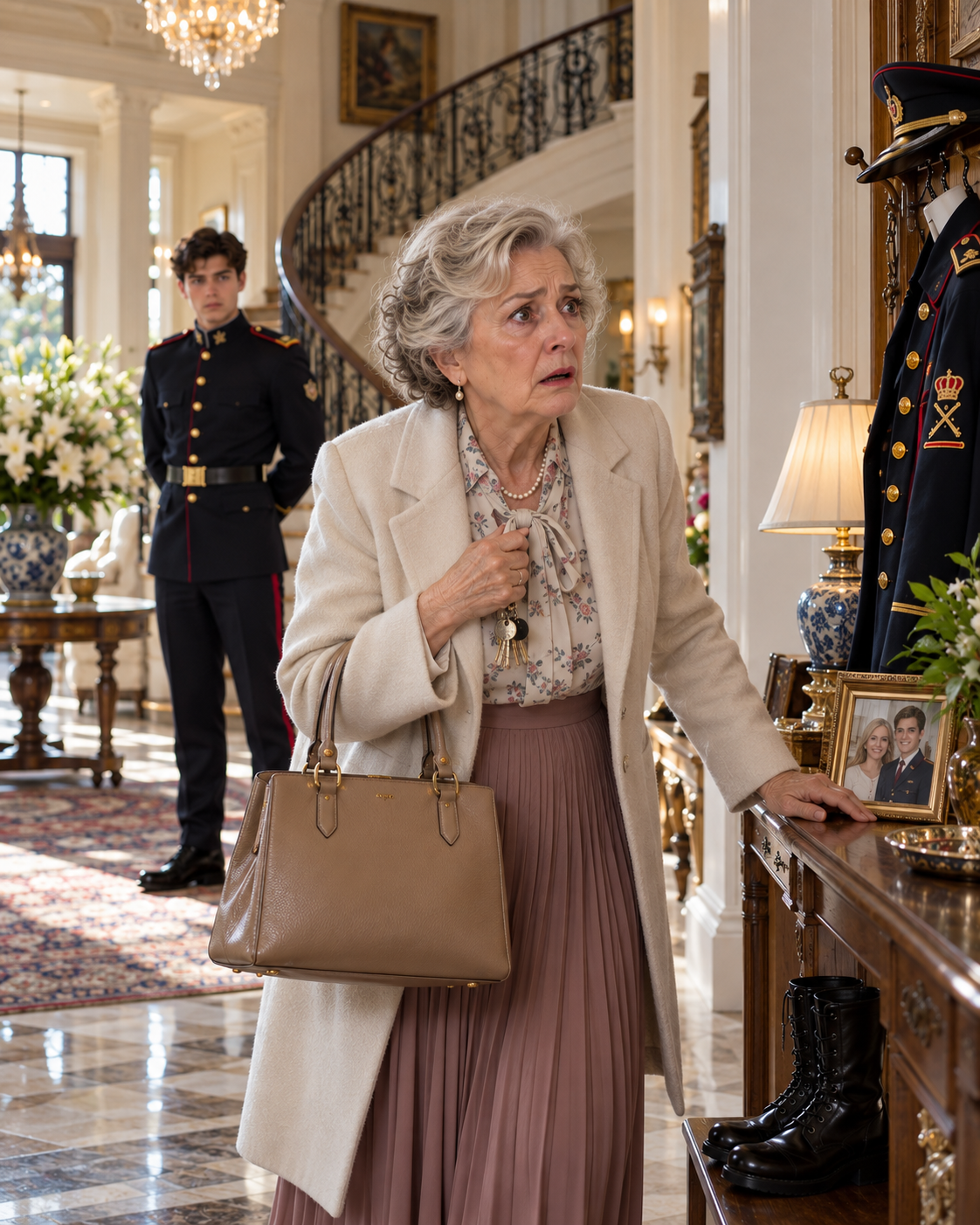
The cold was bitter when I arrived, yet the walkway leading to the front door had been swept. I unlocked the door and stopped dead. Instead of the icy, empty house I’d expected, I stepped into comforting warmth and the unmistakable smell of shoe polish. A pair of black boots stood on the entrance mat, polished so thoroughly that the overhead light gleamed across their toes. On the coat rack, beside my late daughter-in-law’s jacket, hung a military uniform that had been pressed to perfection.
I moved cautiously toward the kitchen. A kettle rested on the stove, and when I touched it, the metal was still warm. One plate and one mug sat in the drying rack. For a moment, I wondered whether someone had broken in, but burglars don’t usually iron uniforms or polish their boots. I grabbed the garden shovel Daniel used for yard work, held it firmly in both hands, and shouted, “Whoever you are, come out right now! I’ve already called the police!”
A tall teenager, perhaps seventeen, appeared at the top of the stairs and began coming down. He wore athletic clothes and carried a school textbook. As soon as he saw me, his thick eyebrows drew together. I recognized that expression immediately. Daniel used to make exactly the same face as a boy whenever he came home with a disappointing report card. The young man straightened into a soldier’s posture and met my gaze without flinching. “Cadet Matthew Wilson, ma’am. My father gave me these keys.” Everything around me seemed to stop. My son had another child, a son he’d never told me about. Yet even that revelation couldn’t compare to the shock waiting for me when someone began pounding on my door later that night. Andrew, Emily’s brother, stood outside wearing a crooked smile and carrying a stack of documents. I had no idea how much worse things were about to become…
PART 2
Andrew entered my apartment without waiting to be invited, with his wife, Susan, following close behind. She surveyed the peeling paint on my walls with barely concealed disgust. The younger children were playing in the bedroom, while Matthew, the grandson I’d only just discovered, quietly washed the dishes from dinner in the kitchen.
“Mrs. Margaret, I think we should discuss this sensibly, like grown-ups,” Andrew began, putting on a sympathetic expression. “That house is much too large for you, and keeping it running will cost a fortune. Heating bills, property taxes… there’s no way your pension can cover everything. Selling it would be the responsible choice. Susan and I could place the children’s money in a trust and manage it until they’re legally adults.”
Susan folded her arms and added, “We’ve already spoken with Child Protective Services, too. No offense, but you’re not getting any younger. Emily would have wanted her children raised by her own family, by people young enough to care for them properly, not squeezed into this little apartment. Cooperate with us, or we’ll take the children whether you like it or not.”
I shouted until they left. I told them they would have to walk over my dead body before taking my grandchildren or stealing the home Daniel had worked so hard to build. Unfortunately, their threats were only the beginning. The next morning, an expensive black SUV stopped outside my building. Out stepped Richard Bennett, Daniel’s business partner in the construction company. At the funeral, Richard had sobbed as though he’d lost his own brother. But now, sitting across from me in my living room, he showed no emotion whatsoever. He opened a leather briefcase and took out a promissory note.
“Margaret, I’m afraid this is an uncomfortable situation,” he said, carefully flattening the document. “A few months ago, Daniel borrowed a substantial amount of money from me personally to cover some financial difficulties. His signature is right here. Once you add the overdue interest, the debt is greater than everything he owned. Still, I’m willing to be reasonable. Transfer his company shares and the house to me, and I’ll consider the debt settled. Otherwise, I’ll start foreclosure proceedings tomorrow, and your entire family will be out on the street.”
I studied the document carefully. After three decades of examining signatures at the bank, I’d developed an eye for details other people overlooked. I could spot a suspicious signature almost instinctively. The capital “D” in Daniel’s name had an elaborate rounded loop, the sort of careful flourish a child might practice in handwriting class. My son never wrote that way. His handwriting was hurried, slightly backward-slanting, and completely plain. I knew the signature wasn’t his. What I didn’t have was proof. Once Richard left, I sank into a chair, my whole body shaking with fear and fury.
Matthew had been listening from the hallway. He stepped forward and whispered, “Grandma, my dad told me something once.” It was the first time he’d ever called me Grandma. “He said, ‘If something happens to me, remember that the important things are hidden beneath the third step.'”
We acted immediately. I gathered the children, called a taxi, and took everyone to a small property we owned outside town. An old cabin stood there, built years ago by Daniel and his father. Matthew found a rusty crowbar, counted the wooden steps leading to the porch, and pulled up the third one. Buried in the dry dirt underneath was an old metal cookie tin. Inside, protected by plastic wrapping, lay a USB flash drive and a handwritten note. I recognized my son’s handwriting at once: “Andrew and Richard are stealing from me. They’re hiding everything behind other people’s names.”
We hurried back to the apartment. When we connected the flash drive to a computer, a password request appeared. We tried birthdays and wedding anniversaries, but nothing worked. Then Matthew quietly entered four names: Matthew, Hannah, Ben, Lucy. Daniel’s children, listed from oldest to youngest. The files opened. Inside were hundreds of fake invoices showing payments to a shell company controlled by Andrew.
With those documents in hand, I made a terrible mistake. I went to Richard’s office alone, leaving my phone recording inside my coat pocket. I placed copies of the fraudulent invoices in front of him. His pleasant expression disappeared instantly. He sprang up, his face turning crimson, and slammed his hand against the desk. “You think you’re clever, you stupid old woman? Those papers prove nothing! Child Protective Services is already heading to that filthy apartment of yours to take those brats away. And when I’m finished, you’ll be sitting in jail for defaming me.”
I fled his office and hurried home, desperately hoping I wasn’t too late. But when I turned onto my street, my heart nearly stopped. A government vehicle was parked directly outside my building. If you think that was the end of our troubles, you can’t imagine the storm that was coming. You need to read Part 3…
PART 3
I rushed through my apartment door, gasping for air, my hands trembling so badly I could barely turn the handle. In the middle of the living room stood Ms. Lauren, an inspector from Child Protective Services, holding a leather folder beneath one arm. Her expression was cold and unwelcoming. She hadn’t even removed her trench coat, as though our modest home didn’t deserve more than a few minutes of her attention. Hannah, Ben, and Lucy stood nearby, too frightened to move. Matthew remained in the corner, rigid as a statue, his jaw tight and his hands clenched.
“We’ve received an anonymous complaint requiring immediate attention,” the inspector announced, speaking with obvious disdain. “According to the report, you’ve brought an unfamiliar young man into this overcrowded apartment, where young girls are living. Surely you understand that someone your age, under circumstances like these, could have their custody revoked without delay. Who exactly is this young man?”
Matthew remained silent. His military training had taught him to stand still and endure harsh treatment without protest, but I noticed the tips of his ears turning bright red with embarrassment.
“He’s my grandson,” I replied, forcing my voice to remain steady. “He’s my late son Daniel’s oldest child. He’s a cadet at the Military Academy, and he’s part of this family. The people who made that complaint are the same relatives trying to steal these children’s inheritance and leave them homeless.”
The inspector raised one eyebrow, plainly skeptical. “Mrs. Margaret, I need official documentation, not an emotional explanation. Until you provide it, I’m required to begin the separation proce—”
She stopped before finishing. Hannah, who had barely managed to speak more than a couple of words at a time since her parents died, slowly approached her. My granddaughter held her notebook tightly against her chest. She tore out a page and offered it to the inspector. Lauren accepted it, frowned, and read the words softly. Written in the shaky, rounded handwriting of a grieving little girl was the sentence Matthew had spoken to his siblings on his first night with us: “Family never leaves family behind.”
Lauren looked from Hannah to Matthew, whose eyes were wet with tears, and then back at me. She took a long breath, removed her glasses, and finally lowered herself onto one of our battered chairs. “Mrs. Margaret, confirming the DNA relationship could take months. But… I don’t see a dangerous stranger standing in this room. I see a big brother trying to protect his family. I’m giving you three months to obtain the DNA results. Good afternoon.”
We had survived that confrontation, but our fight was far from finished. Mr. Parker took the flash drive and the financial records I’d analyzed to the district attorney’s office, where we encountered another obstacle. “Invoices alone won’t be enough,” the prosecutor explained. “Richard Bennett will claim Andrew’s business performed legitimate construction work. We need witnesses or undeniable evidence proving the invoices are fraudulent and the signature on that promissory note was forged.”
The breakthrough came at midnight during a violent rainstorm. Someone began pounding frantically on our door. Matthew opened it to find Tyler, Andrew and Susan’s twenty-year-old son, standing outside. He was drenched from head to toe and shivering uncontrollably.
We hurried him inside, and I handed him a towel. Tyler didn’t bother drying his face. Instead, he reached beneath his soaked jacket and pulled out a yellow folder, which he passed to me with shaking fingers.
“My father hid this underneath his tools in the workshop,” Tyler said, struggling to keep his voice from breaking. “When I heard they were trying to take your house, I started searching for anything that might explain what was happening. Aunt Emily paid my high school tuition when my own dad wouldn’t even give me money for textbooks. If I stay silent now, Mrs. Margaret, I’ll be no better than he is. I couldn’t let him get away with this.”
I opened the folder beneath the warm kitchen light. Inside were dozens of notebook pages covered with handwriting. Every inch of those pages contained attempts to copy Daniel’s signature. There were hundreds of them. The first attempts were awkward, with crooked capital “D”s. But on the final pages, the rounded loop had become flawless. It matched the signature on Richard’s promissory note exactly. Andrew had spent countless nights practicing how to forge a dead man’s name so he could rob his own nieces and nephews.
By the following morning, the pages were on the prosecutor’s desk, together with the recording I’d secretly made in Richard’s office. The evidence changed everything. Police obtained authorization to search Bennett Construction. Mr. Walter, the veteran foreman who had taught Daniel how to mix cement when he was young, accompanied investigators to the properties where Andrew claimed to have constructed warehouses worth millions of dollars. They found nothing but overgrown weeds and stray dogs.
The trial dragged on through the autumn and felt like a nightmare that would never end. But when the truth is supported by undeniable evidence, justice can be merciless. Richard Bennett arrived in court wearing his expensive suits, yet with each passing day he seemed to grow smaller in his chair. Andrew lowered his head when his own son took the witness stand against him, and he barely looked up for the rest of the proceedings.
During a break in the trial, Susan cornered me inside the courthouse restroom. Her eyes were puffy from crying, and mascara streaked her cheeks. “Margaret, please, for God’s sake!” she pleaded, grabbing my arm. “Andrew is Emily’s brother. They’re family! He wasn’t trying to hurt anyone. He made a mistake, and Richard manipulated him. Please drop the charges. Think about what this will do to the family.”
I pulled my arm free so sharply that she stumbled backward. “Susan, making a mistake is getting on the wrong bus. Spending night after night practicing a dead man’s signature so you can steal his children’s home is not a mistake. It’s a deliberate, disgraceful crime. Your husband needs to face the consequences, and you’re going to have to accept that.”
Both men were found guilty of fraud, extortion, and forging legal documents. They were sentenced to prison without the possibility of release on bail.
That same month, the family court reviewed Matthew’s DNA results. The match was conclusive. Matthew was officially recognized as a Wilson. When he received his new birth certificate, the young man who always seemed so strong burst into tears and embraced his three younger siblings. I applied to become his legal guardian as well. “Grandma, I’ll be eighteen soon. You really didn’t have to do all this,” he told me. I gently stroked his short military haircut. “I did it because I never want you to be anyone’s hidden child again, Matthew. You belong with me.”
But Daniel still had one more surprise waiting for us. The bank contacted us to say he had rented a safe-deposit box. Mr. Parker accompanied me into the underground vault. Inside the heavy metal box, we discovered property deeds, a letter written by Matthew’s biological mother begging Daniel never to leave their son alone in the world, and a small USB drive with a handwritten message: “Mom, please watch Emily’s video first. She can explain it better than I can.”
That Saturday, Matthew came home on leave from the Military Academy. We gathered the children in the living room and connected the drive. The screen showed our little property outside town, glowing in the summer sunshine. Emily stood beside a newly poured concrete foundation, a scarf tied around her head and excitement shining in her eyes.
“Hello, Mom!” Emily said to the camera, laughing. “Don’t be mad at us. It’s supposed to be a surprise! Daniel and I are building you a house. See how wide the hallways are? You’ll be able to move around comfortably. And the bathroom… Daniel insisted the builders eliminate every single step in the entire house so your knees won’t hurt anymore. Your bedroom window faces east, so you’ll get to watch the sunrise every morning.”
The camera swung around, revealing Daniel covered in construction dust. He waved enthusiastically, wearing that enormous, carefree grin Ben had inherited. “We’re getting you out of that apartment, Mom! You’re going to live like a queen, right near us.” Then the recording ended.
Nobody spoke. Lucy reached out and gently touched the dark screen with her little fingertips. Ben cried silently, while Hannah wrapped her arms around me from behind and held me so tightly I could hardly breathe. Matthew slipped onto the balcony because he didn’t want anyone to see him wiping away his tears.
Before he died, Daniel had already purchased every material needed to finish the house. Everything was paid for and safely stored. When Mr. Walter and the other construction workers examined the plans, they refused to charge us anything for their labor. “When the company had no jobs, Daniel paid our wages from his own savings, Mrs. Margaret,” Mr. Walter told me, taking off his hard hat. “We’re going to finish this house to honor him, and I’ll personally deal with anyone who tries to charge you a dime.”
And they kept their word. Every weekend, the construction crew worked together like a busy colony of ants, raising walls through sheer love and determination. Matthew carried heavy beams, sometimes getting cement all over his uniform. Tyler, who had found a new family among the people his father had betrayed, helped paint the rooms. Ben handed out nails, while Lucy enthusiastically chose the colors for every wall.
By the following summer, Matthew graduated from the Military Academy. All of us attended the ceremony. Looking out over hundreds of young men with closely cropped hair and identical uniforms, I worried that I might not recognize him. But when the parade began, I spotted him immediately. He marched exactly like Daniel, shoulders straight, moving forward with a confidence and dignity that made my heart ache with pride. After receiving his new rank insignia, he refused to let the military tailor attach them. Instead, he brought them home, handed me a needle and thread, and stood perfectly still, tall and strong as an oak, while I put on my glasses and carefully sewed the insignia onto his shoulders with trembling hands.
Then came our first winter in the new house. Logs crackled inside the fireplace, filling the spacious, step-free hallways with warmth. The bathroom had no raised edges or thresholds, just as Daniel had planned for my aching knees.
One December evening, I began setting the dinner table. I no longer counted the plates with a heavy heart. I simply brought out five. Beside the fireplace sat five pairs of wool slippers Hannah had embroidered herself. Learning how to do it had taken her months, but she’d persevered. Four pairs had names stitched in blue thread: Hannah, Ben, Lucy, Matthew. The fifth pair, mine, carried one word in large, proud letters: Grandma.
Matthew arrived home on leave that evening. When he opened the front door, a gust of freezing mountain air followed him inside. I noticed his beautifully polished military boots on the entrance mat, but this time the sight didn’t send me reaching for the wall to steady myself against grief. Instead, I picked up the slippers bearing the name “Matthew,” warmed by the nearby fireplace, and carried them to him. He looked down at them, smiled softly, and put them on without saying anything.
For thirty years, I spent my working days counting money that belonged to other people. I understand the weight of financial documents, the significance of promissory notes, and the power of a signature. But this tragedy taught me something no bank ever could: your true family isn’t necessarily made up of the people whose names appear beside yours on a birth certificate, or those who gather at a funeral to argue over an inheritance. Real family means the people who refuse to abandon you. The people who help rebuild your home when life has reduced everything to rubble. And most importantly, the people who refuse to remain silent when injustice comes knocking at your door.