
“If anyone calls an ambulance, I’ll kick them out of this house! My wife is under my care, and in this home, my word is final!” my father-in-law roared as my mother-in-law, who had been paralyzed for four years, struggled to draw a breath.
I never thought I would hear such cruel words from a man who had spent nearly forty years married to the woman lying helplessly in front of him.
My name is Emily, I’m thirty-four, and I live in Austin with my husband, Michael, and his parents. My mother-in-law, Margaret, was sixty-two when this nightmare started.
Four years earlier, she had suffered a stroke that robbed her of the ability to walk and made speaking incredibly difficult. From that moment on, I had taken care of bathing her, dressing her, administering her medication, and helping her with meals.
I won’t pretend it was easy. Some days, I was utterly drained. But Margaret always managed to show her gratitude. Sometimes, all it took was a soft squeeze of my fingers.
That afternoon, I came home from the Riverside Farmers Market with several bags of fresh vegetables. I stepped into her bedroom to greet her and stopped dead in my tracks.
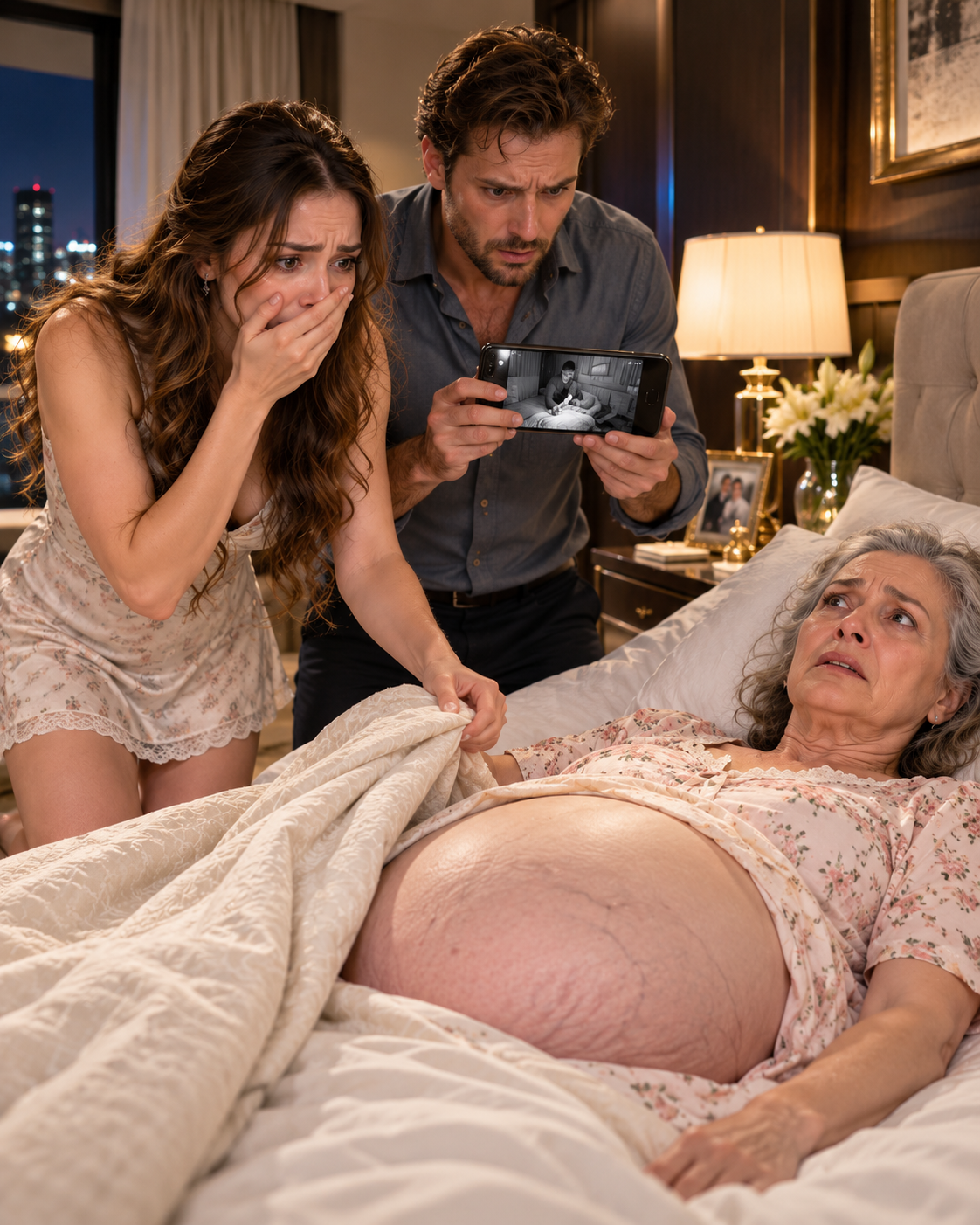
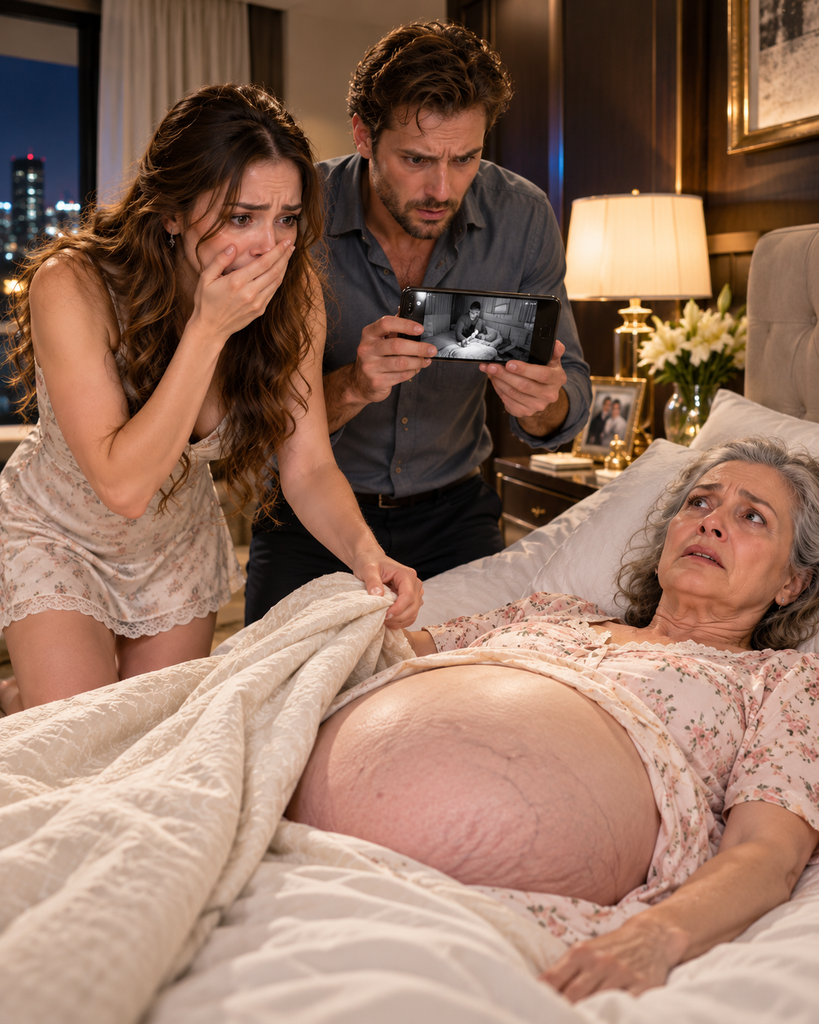
Her abdomen had swollen so dramatically that she looked like a woman eight months into pregnancy.
“Michael, get in here immediately!”
My husband rushed into the room. The moment he pulled back the blanket, he staggered backward in shock.
“What happened to my mother?”
I carefully placed my hand on her stomach. It felt rigid and unnaturally distended. Margaret was breathing with difficulty, tears pooling in her eyes.
What troubled me most was that I had noticed her abdomen becoming larger over the previous few weeks, but my father-in-law, Richard, had repeatedly insisted it was simply part of getting older.
“She needs to go to the hospital,” I said.
Richard appeared at the bedroom entrance.
“It’s just fluid buildup. I’ve already started giving her an herbal treatment. Stop throwing money away on foolishness.”
“What kind of treatment?” I demanded.
“Something recommended by someone I trust. You should concentrate on making dinner.”
My gaze shifted to the bedside table. A bowl of oatmeal sat beside several plain white packets without labels.
Suddenly, I remembered something that had been troubling me for several days: Richard had recently begun preparing Margaret’s meals himself, even though he had never bothered to do that before.
He had also started locking her bedroom and going outside late at night to answer suspicious phone calls.
Once, I heard him whisper into his phone:
“Just be patient, Vanessa. We’re almost finished, and soon we can finally live in peace.”
When I questioned him about Vanessa, he struck the table and warned me to stay out of his personal affairs.
That afternoon, as Michael tried to soothe his mother, Margaret suddenly seized my wrist with surprising force.
She was desperate to communicate something.
Her mouth trembled.
“No… no…”
Her frightened eyes moved toward the doorway, where Richard stood.
A cold shiver traveled down my spine.
Michael saw it as well.
Once we were finally alone, I leaned toward him and whispered:
“Your mother is terrified of your father.”
My husband shook his head in disbelief.
“That can’t be true, Emily. Dad has a difficult temper, but he’d never deliberately hurt Mom.”
“Then why is he refusing to let a doctor see her?”
Michael had no answer.
I told him I intended to call 911. While I reached for my phone, Richard disappeared into his bedroom and shut the door. Michael used that moment to examine footage from a small camera he had secretly installed three days earlier after noticing that his mother began crying whenever his father brought her meals.
Until then, I hadn’t even known the camera existed.
Michael opened the recordings on his cellphone.
The footage showed Richard entering Margaret’s bedroom late at night, carrying a bowl of oatmeal. He removed a small white packet, poured its contents into the food, and stirred the mixture thoroughly.
Then he bent over Margaret.
She attempted to turn her face away.
And that was when Richard’s voice came through the recording with terrifying clarity:
“Eat it and stop fighting me. As long as you’re still alive, I’ll never get to begin my new life.”
Michael seemed to forget how to breathe.
But what his father did next was even more horrifying.
By the time we finished watching the recording, we understood that my mother-in-law wasn’t merely suffering from an illness. Someone had been systematically harming her for a very long time.
PART 2
The video showed Richard gripping Margaret’s jaw and forcing spoonful after spoonful of oatmeal into her mouth while she desperately tried to pull away.
My mother-in-law coughed and sobbed, struggling to spit out the food, but he continued without hesitation.
Afterward, he pulled back her blanket, pressed his fingers gently against her swollen stomach, and smiled.
There was no concern in that expression.
He looked pleased with himself.
“My father is trying to kill my mother,” Michael whispered, his voice shattered by disbelief.
We refused to waste another moment. I dialed 911 and explained that Margaret was struggling to breathe and that we suspected someone had been secretly administering unknown substances to her.
Richard emerged when he heard me speaking to the dispatcher.
“You’re inventing medical emergencies because you want to steal my money!”
Michael positioned himself between his father and Margaret’s bed.
“Dad, move aside. Mom is going to the hospital.”
It was the first time I had ever witnessed my husband openly defy his father.
The ambulance arrived while Richard continued shouting threats. The paramedics immediately recognized that Margaret required urgent treatment and transported her to the hospital.
At the emergency department, physicians ordered blood work and an ultrasound of her abdomen.
About two hours later, a doctor asked to speak with us.
“Your mother has a substantial amount of fluid accumulated in her abdomen, along with serious problems affecting her liver and kidney function.”
My knees almost buckled.
“Is there a chance she’ll recover?”
“We’ll do everything possible. But first, I need a complete list of every medication she’s received over the past few months.”
We showed her the photographs of the mysterious packets along with the surveillance recording.
Her expression grew noticeably more serious.
“Do either of you know if someone has been administering injections to her at home?”
“No,” I replied.
She pointed out a small, fresh puncture mark on Margaret’s arm.
Michael broke down in tears.
His mother had spent four years unable to stand, escape, or protect herself. How often had someone exploited that helplessness to inflict pain?
While the medical team worked to stabilize her, a message arrived from an unfamiliar number.
“If you want Margaret to leave that hospital alive, stop looking into Richard and stay away from Vanessa.”
Michael stared at the screen, horrified.
“Who is Vanessa?”
I told him everything I had overheard during Richard’s secret nighttime conversations.
Then I remembered several papers Richard had concealed a few weeks earlier. One referred to the deed to the family home, which Margaret had inherited from her parents.
Another document mentioned a life insurance company.
“Your father is trying to get control of something valuable,” I told him. “And I think this woman is involved.”
Just then, Richard appeared in the hospital corridor.
He didn’t bother asking how his wife was doing.
Instead, he carried a folder and demanded that Michael sign a document giving Richard complete authority over Margaret’s medical decisions.
“I’m her husband. No one has the right to challenge my authority.”
Michael examined the paperwork before setting it on a nearby chair.
“I’m not signing anything until I’ve consulted her doctors.”
Richard advanced toward him with a threatening expression.
“That woman has turned you against your own father. When your mother dies, don’t come asking me for a thing.”
An awful silence followed.
He had spoken of his wife’s death as casually as though he were discussing an unavoidable piece of paperwork.
Then my cellphone buzzed.
Our neighbor, Mrs. Helen Parker, was calling.
“Emily, you need to hear this. I just watched Richard meet a woman outside the hospital. He handed her a little bag, and she slipped on a white medical coat before entering the building.”
My entire body went cold.
I hurried to the nursing station and explained what our neighbor had witnessed.
The supervising nurse checked the visitor log, and her expression immediately changed.
“A woman named Vanessa came here a few minutes ago asking to see Margaret. She claimed the family had authorized her to administer a treatment.”
“Don’t allow her anywhere near Margaret!” I cried.
The nurse immediately reached for the telephone to contact hospital security.
Before she could finish, another staff member rushed down the corridor.
“Doctor! There’s an unauthorized woman in the restricted area! She’s insisting that she must give a patient an injection before it’s too late!”
Michael sprinted toward his mother’s room.
I raced after him, overwhelmed by fear of what we might find.
PART 3
When we arrived at the intensive care unit, two nurses were struggling to prevent a woman from entering Margaret’s room.
She appeared to be around forty, with artificially blonde hair and a white medical coat thrown over her regular clothing. A plastic bag dangled from one hand while she used the other to push against one of the nurses.
“You’re wasting precious time!” she shouted. “Her husband gave me permission to bring her medication!”
“No one can administer anything to a patient here without a physician’s authorization,” one nurse answered.
Michael stopped in his tracks.
I faced the unfamiliar woman.
“Are you Vanessa?”
She turned sharply toward me.
Her expression shifted.
“Who are you supposed to be?”
“I’m the daughter-in-law of the woman you’re trying to reach with that bag.”
Vanessa retreated a step.
At that exact moment, Richard appeared behind us.
“Let her inside! I’m the one who told her to come!”
Michael spun toward his father.
“You sent this woman?”
Richard opened his mouth but couldn’t produce an answer.
The nursing supervisor had already contacted security. Two guards arrived and instructed Vanessa to stay where she was while they confirmed who she was.
She quickly attempted to conceal something inside her plastic bag.
I spotted a syringe.
“Don’t let her leave with that!” I shouted.
Vanessa glared at me with undisguised hatred.
“You interfering little witch! You’re destroying everything!”
Her outburst confirmed to Michael that this was far more than an innocent mix-up.
His father hadn’t arranged for a qualified nurse to help Margaret.
He had brought a woman who had no permission whatsoever to provide medical treatment.
And both seemed frantic to reach Margaret before anyone could stop them.
Security prevented Vanessa from approaching the room and contacted the police. When officers arrived, we described everything we had seen and gave them the recording from our hidden camera.
One officer instructed hospital administrators to preserve the relevant security footage.
He also requested that the items Vanessa had carried into the hospital remain untouched until investigators could examine them through the proper procedures.
Richard erupted in anger.
“I’m her husband! That’s my wife in there! You have no right to treat me like some criminal!”
Michael stared at him, his eyes red from crying.
“Then tell me why you were mixing an unidentified powder into her food while telling her you wanted her dead.”
My father-in-law froze.
He clearly hadn’t realized we had heard his confession.
“What on earth are you talking about?”
Michael held up his phone.
He played a short section of the recording.
Richard’s own voice rang through the hospital corridor:
“As long as you’re still alive, I’ll never get to begin my new life.”
Vanessa dropped her gaze.
Richard reached for Michael’s phone, trying to snatch it away, but a security guard blocked him.
For the first time since I had met him, that controlling, aggressive man seemed completely speechless.
“You’re twisting what I said,” he muttered.
“Are we also twisting the footage of Mom crying while you force food down her throat?” Michael demanded.
Richard remained silent.
The officers separated us to collect individual statements. Meanwhile, the medical team continued treating Margaret and ordered that no visitor-supplied food or medication be allowed near her.
Later that evening, we filed an official criminal complaint with the district attorney’s office.
We submitted the original surveillance video, pictures of the mysterious packets, and the threatening text messages. We also described the unexplained injections and the documents Richard had pressured us to sign.
The attending physician provided whatever medical information she was legally authorized to release. Tests had already established extensive damage to several organs, although toxicology examinations were still necessary to identify the substances responsible.
One investigator asked me a question I hadn’t expected.
“Mrs. Emily, are you aware of any financial difficulties your father-in-law might be experiencing?”
I thought about the secret calls, the hidden paperwork, and his constant refusal to spend money on medical care.
“I don’t know for certain, but I suspect he’s trying to take ownership of my mother-in-law’s property.”
The investigator made a note.
“Then that’s another avenue we’ll need to investigate.”
Over the next several days, the truth began emerging piece by piece.
The house we had lived in originally belonged to Margaret’s parents. She had inherited it long before her stroke.
Richard’s name had never been on the deed.
Yet he was in desperate need of cash.
He had accumulated enormous debts through illegal gambling and predatory loans with outrageous interest rates. Several creditors had been pressuring him for months.
Investigators examining his finances discovered repeated transfers to an account associated with Vanessa.
She wasn’t some longtime acquaintance of the family.
She was Richard’s mistress.
They had been conducting a secret affair for almost three years.
When Michael learned the truth, he buried his face in his hands.
“My mother was trapped in that bed, unable to move, while he was out living another life…”
I couldn’t find the words to comfort him.
But the investigation was about to uncover something even more disturbing.
Two days later, detectives found documents Richard had prepared in an effort to transfer ownership of the house. Several contained signatures supposedly written by Margaret, even though her physical condition would have made signing them nearly impossible.
Investigators also discovered records relating to an older life insurance policy.
Richard was named as its beneficiary, and he had recently requested amendments whose legitimacy was now being examined.
Every clue seemed to lead back to money.
But when Vanessa realized how damaging the evidence had become, she decided to reveal information that transformed the entire investigation.
According to her statement, Richard had concealed the truth about the death of a man named Thomas Bennett for years.
Thomas had been an acquaintance of Richard’s in a small town near Lake Travis. Years earlier, they had argued about money Richard had borrowed and refused to repay.
One evening, the two men met beside a canal.
Their disagreement became violent.
Thomas fell into the water and drowned.
At the time, authorities had classified his death as an accident because they lacked sufficient evidence to establish otherwise.
But Margaret had known something.
She had watched Richard return home that night with soaked clothing and an injured hand. Later, she overheard a conversation that led her to suspect her husband had played a role in Thomas’s death.
Vanessa claimed Margaret had confronted Richard about her suspicions.
He had ordered her to keep quiet.
Years afterward, when Margaret suffered her stroke, Richard began treating her difficulty speaking as reassurance that she could never expose him.
The revelation made me feel physically ill.
The woman who had spent four years confined to a bed had also endured the terror of possessing a secret that could destroy her husband.
Vanessa further claimed that Richard’s financial troubles had become so severe that his creditors were threatening to strip him of everything.
She knew his darkest secret and used it to manipulate him.
She wanted him to sell the house so they could disappear together.
But Margaret was the legal owner, and they couldn’t sell her property without her approval.
Eventually, they began discussing what might happen if Margaret died.
Richard could attempt to claim an inheritance, collect the insurance proceeds, and use the money to settle part of his debt.
Vanessa expected to receive her share.
Investigators couldn’t immediately verify every detail of her statement. The district attorney’s office launched additional inquiries into Thomas’s death, attempting to locate witnesses from years earlier and reexamine the original case records.
Nevertheless, her account of what had happened to Margaret aligned with the video evidence, financial records, and materials already recovered.
Gradually, investigators reconstructed the way Richard had exploited his wife’s helpless condition.
Initially, he began giving her products he claimed would ease her pain.
Later, he substituted some of her prescribed medications with unidentified substances.
Whenever I asked questions, he insisted they were harmless herbal remedies.
Whenever Michael suggested a doctor’s appointment, Richard complained that medical care was too expensive.
And whenever Margaret refused to eat, he forced the food into her mouth.
Following the necessary legal procedures, investigators recovered the remaining packets from the house.
Laboratory analysis identified medicinal compounds that were not included in Margaret’s prescribed treatment. Medical experts explained that improper use of those substances could seriously aggravate her existing liver and kidney problems.
What had happened was not merely a case of neglect.
The evidence suggested someone had deliberately harmed her over an extended period.
As the investigation progressed, Michael and I remained at Margaret’s bedside whenever hospital rules permitted.
The swelling in her abdomen gradually decreased after doctors treated the fluid accumulation, but her internal organs had suffered devastating damage.
One afternoon, Michael asked me a question that I will never forget.
“Emily, how could I have lived under the same roof without seeing what was happening?”
We were sitting beside a coffee vending machine in the hospital.
Dark circles surrounded his eyes, and he had barely managed a few hours of sleep over the previous two nights.
“I watched my father scream at you,” he continued. “I saw how he treated my mother. I always told myself that was just his personality. That caring for her had worn him down.”
His voice cracked.
“Whenever he insisted she didn’t need a doctor, I believed him.”
I reached for his hands.
“Michael, you had no idea what he was doing. But now you understand that your mother needs you beside her.”
He started sobbing.
“I’ve spent my entire life terrified of standing up to him.”
For a moment, I couldn’t speak.
Because I finally understood that Richard had created a household where everyone learned to remain quiet to avoid provoking his rage.
Margaret had remained silent because she was frightened.
Michael had remained silent because he believed he owed his father respect.
And I had remained silent too often because I wanted to prevent arguments.
Our silence had given Richard the freedom to continue for far too long.
The days that followed were agonizing.
Doctors managed to improve some of Margaret’s medical readings, but her body remained dangerously weakened.
Each morning, we waited for updates, clinging to a hope that seemed to fade a little more every day.
Sometimes, she opened her eyes when we spoke to her.
Other times, she slept so deeply that she barely responded.
I brought her favorite hand lotion and talked about ordinary things: the plants on the patio, the flowers beginning to bloom, and the neighbors who kept asking when she would come home.
I didn’t want her remaining memories to consist only of hospitals, police investigations, and pain.
One morning, while I adjusted her pillow, Margaret opened her eyes and stared directly at me.
She slowly lifted one hand.
I took it gently between mine.
“I’m here, sweetheart. I’m not leaving you.”
Her lips moved.
Several long seconds passed before she managed to speak.
“Thank you… my daughter…”
Tears immediately filled my eyes.
She had never called me her daughter before.
For four years, I had been her daughter-in-law, her caregiver, and frequently the person who spent more time with her than anyone else.
But that single word made every exhausting day seem to disappear for a moment.
“You don’t owe me any thanks,” I whispered.
Margaret gave my hand a faint squeeze.
Then her gaze drifted toward the doorway.
“Michael…”
I hurried to find him.
My husband came straight into the room and leaned over her bed.
“I’m right here, Mom.”
Margaret studied his face for a long time.
Michael began apologizing.
“I’m so sorry I didn’t protect you. I’m sorry I trusted Dad. I should have known something was wrong…”
She slowly moved her head from side to side.
Although speaking was almost impossible, she managed to brush his fingers with her hand.
Michael wept like a frightened child.
“I love you more than anything, Mom.”
Margaret gathered what little strength she had left.
“Live… a good life…”
Those were the final complete words we ever heard from her.
Later that afternoon, her condition suddenly worsened.
Doctors transferred her back into intensive care. Her blood pressure plunged, and her organs began shutting down.
Michael and I waited in the hallway.
He prayed without speaking.
I couldn’t stop watching the doors, desperately hoping a doctor would emerge with reassuring news.
But no reassurance came.
Several hours later, the attending physician walked toward us.
I knew what she was going to say before she opened her mouth.
The medical team had attempted to revive Margaret, but her body could no longer endure the damage.
My mother-in-law was gone.
Michael stood motionless.
Then he slowly lowered himself to the floor and began crying uncontrollably, hiding his face in his hands.
An indescribable emptiness opened inside me.
We had rescued her from that terrible house.
We had uncovered the identity of the person responsible for hurting her.
We had made certain those people could never approach her again.
But we had been unable to give back the health they had taken from her.
A gentle rain fell on the day of her funeral.
Relatives, neighbors, and people who remembered Margaret from before her stroke came to say goodbye.
Mrs. Helen Parker arrived with a bouquet of white flowers.
She wrapped her arms around me, and we cried together.
“She was such a wonderful woman, Emily. None of this should ever have happened to her.”
I looked at the photograph displayed above her coffin.
She wore the same warm smile I remembered from the years when she could still walk, her hair carefully arranged and her gentle eyes almost untouched by sadness.
Michael remained beside the coffin for a long time.
Eventually, he spoke softly.
“Mom, I promise I’ll never let anyone control our family through fear again.”
Several months later, the criminal trial concerning Margaret’s suffering and death began.
Medical expert testimony, surveillance recordings, hospital documentation, and other written evidence played essential roles.
The court also heard from the hospital employees who had stopped Vanessa from entering the intensive care unit.
Richard insisted that everything he had done was intended to relieve his wife’s suffering.
But the evidence painted a completely different picture.
Vanessa tried to downplay her involvement and claim Richard had made every important decision.
However, their messages and the other evidence gathered by investigators demonstrated that she had understood the dangers and actively participated in the scheme.
In the end, the court found both defendants guilty of the offenses established during the trial, including crimes involving the deliberate mistreatment of Margaret and her death.
Both were sentenced to prison.
The suspicious property transactions remained the subject of a separate investigation, as did the reopened case concerning Thomas Bennett’s death.
When the judge announced the verdict, I felt no happiness.
I turned toward Michael.
Tears were streaming down his cheeks.
He wasn’t celebrating the fact that his father would be imprisoned.
He was grieving because he would have sacrificed anything to turn back time and see his mother healthy, standing in the kitchen again.
Outside the courthouse, he reached for my hand.
“I finally understand something, Emily.”
“What do you mean?”
“My mother never needed me to obey my father. She needed me to stand up for her.”
I couldn’t think of anything to say.
So I simply held him.
Eventually, we moved into a modest little house, far away from the painful memories of Margaret’s bedroom.
We brought a few of her treasured possessions with us: her favorite photograph, a handmade knitted blanket, and the flowerpots she had lovingly tended before becoming ill.
I water those plants every single morning.
Sometimes, I remember the afternoon when I discovered her swollen stomach and instinctively knew that something was terribly wrong.
I also think about the many earlier occasions when her eyes seemed to be pleading for help that her voice could no longer request.
If I could relive those days, I would have demanded medical attention much sooner.
I would have challenged Richard’s decisions without allowing his anger to frighten me into silence.
But nothing can undo the past.
What we can change is how carefully we listen to people who rely on us for protection.
I understand now that illness does not strip a person of dignity, rights, or the need to be heard simply because they can no longer leave their bed.
And I have learned that showing respect for family must never mean quietly tolerating cruelty.
My mother-in-law did not survive long enough to witness the justice she deserved.
But during her final days, she was surrounded by people who genuinely loved her and had finally discovered the courage to keep her safe.
Whenever I look at her photograph, I hear that fragile voice calling me her daughter.
And I realize that although we shared no blood, Margaret gave me a lesson I will carry for the rest of my life:
Sometimes, loving your family doesn’t mean holding everyone together regardless of the cost. Sometimes, it means finding the strength to confront the person tearing that family apart, even when that person carries the same last name.