
Bringing twins into the world had left my body feeling as though it had survived a terrible battle.
Every movement sent pain through my abdomen, where an emergency cesarean incision was still healing. My legs were swollen, my pelvis ached, and five sleepless days in the hospital had left me barely able to think.
But nothing hurt quite as much as realizing that my husband, Nathan, had abandoned me when I needed him most.
During my hospital stay, he complained about the uncomfortable chairs, the food, and the nurses interrupting his sleep. On the third day, he announced that he was going home to prepare for our daughters’ arrival.
His mother, Patricia, had traveled from another state to help us.
At least, that was what I’d believed.
When the hospital discharged me, Nathan claimed his car needed repairs. I had to arrange my own ride home, sitting between the infant carriers holding my newborn daughters, Emma and Grace.
All I wanted was to sleep in my own bed and recover.
Instead, I walked into a nightmare.
After struggling through the front door with both babies, I noticed an unfamiliar humming coming from the kitchen.
I followed the sound and froze.
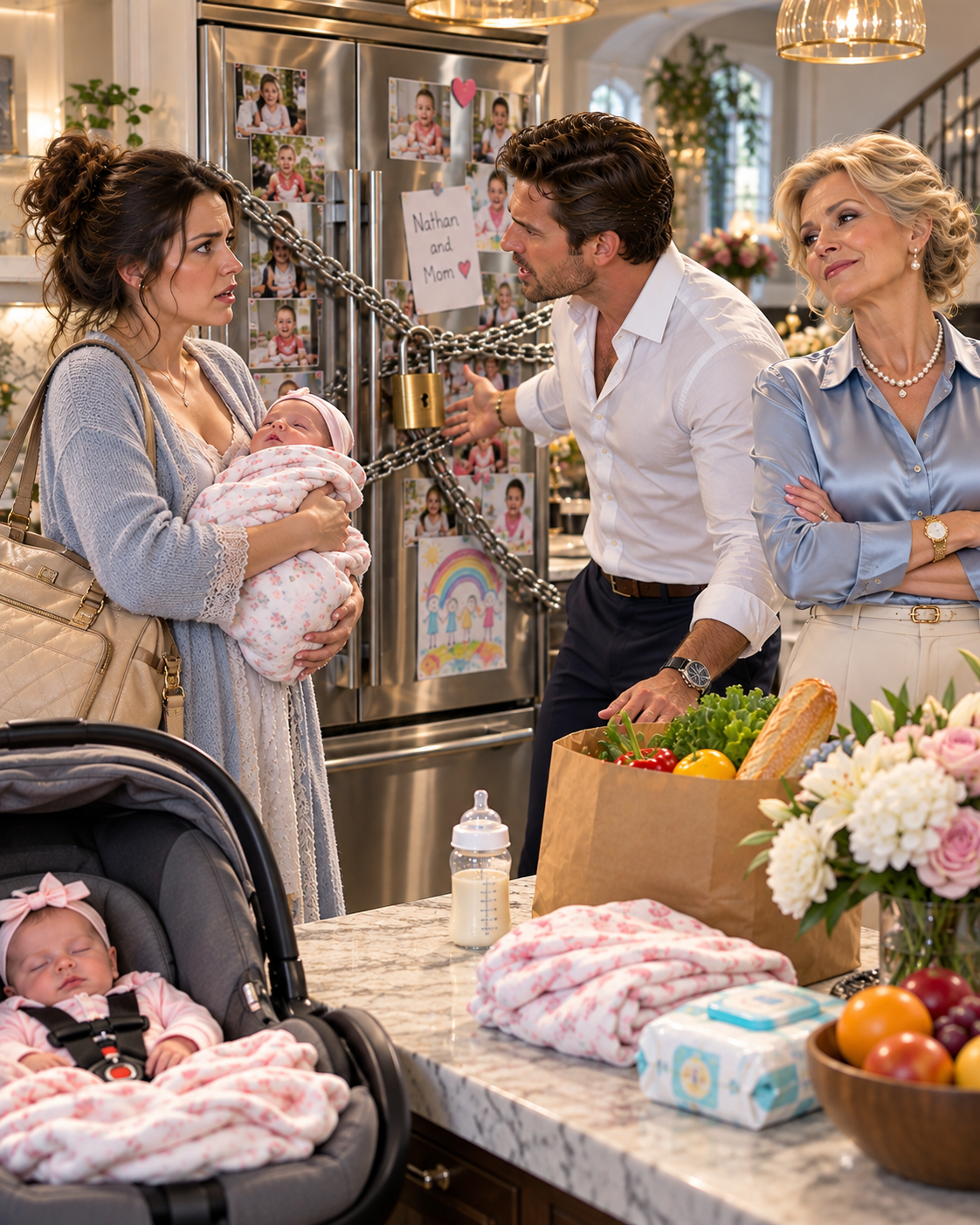
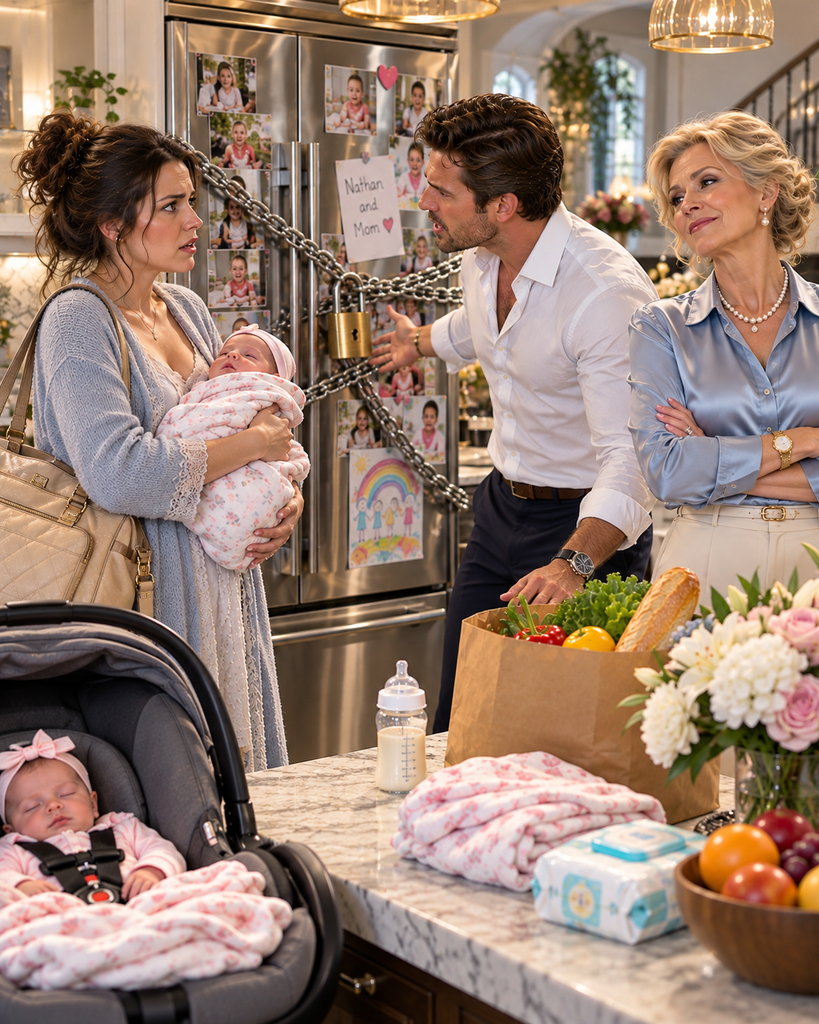
A gigantic stainless-steel refrigerator stood in the middle of my beautiful kitchen, blocking the pantry.
A handwritten sign was taped to its door.
“Nathan and Mom.”
My husband stood beside it with his arms folded. Patricia, wearing an expensive cardigan and drinking tea from my favorite mug, smiled smugly.
“What is this?” I whispered.
Nathan looked almost pleased with himself.
“It’s called setting boundaries, Claire. Mom and I have decided we’re tired of you controlling the household finances.”
I stared at him.
“Controlling?”
“You make more money than I do, and you never let me forget it. From now on, we’re keeping our expenses separate.”
He gestured toward the refrigerator.
“Mom and I will buy our groceries. You can buy yours. You’re responsible for feeding yourself and the twins.”
For several seconds, I couldn’t speak.
I’d just undergone major surgery to deliver his daughters, and he was telling me that providing food for them was entirely my responsibility.
“You bought another refrigerator so you could keep food away from your wife and newborn children?”
“It’s about respect,” Patricia interrupted. “Nathan is the man of this house. He shouldn’t have to depend on his wife for money.”
I felt dizzy.
“I need to lie down.”
I was too exhausted to argue. I collected the babies and slowly climbed the stairs.
But when I reached our bedroom, another shock awaited me.
Patricia’s clothes filled my walk-in closet. Her slippers were beside my favorite chair, and her perfume bottles covered my vanity.
She had moved into my bedroom.
I hurried to the nursery.
The cribs I’d carefully chosen for Emma and Grace had been pushed into a corner. A bulky recliner and portable television occupied the center of the room.
My daughters’ nursery had become Patricia’s private lounge.
They hadn’t simply rearranged the furniture.
They had pushed me out of my own home.
I returned to the bedroom, placed the babies safely beside me in their carriers, and lay on the edge of the mattress.
That evening, I heard Nathan and Patricia laughing downstairs.
“Did you see her expression?” Patricia said. “I told you this would work. Women who earn that much money need to be reminded who’s in charge.”
Nathan chuckled.
“She looked ready to cry when I told her to buy her own groceries.”
“What if she leaves?” Patricia asked.
Nathan laughed even harder.
“Where would she go? She’s barely able to walk, and she’s got two newborns. Nobody’s going to take her in like that.”
My stomach turned.
“By tomorrow, she’ll be begging for help,” he continued. “Then she’ll finally give me access to her investment accounts.”
I lay perfectly still.
So that was their plan.
They wanted to make me desperate enough to surrender control of my money.
Unfortunately for them, Nathan had forgotten two things.
I worked in senior risk management for a major financial corporation. Identifying threats and protecting valuable assets was literally my profession.
And I had been raised by a man who never ignored a call for help.
I quietly photographed the refrigerator, the sign, Patricia’s belongings in my bedroom, and the displaced nursery furniture.
Then I opened a group conversation with my father, Robert, and my older brothers, Jackson and Tyler.
My father was a retired Marine colonel who now owned a successful construction company. My brothers worked alongside him.
I sent the photographs.
“Dad, Nathan and his mother have taken over my bedroom and separated their food from mine. He says I’m responsible for feeding the twins alone. I’m still recovering from surgery, and I can’t handle this by myself. Please come before breakfast. Bring Jackson and Tyler. Bring the truck.”
All three read the message immediately.
Thirty seconds later, my father replied.
“We’re leaving tonight. You’re not facing this alone.”
They lived hundreds of miles away.
I put down my phone and gently touched my daughters’ tiny hands.
“Sleep peacefully, my girls,” I whispered. “Tomorrow, everything changes.”
The night passed slowly.
I barely slept.
At 5:45 the next morning, my phone vibrated.
“We’re on your street. Open the door.”
I wrapped myself in a cardigan and carefully made my way downstairs.
Nathan was asleep on the living room sofa, an empty beer bottle beside him.
I unlocked the front door.
Outside stood my father’s enormous black pickup truck and my brother’s construction van.
Robert stood on the porch between Jackson and Tyler.
At sixty-two, my father was still broad-shouldered and imposing, with closely cropped silver hair and the unmistakable bearing of a military officer.
My brothers were equally formidable.
But the moment Dad saw me, his expression softened.
He carefully wrapped his arms around me.
For the first time since giving birth, I felt safe.
Then he looked past me into the kitchen.
He saw the refrigerator.
He read the sign.
His expression hardened.
He gave my brothers a single nod.
Jackson and Tyler walked upstairs to gather Patricia’s belongings.
I sat in the living room while Dad stood near the staircase.
Moments later, Patricia’s furious voice rang through the house.
“Who are you? What are you doing in here?”
“Gather your things,” Jackson answered. “You’re leaving this bedroom.”
The commotion woke Nathan.
He stumbled upright.
“Claire? What’s happening?”
Then he saw my father.
“Robert? Why are you here?”
“My daughter asked me to come,” Dad replied calmly. “Apparently, you’ve forgotten whose home you’re living in.”
Nathan looked offended.
“This is a private family matter. Claire is hormonal and exaggerating everything!”
“Then you won’t mind explaining it to the police,” my father said.
Nathan hesitated.
Upstairs, my brothers were collecting Patricia’s belongings into large contractor bags.
Patricia appeared at the landing, furious.
“Nathan! Call the police! These men are throwing out my things!”
Nathan looked at me.
“Claire, tell your family to leave my house!”
I met his eyes.
“Your house?”
My father stepped forward.
“The mortgage is in Claire’s name. She’s the one paying for this property. And last night, while you were laughing about how helpless she was, she was protecting herself.”
He handed Nathan a folder containing copies of financial documents and instructions prepared with my attorney.
Nathan opened it.
His expression changed.
“What is this?”
“Documentation of my separate assets,” I replied. “And notice that you no longer have permission to use my personal accounts.”
Nathan looked up sharply.
“You can’t do that!”
“You wanted financial independence, remember?”
I stood slowly, holding my abdomen, and walked toward the kitchen.
Everyone followed.
I stopped beside the enormous refrigerator.
“Let’s discuss those boundaries you were so eager to establish.”
I placed another folder on the island.
“Your access to my personal credit cards has been canceled. I’ve secured my separate investments, changed my passwords, and contacted my attorney about protecting the marital accounts. Any jointly owned funds will be handled legally.”
Nathan’s face went pale.
“And I’ve discovered something else.”
He stared at me.
“What?”
“Fifty thousand dollars.”
The room fell silent.
“For two years, you’ve been secretly borrowing money to gamble on cryptocurrency and speculative stocks. You’ve opened several high-interest credit accounts and concealed the debt.”
Patricia suddenly looked away.
“You knew, didn’t you?” I asked her.
She said nothing.
Nathan began shaking his head.
“I was trying to make money for our family!”
“You were gambling with our future while hiding the losses.”
“I was going to recover everything!”
“Then why did you need access to my investments?”
He couldn’t answer.
The truth was obvious.
His demand for separate finances had never been about independence.
He wanted to hide his debts while gaining control of my savings.
Patricia finally exploded.
“You selfish woman! My son deserves respect! If you divorce him, we’ll take those babies away from you!”
My father took out his phone.
“Before you make another threat, listen to this.”
He played the recording I’d captured the previous evening.
Nathan’s voice filled the kitchen.
“Where would she go, Mom? She’s barely able to walk, and she’s got two newborns. She’s trapped. By tomorrow, she’ll be begging for help.”
The recording ended.
Nobody spoke.
I looked at Nathan.
“You knew exactly how vulnerable I was. You planned to use my recovery and our daughters against me.”
“Claire, I was only venting,” he whispered.
“No. You were planning.”
I showed him the photographs and explained that my attorney had already received copies, along with the recording and financial records.
“I’ve begun preparing for divorce. I’m also seeking temporary custody arrangements that protect the girls.”
Patricia looked horrified.
“You can’t keep Nathan from his children!”
“That’s for the court to determine,” I replied. “But I’ll make sure the judge knows what happened here.”
Nathan began crying.
“Please, Claire. I was stressed about the debt. I didn’t mean any of it.”
I looked at the refrigerator.
“Then why is that still standing in my kitchen?”
At that moment, Jackson and Tyler returned with a heavy-duty appliance dolly.
Jackson glanced at me.
“Ready to move it?”
I nodded.
Nathan panicked.
“Wait! That’s my refrigerator!”
“Then you can take it with you,” Tyler replied.
My brothers carefully disconnected the appliance, secured it to the dolly, and wheeled it toward the front door.
Patricia followed them, shouting about the groceries inside.
“My expensive cheeses! My food!”
Jackson looked back.
“Then you’ll want to make sure you take it all.”
They rolled the refrigerator onto the driveway and left it beside Patricia’s packed belongings.
The handwritten sign was still attached.
“Nathan and Mom.”
I almost smiled.
The object they’d bought to humiliate me was now sitting outside, waiting to leave with them.
Nathan dropped to his knees.
“Claire, please. I’ll get rid of the refrigerator. I’ll make Mom leave. We can fix this!”
I looked down at him.
“You had five days to help me recover. Instead, you used that time to make plans against me.”
“I love you!”
“Love doesn’t look like this, Nathan.”
He began sobbing harder.
“I have nowhere to go. My credit cards are maxed out. Mom doesn’t have much money left.”
I remembered how he’d laughed about me having nowhere to go.
“You wanted us to live separately,” I said. “Now we’re going to make that separation real.”
My father helped arrange for Nathan and Patricia to collect their belongings and leave without further confrontation. My attorney would handle the formal legal questions about the house and occupancy.
They eventually walked outside.
Nathan looked back once, hoping I would change my mind.
I didn’t.
When the front door closed, I returned upstairs.
I found Emma and Grace sleeping peacefully.
I sat beside their cribs and kissed their foreheads.
“We’re going to be okay,” I whispered.
For the first time since coming home from the hospital, I believed it.
The following months were difficult, but they were also the beginning of my freedom.
My attorney guided me through the divorce, financial disclosures, and temporary parenting arrangements.
Nathan’s hidden debts became a serious problem.
Without access to my personal income, he struggled to make payments. Creditors pursued him, and eventually he filed for bankruptcy.
The court examined the evidence of his financial secrecy, the recording of his threats, and his conduct immediately after the twins’ birth.
I was granted primary custody of Emma and Grace, while Nathan received supervised visitation under the initial parenting order.
He rarely attended.
Patricia’s retirement savings had already been depleted helping Nathan cover his debts. The two moved into a small apartment near an industrial district.
According to mutual acquaintances, they soon began blaming each other.
Nathan accused Patricia of encouraging the refrigerator scheme.
Patricia accused Nathan of ruining their financial future.
Without me available to absorb their anger, they directed it at each other.
I didn’t celebrate their misery.
I simply stopped allowing it into my life.
The week after they moved out, I hired professional cleaners.
They thoroughly cleaned the bedroom, removed Patricia’s lingering perfume scent, and restored the closets.
Jackson and Tyler helped me remove the recliner and television from the nursery.
We repositioned the cribs, repaired the scratches in the floor, and hung the soft curtains I’d chosen months earlier.
The nursery finally belonged to my daughters.
My home smelled of fresh laundry, baby powder, and peace.
Dad stayed nearby during the first weeks, helping with meals and appointments while I recovered.
My brothers visited whenever they could.
They assembled furniture, repaired little things around the house, and took turns holding the twins so I could sleep.
For the first time, I understood what genuine support looked like.
Nobody demanded gratitude for feeding me.
Nobody treated my recovery as an inconvenience.
Nobody suggested that caring for my children was solely my responsibility.
When my maternity leave ended, I returned to work with renewed focus.
I had spent years managing Nathan’s insecurities, protecting his ego, and trying to prevent arguments with Patricia.
Without that constant emotional burden, I had energy I’d almost forgotten existed.
Within several months, I helped lead a major corporate merger and was promoted into a higher executive risk-management role.
It was an important professional achievement.
But my greatest success was waiting at home.
One spring afternoon, I sat on the patio with a cup of coffee.
Through the open doors, I could see Dad sitting on the living room carpet.
Emma was pretending to pour tea into a tiny plastic cup.
My father, a man who had once commanded Marines, accepted it with complete seriousness.
“Excellent tea, sweetheart,” he said.
Nearby, Jackson and Tyler were letting Grace crawl over them while they pretended to be mountains.
The house rang with laughter.
I leaned back and closed my eyes.
I’d once believed that being a good wife meant tolerating everything.
I thought marriage required me to shrink myself so Nathan could feel important.
But I had been wrong.
A healthy marriage should never require one person to surrender their dignity.
The refrigerator hadn’t destroyed my family.
It had exposed the truth about the family I thought I had.
Months later, a letter from Nathan arrived.
His familiar handwriting covered the envelope.
I could imagine what it contained.
Perhaps an apology.
Perhaps another request for money.
Perhaps an explanation blaming his mother, his debts, or the stress of becoming a father.
A year earlier, I would have opened it immediately.
I would have searched every sentence for signs that he finally understood what he’d done.
But I no longer needed his understanding to validate my decision.
I placed the unopened letter aside for my attorney to handle if necessary.
Then I made myself coffee and went outside to watch my daughters play.
His words no longer controlled my peace.
Three years later, our backyard was filled with laughter during our annual Fourth of July barbecue.
The smell of grilled salmon, sweet corn, and summer flowers drifted through the warm evening air.
Emma and Grace, now three and a half, raced across the grass in matching summer dresses, their dark curls bouncing.
Tyler scooped Emma into his arms while Jackson chased Grace with a water balloon.
My father stood beside the grill, laughing with friends and colleagues.
The yard was full of people who loved us without conditions.
I stood on the stone patio, watching my daughters enjoy the childhood they deserved.
They were confident, curious, and happy.
They knew that love meant safety, kindness, and respect.
And they knew that the people who cared for them would never use their vulnerability as a weapon.
I thought back to the morning I’d returned from the hospital.
I remembered the pain in my abdomen, the exhaustion, and the terrible humiliation of seeing that enormous refrigerator in my kitchen.
Nathan had believed that childbirth had made me powerless.
He thought my physical weakness meant I would accept anything.
But he had mistaken exhaustion for surrender.
He had forgotten that I possessed the education, experience, and determination to protect myself.
More importantly, he had forgotten that I had people who loved me enough to answer when I called.
I had learned something I would teach my daughters when they were old enough to understand.
Being a wife doesn’t mean accepting humiliation.
Being a mother doesn’t mean sacrificing your dignity.
And keeping a family together is never worth teaching children that cruelty is normal.
Sometimes, the bravest thing a woman can do is admit that the life she has been trying to preserve is the very thing hurting her.
My husband wanted to teach me a lesson about independence.
He separated our groceries, claimed our bedroom for his mother, and expected me to beg for his help.
Instead, I learned that I had been independent all along.
I owned my home.
I supported my children.
I had a career I’d worked hard to build.
And I had a family who stood beside me when I needed them.
As the summer sun began to set, Dad walked over and handed me a plate of food.
He gently tapped his drink against mine.
“To you and the girls,” he said.
I smiled.
“To family.”
I looked across the yard at Emma and Grace, laughing beneath the golden evening sky.
For years, I had thought strength meant enduring whatever life placed in front of me.
Now I understood that real strength sometimes meant refusing to endure another day of disrespect.
Nathan and Patricia had tried to push me out of my own life.
Instead, they had given me the courage to reclaim it.
And the most important thing I recovered wasn’t my bedroom, my kitchen, or even my financial independence.
It was my peace.