
The grand halls of Columbia University’s medical school were built to make ordinary people feel insignificant.
Beneath their towering ceilings and polished stone walls lived generations of prestige, ambition, and impossible expectations. But to understand the silence that would eventually consume its graduation ceremony, you first need to understand the exhausting struggle that brought my daughter and me there.
For twenty years, my life had been a relentless battle for survival.
My name is Margaret Bennett. I was the invisible cleaning woman who scrubbed blood and iodine from emergency room floors at three in the morning. I emptied trash cans for future surgeons, polished office doors, and walked past wealthy professors who rarely acknowledged my existence.
My daughter, Olivia, was the one extraordinary blessing that made every sacrifice worthwhile.
At eighteen, Olivia was already a medical prodigy. She had raced through public school, completed her undergraduate studies years ahead of schedule, and become the youngest valedictorian in Columbia’s medical school history. She had grown up surrounded by overdue bills and my endless double shifts, learning to read from discarded anatomy textbooks I brought home from the hospital.
By her final year, I believed our suffering was almost over.
Then she met Nathaniel Whitmore.
Nathaniel was the handsome, privileged heir to a pharmaceutical fortune. His family financed several university research facilities, and he depended heavily on Olivia’s intelligence to survive his clinical training.
I warned her about powerful families who believed their money placed them above everyone else.
Unfortunately, I was right.
One October morning, Nathaniel disappeared. His apartment was emptied, his phone disconnected, and his family sent him to Zurich on a supposedly important academic assignment.
He left without saying goodbye.
That same morning, Olivia discovered she was pregnant.
She stood in our tiny bathroom staring at two pink lines on a pregnancy test, her entire future suddenly uncertain.
But my daughter refused to surrender.
She purchased oversized laboratory coats, continued her hospital rotations, and concealed her pregnancy beneath loose clothing. She was determined to graduate and raise her child.
We believed hard work and silence would protect us.
We were wrong.
One evening, while I was mopping a basement corridor, the heavy security doors opened.
Victoria Whitmore stepped inside, accompanied by two men in expensive suits.
Nathaniel’s mother was an elegant, ruthless woman whose donations gave her enormous influence over the university.
She examined my cleaning uniform with open contempt.
“We need to discuss the unfortunate situation your daughter has created,” she announced.
I tightened my grip on my mop.
“My daughter hasn’t done anything wrong.”
Victoria approached, her expensive perfume overpowering the cleaning chemicals.
“My son has a remarkable future. He cannot be burdened by a child born into your circumstances.”
She offered two choices.
Olivia could end her pregnancy, or she could give birth, surrender the baby through a private adoption arranged by Victoria’s attorneys, and accept five million dollars in exchange for disappearing from Nathaniel’s life.
“She will never give away her baby,” I replied.
Victoria smiled coldly.
“Then I’ll destroy her career.”
She explained that her position on the university’s governing boards allowed her to influence academic decisions. Olivia could fail her clinical evaluations, lose her residency opportunities, and find herself blacklisted from hospitals nationwide.
“Your daughter can become a surgeon,” Victoria whispered, “or she can become another cleaning woman like you.”
She dropped an envelope into my dirty mop bucket.
“You have forty-eight hours.”
That night, I told Olivia everything.
She sat silently at our kitchen table, listening to the radiator hiss.
Then she closed her textbook.
“I’m keeping my baby, Mom. And I’m finishing medical school. She doesn’t get to decide my future.”
For the following month, Victoria made good on her threats.
Olivia’s rotations became impossibly demanding. She was assigned overnight emergencies, consecutive thirty-hour shifts, and the most physically exhausting responsibilities.
Her face grew pale. Dark circles surrounded her eyes. I watched her struggle through each day, surviving on determination and whatever rest she could steal.
Then, during a violent winter storm, everything collapsed.
I was cleaning the pediatric waiting room when my phone rang.
It was Nurse Rebecca, a longtime hospital employee who had always treated me kindly.
“Margaret, come to basement storage room C immediately,” she whispered. “Use the service elevator. Don’t let anyone see you.”
Something in her voice terrified me.
I abandoned my cleaning cart and ran.
When I opened the storage room door, I found Olivia lying on the concrete floor, surrounded by medical supplies.
Her scrubs were soaked. Her face was white with pain.
“Mom,” she gasped. “The baby’s coming.”
She was only twenty-eight weeks pregnant.
Her water had broken, and the contractions were already dangerously close together.
“We need maternity,” I cried.
Olivia grabbed my wrist.
“No! They’ll register me. Victoria will find out. Her lawyers will take my baby.”
Rebecca was already preparing sterile pads and emergency supplies.
“We don’t have time,” she said. “Margaret, help me.”
Under the flickering fluorescent lights of a hospital storage room, my daughter gave birth to a tiny baby girl weighing barely two pounds.
For one terrible moment, the child made no sound.
Her skin was bluish. Her chest barely moved.
“She’s not breathing,” Rebecca whispered.
She immediately began emergency ventilation.
Suddenly, someone pounded on the locked door.
“Open up! Immediately!”
I recognized the voice.
Dr. Preston, the hospital’s chief medical officer, whose research was financed by the Whitmore Foundation.
I pressed my shoulder against the door while Rebecca worked desperately to help the baby breathe.
Then a tiny cry broke through the room.
It was the most beautiful sound I had ever heard.
But the child urgently needed neonatal intensive care.
Olivia looked at me, tears streaming down her face.
“Mom, please. Save her.”
I opened the door.
Rebecca rushed the newborn toward the NICU while I helped Olivia follow.
The baby was stabilized inside a temperature-controlled incubator, surrounded by monitors and specialized equipment.
For a brief moment, I believed the worst was over.
Then Dr. Preston appeared with three security guards.
“Olivia Bennett,” he announced loudly, “a security inspection has uncovered three missing vials of fentanyl inside your personal belongings.”
Olivia stared at him.
“What?”
“We found the medication in your hospital bag. You are facing immediate expulsion and criminal charges.”
“That’s impossible!” I shouted. “Someone planted them!”
Dr. Preston ignored me.
“And you, Mrs. Bennett, are terminated for assisting her. Security will escort both of you off hospital property.”
I looked through the NICU window at my granddaughter fighting for her life.
Victoria had failed to purchase the baby.
Now she intended to destroy her mother.
The following weeks were unbearable.
We were banned from campus. Olivia faced disciplinary proceedings, and I found overnight work cleaning a greasy restaurant to pay for our living expenses and the specialized care our premature granddaughter required.
We named her Grace.
After several weeks of treatment, she was discharged with strict medical instructions and a demanding feeding schedule.
Olivia barely slept.
Then, the evening before her disciplinary hearing, a lawyer arrived at our apartment.
He offered one final agreement.
If Olivia surrendered parental rights to Nathaniel and allowed the Whitmores to take custody of Grace, the drug allegations would disappear.
Olivia looked at her sleeping daughter.
Then she looked at the documents.
“No.”
The lawyer left.
For several minutes, my daughter remained silent.
Then she opened her battered laptop.
“They think owning the hospital means owning the truth,” she said.
“What are you going to do?”
“Find the evidence they forgot to erase.”
Olivia understood the hospital’s digital systems better than almost anyone. She knew where legitimate audit records were retained, which employees had witnessed irregularities, and which communications might establish what happened.
Over the following days, she worked with a sympathetic attorney and trusted hospital employees to preserve records and obtain evidence through authorized channels.
She also met privately with Rebecca, who knew far more than she had initially revealed.
Most importantly, Olivia had recorded a confrontation with Dr. Preston in which he admitted the accusations had been fabricated.
She submitted the evidence to federal investigators.
But she had another plan.
On graduation morning, the air in New York City was warm and humid.
Olivia emerged from her bedroom wearing her crimson academic gown.
Grace was secured against her chest in a breathable infant carrier, with the gown draped carefully around her.
“Are you sure about this?” I asked.
“Absolutely.”
“Security won’t let you inside.”
“They can try.”
She adjusted her graduation cap.
“Today, everyone learns what the Whitmores did.”
The university graduation pavilion was filled with crimson banners, expensive flowers, proud families, and hundreds of graduates.
I sat near the back in a secondhand floral dress.
Victoria Whitmore occupied a front-row seat, wearing designer sunglasses and a cream-colored suit.
She looked completely confident.
The university had already informed Olivia that her academic honors were revoked and that her expulsion would become final at the conclusion of the ceremony.
She was forbidden from approaching the stage.
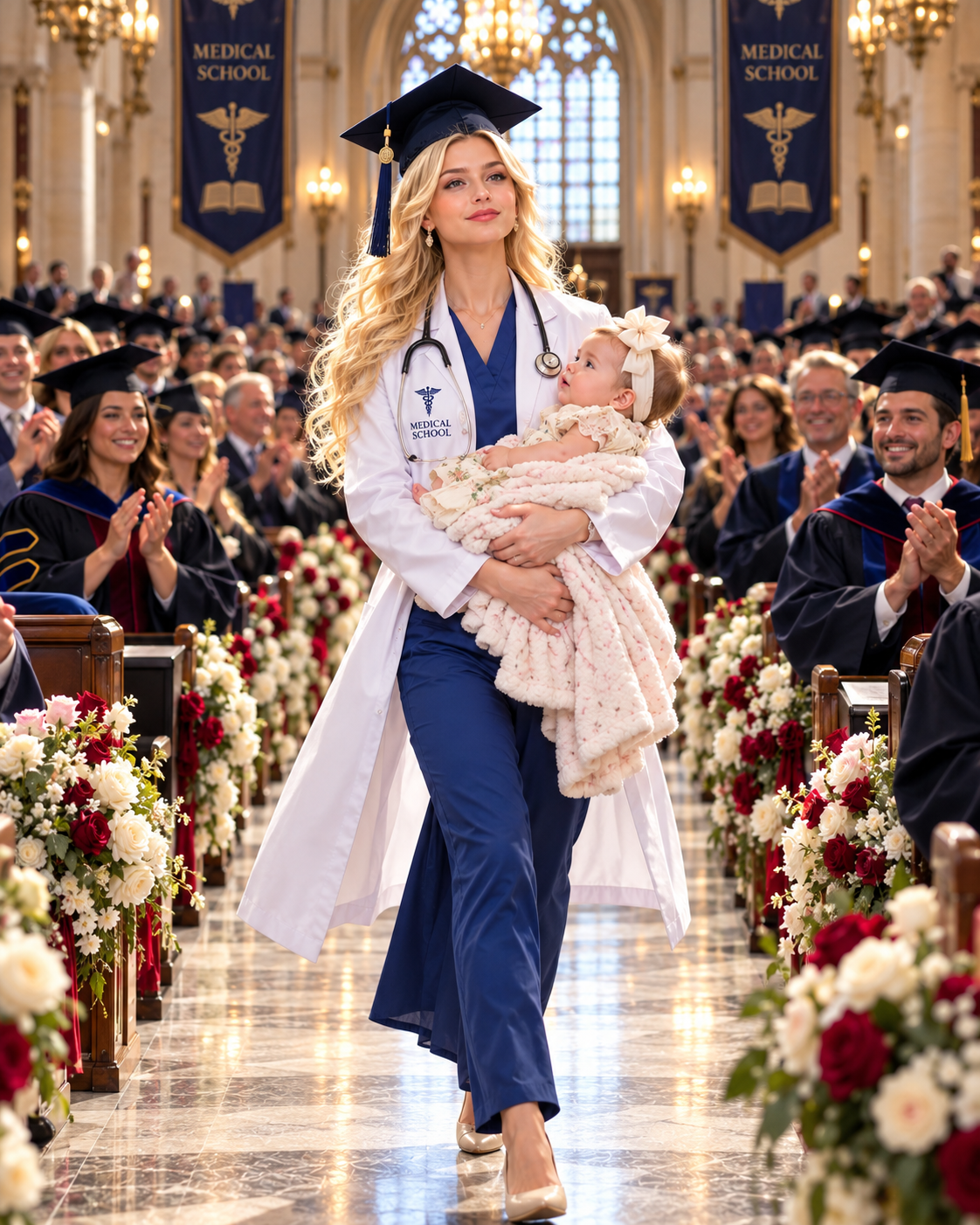
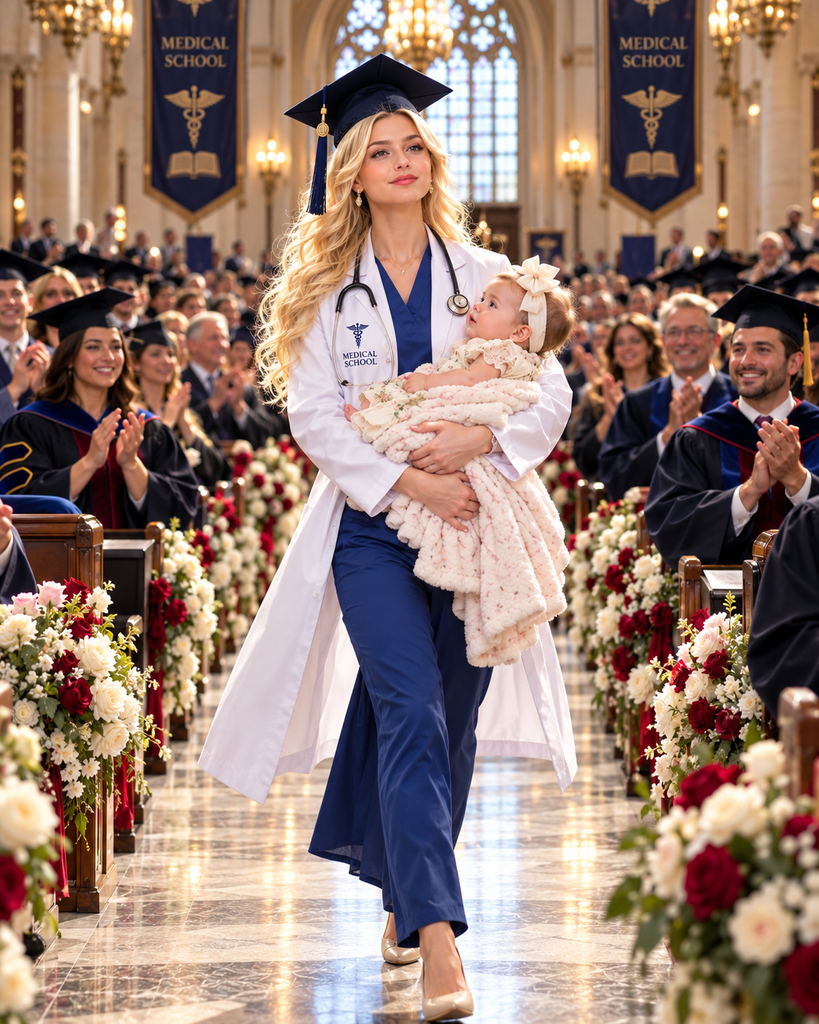
But when the graduates began lining up for their diplomas, Olivia stepped into the center aisle.
She walked forward calmly, Grace sleeping against her chest.
Whispers spread through the audience.
Victoria noticed her and smiled.
She apparently believed Olivia had come to beg.
At the stage entrance, Dr. Preston appeared with two security guards.
“Miss Bennett,” he hissed, “you have been expelled. Leave immediately.”
Olivia continued forward.
One guard reached for her arm.
Before I knew what I was doing, I was running down the aisle.
“Don’t touch my daughter!”
I pushed myself between Olivia and the guards.
Dr. Preston recoiled.
“Mrs. Bennett, you need to step aside.”
“No.”
I stood firmly in front of him.
“She earned her place on that stage. If you want to stop her, you’ll have to drag a fifty-year-old cleaning woman away in front of thousands of witnesses.”
He glanced nervously toward the cameras.
“Go, Olivia,” I whispered.
My daughter climbed the stairs.
She walked past the stunned university officials and approached the podium.
Dr. Preston signaled frantically toward the audio technicians.
Olivia opened her mouth.
The microphone went dead.
Victoria leaned back, smiling.
But Olivia had anticipated this.
She took out her phone and activated a compact, independent speaker system that had been positioned with help from sympathetic event personnel.
A sharp burst of feedback echoed through the pavilion.
Then her voice rang out.
“Can everyone hear me?”
The crowd fell silent.
Behind her, the enormous graduation screen changed.
The university emblem disappeared.
In its place appeared a series of emails.
The messages documented communications between Victoria Whitmore and Dr. Preston concerning Olivia’s pregnancy, the fabricated fentanyl accusation, and plans to remove her from the university.
A collective gasp swept through the audience.
The evidence included preserved message headers, dates, and supporting records that Olivia’s attorney had already provided to investigators.
“For years,” Olivia began, “I believed this university represented truth, integrity, and the duty to protect human life.”
She looked directly at Victoria.
“But some people here believe money gives them permission to destroy lives.”
Victoria’s smile vanished.
“Three weeks ago, my daughter was fighting to survive after being born prematurely,” Olivia continued. “Instead of helping us, powerful people tried to use my child’s vulnerability to force me into surrendering her.”
She paused.
“Victoria Whitmore offered me five million dollars to give up my baby. When I refused, she arranged for false drug accusations to destroy my medical career.”
The screen changed again.
This time, the audience heard Dr. Preston’s recorded voice.
“Victoria threatened to withdraw my research funding, Olivia. I had no choice. I planted the vials because she demanded it.”
The pavilion erupted in shocked whispers.
Faculty members exchanged horrified looks.
Reporters raised their cameras.
Victoria sat motionless, her face drained of color.
“You can take away my honors,” Olivia declared. “You can threaten my residency. You can remove my name from your graduation program.”
She opened the front of her gown, revealing Grace asleep against her chest.
“But you cannot buy my daughter.”
A stunned silence followed.
Then Olivia turned toward me.
“And there’s someone else I need to recognize.”
Her voice softened.
“People call me gifted. They call me a prodigy. But everything I’ve accomplished began with a woman who worked through the night so I could study.”
Tears filled my eyes.
“My mother cleaned hospital floors while other families slept. She skipped meals to buy my books. She carried every burden without asking for recognition.”
Olivia looked directly at me.
“Mom, you taught me that medicine isn’t about prestige or wealth. It’s about protecting people who cannot protect themselves.”
I covered my mouth.
“You are the strongest person I’ve ever known.”
Then she faced the crowd.
“My name is Dr. Olivia Bennett. This is my daughter, Grace. And neither of us belongs to the Whitmore family.”
She stepped away from the podium.
For three long seconds, nobody moved.
Then a young medical student stood and began applauding.
Another graduate joined her.
Then a professor.
Within moments, the entire graduating class was standing.
Thunderous applause swept across the pavilion.
Parents cheered. Students shouted Olivia’s name. Cameras flashed everywhere.
Victoria attempted to leave, but reporters surrounded her with questions.
Dr. Preston hurried toward a side exit.
There, federal investigators who had been examining Olivia’s evidence were waiting to question him.
Olivia walked down the stage stairs.
I reached for her.
She fell into my arms, carefully protecting Grace between us.
For the first time in years, I allowed myself to cry without restraint.
My daughter had not simply defended her future.
She had exposed the corruption that nearly destroyed it.
One year later, everything had changed.
The Whitmore pharmaceutical empire faced extensive federal investigations into bribery, coercion, obstruction, and financial misconduct.
Victoria resigned from her university and corporate positions. Although she avoided imprisonment, her public reputation collapsed, and she withdrew from public life to a private estate in Switzerland.
Dr. Preston lost his medical license and received a five-year prison sentence following his conviction for evidence tampering and fraud.
Nathaniel never returned from Zurich.
The university’s governing board conducted an independent review. With the accusations discredited and Olivia’s academic achievements confirmed, her expulsion was overturned.
Her honors were restored.
Her medical degree was formally awarded, accompanied by a public apology.
Today, Olivia is a respected pediatric surgical resident in New York City. She devotes herself to caring for vulnerable children, especially premature infants whose families lack financial resources.
She never forgot the terror of watching Grace struggle to breathe.
And she never forgot the people who helped save her.
As for me, I no longer spend my nights scrubbing hospital floors.
I now manage a thriving daycare center affiliated with Olivia’s hospital.
Every morning, I arrive to the sound of children laughing instead of machines beeping.
And every afternoon, I watch my granddaughter Grace run across the colorful playroom, a toy stethoscope dangling from her neck.
She places it against her stuffed animals and announces, with enormous seriousness, that they’re going to be fine.
Sometimes Olivia comes to collect her after a long shift, still wearing her surgical scrubs.
I watch my daughter lift Grace into her arms, and I remember that terrible night in the storage closet.
I remember the tiny blue baby who couldn’t breathe.
I remember the wealthy woman who believed she could purchase our obedience.
And I smile.
Victoria Whitmore never understood what real power looked like.
It wasn’t the millions she controlled, the buildings bearing her family’s name, or the influential people who answered her calls.
Real power was a frightened young mother refusing to surrender her child.
It was a nurse risking her career to save a premature baby.
It was a cleaning woman standing between her daughter and the men who wanted to silence her.
And it was the truth, spoken aloud before thousands of witnesses, becoming impossible to bury.
We had spent twenty years being told where we belonged.
In the end, my daughter stepped onto the stage they tried to deny her and showed the entire world that dignity cannot be purchased, courage cannot be inherited through a fortune, and the strongest foundations are built by people who refuse to let those they love fall.