
The slap comes so suddenly that I barely understand what has happened until the pain spreads across my face.
One moment, I’m standing in their spotless kitchen, politely asking my daughter-in-law to stop smoking near me because my damaged lungs can hardly tolerate ordinary air. The next, my son’s hand strikes my cheek with a sharp crack that echoes through the enormous room.
My head jerks sideways. Burning pain spreads beneath my skin, and the metallic taste of blood fills my mouth where my teeth have cut my inner cheek. I grab the granite countertop to steady myself, struggling to remain upright.
Sloan’s cigarette smoke continues drifting lazily through the kitchen. My son, Deacon, the boy I raised alone in a tiny apartment in Columbus, the child I sacrificed my health and happiness to support, has just slapped his seventy-three-year-old mother for asking to breathe.
“Maybe that’ll teach you to keep your mouth shut,” he says coldly.
He looks at me with such indifference that it hurts almost as much as the blow.
My lungs tighten. Every breath feels like pulling air through a soaked towel. My doctor has warned me repeatedly that my chronic lung disease will worsen with exposure to cigarette smoke. All I wanted was a little consideration.
But this is their house, and apparently my health means nothing here.
Sloan gives a satisfied little laugh. Her perfectly painted lips curve into a cruel smile as she deliberately takes another puff. Her expensive clothes, flawless makeup, and platinum-blonde hair make her look like someone who has never experienced a difficult day.
Deacon turns away from me, approaches his wife, and gently kisses her forehead with the same hand he used to strike me.
“Dinner downtown tonight?” he asks affectionately.
“That new steakhouse sounds wonderful,” Sloan replies.
“Perfect. I’ll change.”
She crushes her cigarette against a delicate ceramic plate I had carefully washed that morning.
Fifteen minutes later, they leave.
Through the window, I watch Deacon wrap his arm around Sloan’s waist as they laugh on their way to his BMW. Three years earlier, I helped him purchase that car using money I had saved for a hearing aid.
Now they drive away to enjoy an expensive dinner while I remain alone, holding my swollen cheek.
The house becomes painfully silent.
I slowly climb the stairs, stopping frequently to catch my breath. At the end of the hallway is the guest bedroom where I’ve been allowed to stay for six months.
Not my bedroom. Their guest room.
Everything is white, gray, expensive, and lifeless. Even the temperature is controlled by Sloan, who forbids me from touching the thermostat.
I sit on the bed, trembling.
Beside my phone stands a photograph of Deacon’s high school graduation. In it, he has his arm around me, and we’re both smiling with genuine happiness.
I hardly recognize those people anymore.
My cheek throbs. By morning, the bruise will be impossible to hide.
I pick up my phone and scroll through my contacts until I find a name that makes me smile despite the pain.
Ethan Brooks.
Twenty years ago, Ethan was a desperate young father abandoned by his wife. He had an infant daughter, enormous debts, and almost no support.
We lived in the same apartment building. I babysat his daughter while he worked double shifts, brought him homemade meals, and occasionally gave him grocery money.
I never asked for anything in return.
“One day, when things improve, you can help someone else,” I always told him.
Ethan eventually graduated from law school and became a respected attorney specializing in elder abuse and financial exploitation.
I press his number.
“Lillian? Is that really you?” he answers warmly.
“Ethan, I need help.”
His tone changes immediately.
“Are you hurt? What happened?”
I explain the slap, the smoking, and the money Deacon and Sloan have been taking from my disability payments.
“Listen carefully,” Ethan says firmly. “Save every receipt, message, and bank statement. Don’t confront them. Don’t tell them what you’re planning. Can you do that?”
“Yes.”
“Good. We’re going to document everything. You helped me survive when I had nothing. Now I’m going to help you.”
After hanging up, I make another call.
Vanessa Carter answers almost immediately.
“Lillian! I was thinking about you recently!”
Vanessa grew up near me in Columbus. When her mother developed cancer during Vanessa’s college years, I helped care for her so Vanessa could finish school.
Today, Vanessa is an investigative journalist with the Columbus Herald.
I tell her everything.
“Are you certain you want your story published?” she asks. “Once it becomes public, you can’t take it back.”
“I’ve spent six months being treated like I don’t exist. I’m finished staying silent.”
“Then I’ll help. We’ll make sure people hear the truth.”
My third call is the most difficult.
Caleb Ramirez was Deacon’s college roommate. He spent countless evenings in my apartment, eating my cooking and calling me “Mama Lillian.”
I treated him like another son.
He eventually became a forensic accountant specializing in financial fraud.
“Mama Lillian!” he exclaims when he answers. “Where have you been? I’ve been trying to reach you!”
“I’m living with Deacon and Sloan.”
“That’s wonderful, isn’t it? They’re looking after you?”
My silence answers his question.
“What happened?”
I tell him.
When I finish, his voice is shaking with anger.
“I’m going to examine their finances. If they’ve been exploiting you, I’ll find proof. I’ll be there tomorrow.”
Just as I end the call, I hear Deacon and Sloan returning.
Their laughter carries through the hallway.
They have no idea what tomorrow will bring.
I look in the mirror. Deacon’s fingers have left clear red marks across my cheek.
For the first time in months, I smile.
Let them believe I’m helpless.
Tomorrow, they’ll discover how wrong they are.
But to understand why I stayed so long, you need to know what I sacrificed for my son.
I was seventeen when I met Robert Patterson, a twenty-two-year-old construction worker with a charming smile and a talent for making promises.
We married quickly. Three months later, I became pregnant.
Robert celebrated by drinking with his friends until three in the morning.
Deacon was born the following March, weighing seven pounds and four ounces.
When Robert finally arrived at the hospital, he smelled of alcohol. Yet when he held our son, his expression softened.
I foolishly hoped fatherhood would change him.
It didn’t.
We lived in a cramped two-bedroom apartment on Columbus’s east side. The walls were thin, the neighborhood noisy, and money was constantly short.
When Deacon was six months old, I began working at Franklin Textile Mill.
My shift ran from four in the afternoon until midnight.
Robert promised to care for our baby, but I frequently returned home to find Deacon crying in a soaked diaper while his father slept drunk on the couch.
I worked longer hours whenever overtime became available.
The industrial chemicals damaged my hands. Cotton dust and cigarette smoke filled the factory air, slowly destroying my lungs.
Still, I kept working.
I began hiding small amounts of money in coffee cans inside my closet.
Some weeks, I saved twenty dollars. Other weeks, only five.
I called it Deacon’s future.
Robert died from liver failure when Deacon was twelve.
At the funeral, my son and I stood holding hands. Neither of us cried.
Afterward, our lives became quieter.
I worked weekends, holidays, and overnight shifts. Sometimes I slept only four hours before preparing dinner and helping Deacon with homework.
The coffee cans multiplied.
Deacon joined his high school basketball team and dreamed of winning a college scholarship.
I attended every game, cheering until my damaged lungs ached.
But the scholarship never came.
After his final game, I emptied every coffee can onto our kitchen table.
Seventeen thousand three hundred forty-two dollars.
That money represented seventeen years of sacrifice: skipped meals, worn-out shoes, freezing winters, and countless hours of exhausting work.
I used it to pay for his college education.
Four years later, when Deacon graduated with a finance degree, only twelve dollars and thirty-seven cents remained.
But I was proud.
My son had opportunities I never had.
He found a prestigious job, bought expensive suits, and began earning more money than I could have imagined.
Then he met Sloan.
She worked in medical equipment sales, earned a six-figure salary, and lived in a luxurious downtown apartment.
They married two years later.
At their elegant wedding, I wore a secondhand dress I had altered myself. I sat in the third row, careful not to spoil their professional photographs.
I told everyone how proud I was.
And I meant every word.
Soon, they purchased a beautiful suburban home with a three-car garage and immaculate landscaping.
Afterward, Deacon visited me only twice a year, on Christmas and my birthday.
Our conversations became brief and distant.
I told myself this was normal. Children grow up, become successful, and build their own lives.
Then my coughing began.
At first, it was occasional. Eventually, it became so severe that I struggled to breathe.
Without health insurance, I avoided visiting a doctor.
I bought cough syrup, drank honey tea, and hoped the problem would disappear.
Instead, I collapsed in a grocery store parking lot.
At the hospital, a young doctor explained that I had chronic obstructive pulmonary disease.
“Your lungs have extensive permanent damage,” she said gently.
“But I’ve never smoked.”
“Decades of exposure to cotton dust, industrial chemicals, and secondhand smoke can cause serious damage.”
She prescribed inhalers, medication, and breathing treatments.
The bills were overwhelming.
Soon, I could no longer perform my factory duties.
After thirty years of labor, I lost my job.
Three months later, my disability payments began.
Eleven hundred dollars monthly.
My rent was seven hundred. Utilities cost another hundred fifty. Medication required approximately two hundred.
The numbers were impossible.
I skipped meals, reduced my heating, and sometimes went without medication.
Eventually, I had no choice but to call Deacon.
“Son, I need help.”
There was a long silence.
“What kind of help?”
“I can’t afford my apartment anymore. Could I possibly stay with you temporarily?”
“You want to move in?”
“Only until I figure something out.”
“I’ll talk to Sloan.”
Three hours later, he called back.
“You can use the guest room.”
Relief nearly brought me to tears.
“Thank you. I’ll contribute whatever I can. I promise I won’t be a burden.”
“We’ll discuss that later.”
He hung up.
I moved in the following Saturday with two old suitcases and three cardboard boxes.
Sloan greeted me at the door wearing expensive white jeans and a silk blouse.
“Lillian. Come inside.”
She didn’t offer to carry anything.
“The guest room is upstairs. Second door on the right.”
I struggled up the staircase, stopping twice to breathe.
Before I finished unpacking, Sloan appeared.
“We need to establish some rules.”
“Of course.”
“The master bathroom is private. Use the bathroom near the laundry room. Don’t come downstairs before nine on weekends. Never adjust the thermostat. And you’ll pay four hundred dollars monthly toward household expenses.”
“Four hundred?”
“That’s reasonable considering what we’re providing.”
I wanted to object, but I had nowhere else to live.
“All right.”
“Payment is due Monday. Also, please keep your medical equipment out of sight. It makes the house look depressing.”
She walked away.
During my first month, I tried to repay their hospitality by cooking, cleaning, and doing laundry.
Nothing pleased Sloan.
The food was too salty, then too bland. The towels were folded incorrectly. I used the wrong cleaning supplies.
Eventually, I stopped trying.
I spent most days alone in my room.
Then the payments increased.
Four hundred became four hundred fifty because of utilities.
Then five hundred for groceries.
Then five hundred fifty because of rising property taxes.
Additional charges appeared whenever Sloan wanted them.
After six months, nearly two-thirds of my disability income disappeared into their accounts.
And somehow, they still treated me as if I owed them everything.
Then came the cigarette smoke, my simple request, and Deacon’s slap.
Which brings me to the following morning.
I wake at five-thirty, as I have for decades.
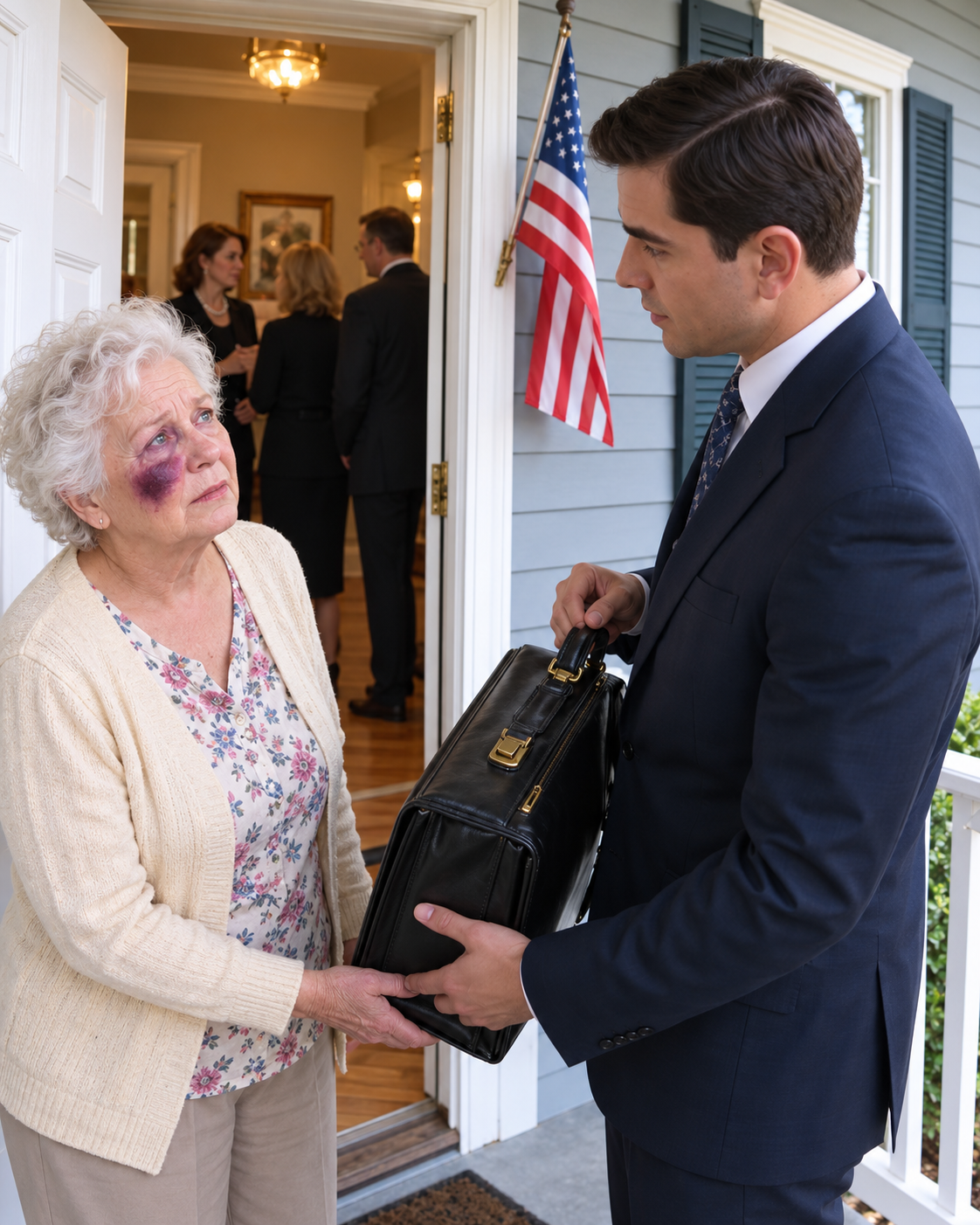
My cheek is swollen and purple, with the outline of Deacon’s fingers clearly visible.
I take several photographs.
At eight, I go downstairs.
Deacon sits drinking coffee and looking at his phone. Sloan eats yogurt while reading her tablet.
Neither acknowledges my bruised face.
“Good morning,” I say.
“Morning,” Deacon mutters.
I pour myself coffee and sit quietly.
At precisely nine o’clock, the doorbell rings.
Deacon looks up.
“Expecting somebody?”
“Yes.”
Sloan frowns.
“Who?”
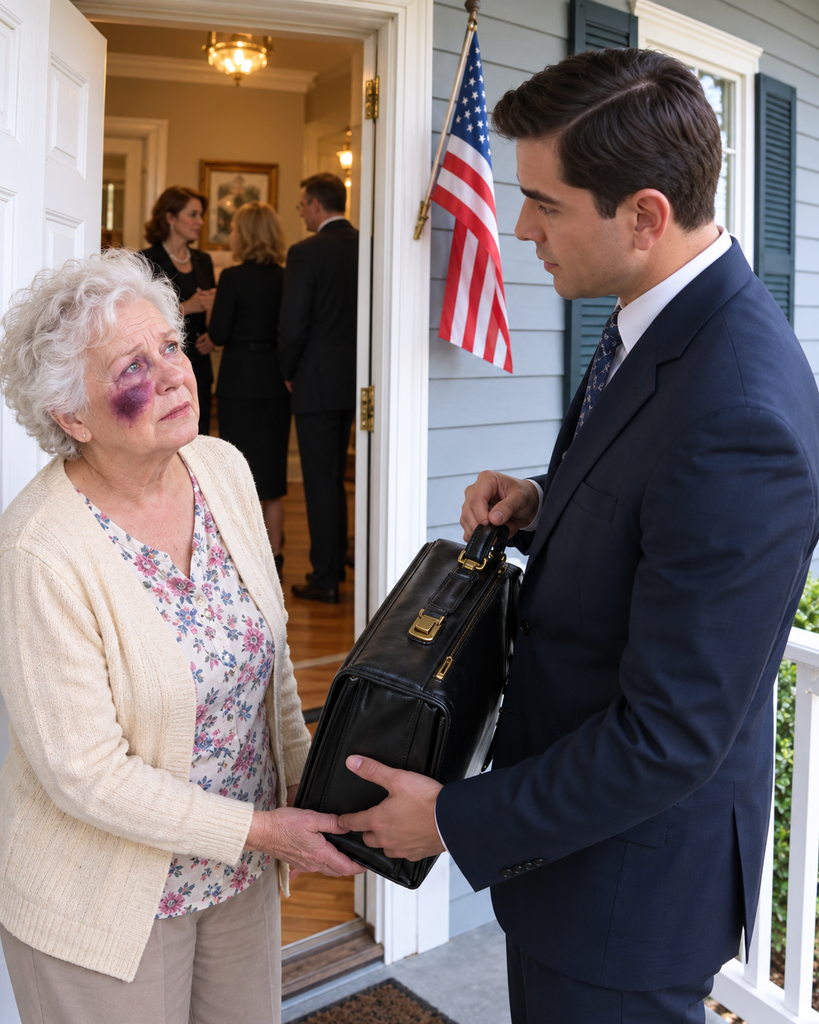
I walk to the front door and open it.
Ethan Brooks stands outside in a charcoal suit, holding a leather briefcase.
His expression changes when he sees my injury.
“Good morning, Lillian.”
Then he looks beyond me.
“Mr. Patterson. Mrs. Patterson. I’m Ethan Brooks, an attorney specializing in elder mistreatment and financial exploitation.”
Deacon approaches.
“What’s going on?”
“I asked for help,” I answer. “You assaulted me yesterday, and you’ve been taking advantage of me financially for months. I won’t tolerate it anymore.”
Ethan opens his briefcase.
“We are initiating formal proceedings concerning suspected financial and emotional abuse. We’re also preparing an application for a protective order.”
Sloan rushes forward.
“This is ridiculous! We gave her somewhere to live!”
Ethan calmly produces bank statements.
“Mrs. Patterson, these records show that Lillian has been paying between four hundred and five hundred fifty dollars monthly from an eleven-hundred-dollar disability check, sometimes with additional charges.”
“We have bills!” Sloan protests.
“Then please provide an itemized accounting explaining these charges and how they relate to her actual expenses.”
Sloan falls silent.
Ethan places photographs of my bruised face beside the financial records and lists of medications I couldn’t afford.
Deacon’s complexion turns pale.
“Mom, we can discuss this privately.”
“You had six months to discuss it,” I reply.
The doorbell rings again.
Vanessa enters with a photographer. Behind them is a county Adult Protective Services investigator.
“We received a report concerning possible elder abuse and financial exploitation,” the investigator explains. “I need to speak with everyone involved.”
Sloan begins protesting, but Ethan advises her to cooperate.
Vanessa introduces herself.
“I’m Vanessa Carter from the Columbus Herald. I’m investigating financial abuse of elderly parents in wealthy households. Would anyone like to comment?”
Deacon says nothing.
The investigator takes me into the formal living room, where Sloan had always forbidden me from sitting on the white couches.
She asks about my finances, living conditions, health, and yesterday’s assault.
I answer every question.
Another car arrives.
Caleb walks through the front door and immediately notices my face.
“Mama Lillian.”
He kneels beside me, holding my hand.
“I’m sorry I didn’t know.”
“You couldn’t have known, sweetheart.”
He stands and turns toward the hallway.
“Deacon. Get in here.”
My son enters reluctantly.
Caleb places a folder on the coffee table.
“I reviewed the financial information available to me. Would you like to explain why you claimed you couldn’t afford to support your mother?”
He opens the folder.
“Investment portfolio: approximately 1.4 million dollars. Combined annual income: around six hundred thousand. Liquid assets: seven hundred fifty thousand.”
The investigator writes quickly.
“Last month, you spent almost four thousand dollars eating at restaurants,” Caleb continues. “Meanwhile, you charged your mother fifty dollars for groceries she barely consumed.”
Deacon lowers his head.
“I didn’t realize things had gotten this bad.”
“You slapped her,” Caleb replies sharply. “You struck the woman who worked herself sick to give you an education. All because she asked your wife not to smoke around her.”
Deacon says nothing.
The investigator closes her notebook.
“Mrs. Patterson, based on what you’ve told me, I’m concerned about your safety here. Do you have another place to stay?”
“She can stay at my guest house,” Ethan immediately offers. “My wife and I would be happy to have her.”
“I’ll move her belongings today,” Caleb adds.
Vanessa looks toward Deacon and Sloan.
“And I intend to publish this story. People deserve to know what happened.”
For the first time, Sloan appears genuinely frightened.
Three days later, I sit in Ethan’s downtown office reviewing documents.
“Your son and daughter-in-law have agreed to the proposed settlement terms,” he explains.
He lists them carefully.
They will repay thirty-three hundred dollars, cover my future medical expenses, and issue a public apology. The proposed protective order will require them to remain five hundred feet away unless I initiate contact.
Ethan points to another provision.
“They’ve also agreed to contribute five thousand dollars annually for ten years toward scholarships supporting family caregivers.”
“Fifty thousand dollars?” I ask.
“Yes.”
“That wasn’t something I requested.”
“It was my suggestion. But you have to approve it.”
I think about all the elderly parents who might be suffering silently in beautiful houses, convinced they have no options.
“Do it,” I say.
Soon afterward, Ethan and his wife help me find a small apartment.
It has one bedroom, a bathroom with safety rails, and a cozy kitchen.
The windows let in plenty of sunlight.
The heating works properly.
Nobody tells me when I can eat, where I can sit, or how warm my home should be.
For the first time in months, I feel safe.
Caleb brings furniture from storage and helps arrange everything.
Vanessa visits regularly, bringing groceries and sharing letters from readers who recognized their own experiences in my story.
“You’ve helped more people than you realize,” she tells me.
My lungs remain permanently damaged, but I can finally afford my medications and medical appointments.
Without constant cigarette smoke and emotional stress, my breathing begins to improve.
My doctor tells me that living in a healthier environment could significantly improve my quality of life.
Three weeks after leaving Deacon’s house, someone rings my doorbell.
Through the peephole, I see my son holding an envelope.
For a moment, I consider calling Ethan.
Instead, I open the door with the security chain attached.
“You’re violating the protective order,” I tell him.
“I know.”
His voice trembles.
“I needed to apologize in person. I’m sorry, Mom. For everything. For the way I treated you. For hitting you. I know I don’t deserve forgiveness.”
He raises the envelope.
“There’s fifty thousand dollars here. I want you to have it for medical bills or anything else.”
I don’t take it.
“I don’t want your money, Deacon.”
His eyes fill with tears.
“Then what do you want?”
I think carefully before answering.
“I want you to become a better person. Keep supporting those caregiver scholarships. Treat elderly people with dignity. Remember what you did to me, and never do it to anyone else.”
“I promise.”
“You cannot erase what happened,” I continue. “You can only choose who you become afterward.”
He wipes his face.
“Does that mean you’ll never forgive me?”
“I believe you’re sorry. But forgiveness doesn’t mean I have to let you back into my life.”
He lowers his head.
“I understand.”
“Love without respect is not enough,” I tell him. “And I will never again accept cruelty simply because it comes from someone I love.”
He places the envelope on my doorstep and walks away.
I close the door.
The next day, Caleb helps me arrange for the money to be donated to an organization supporting abused seniors.
That evening, I sit beside my window with a warm cup of coffee.
Outside, two bright red cardinals perch on the bird feeder Caleb installed.
The apartment is peaceful.
My medication is on the table, my bills are paid, and the air is clean.
I think about the seventeen thousand dollars I saved for Deacon’s education, the exhausting factory shifts, and the years I spent believing a mother’s duty was to sacrifice everything.
I don’t regret giving my son opportunities.
But I finally understand that loving someone does not require surrendering my dignity.
Walking away from people who refuse to recognize your worth is not weakness. Sometimes it takes more courage than staying.
For years, I believed I had to earn kindness by working harder, giving more, and asking for less.
Now I know better.
Respect is not a reward for sacrifice.
Safety is not a privilege granted by someone wealthier or stronger.
And growing old does not make a person less deserving of compassion.
My story is not finished.
I still have difficult days. My lungs still ache, and some mornings I need extra time just to get out of bed.
But those struggles no longer come with fear of being humiliated or hurt.
I can invite friends over, choose what to cook, and sit wherever I please.
I can open my windows when the weather is beautiful.
I can say no without worrying about punishment.
Most importantly, I can look in the mirror and recognize myself again.
I am not merely Deacon’s mother, someone’s unwanted guest, or an elderly woman surviving on disability payments.
I am Lillian Patterson.
I worked hard. I loved deeply. I helped others when they had nothing.
And after everything I endured, I finally learned to give myself the same kindness I had spent my life offering everyone else.
I have always deserved dignity.
Now, at seventy-three, I am finally living as though I believe it.