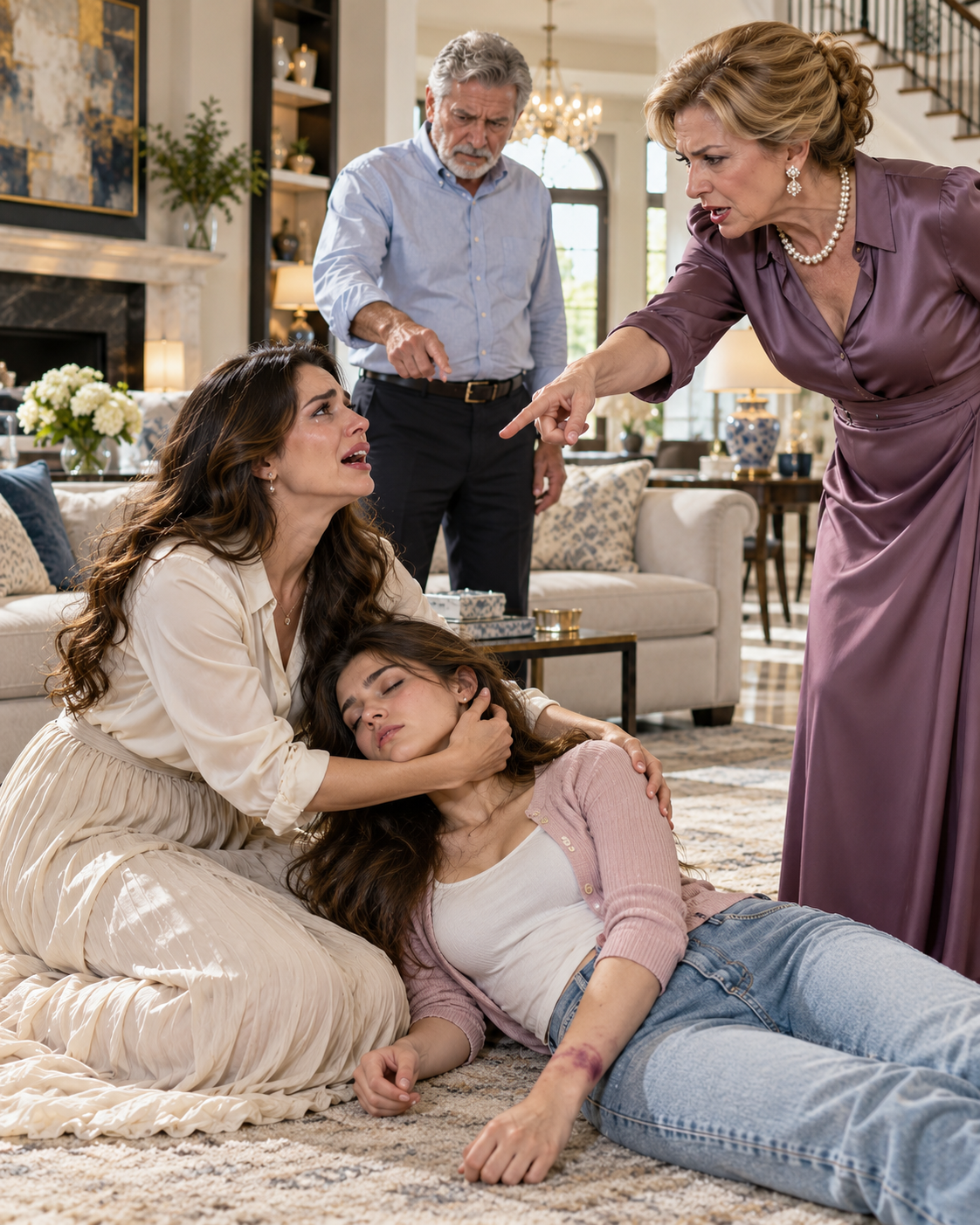

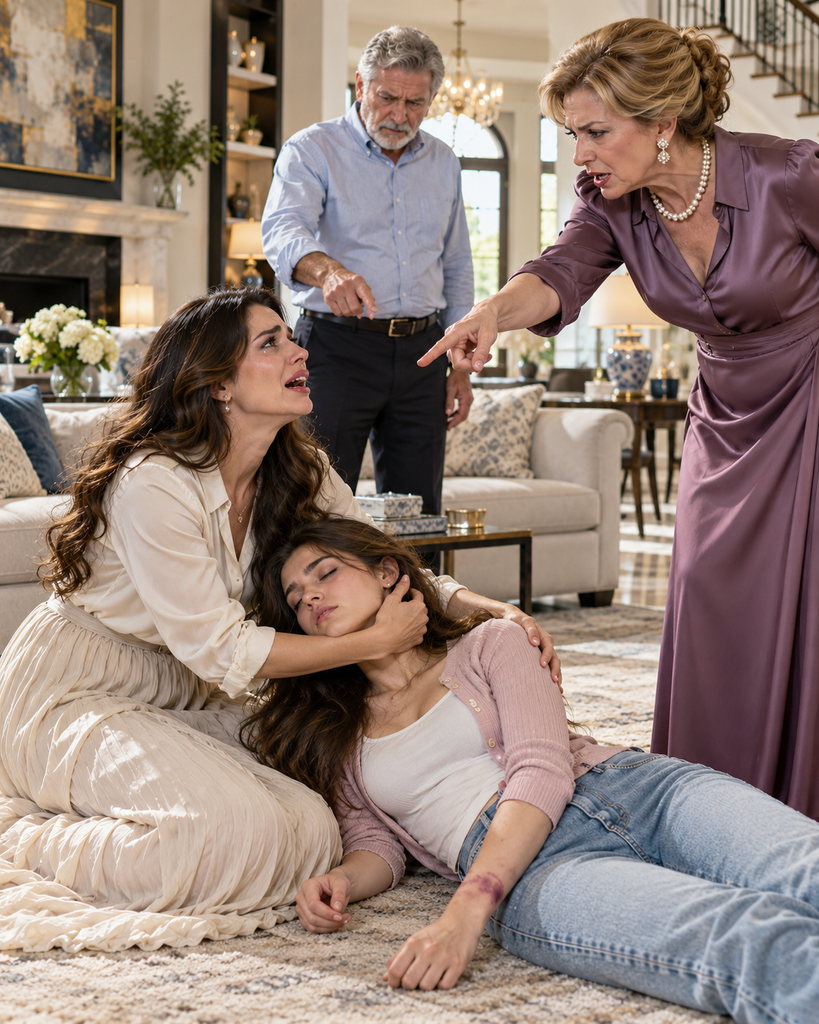
“My granddaughter is not leaving this house, even if you call the cops! What happens under this roof is my decision!” my mother screamed, standing in the doorway to keep me out.
It was 2:30 a.m. I stood on the doorstep of my parents’ home in Scottsdale, completely unaware that moments later, I would discover my fifteen-year-old daughter sprawled across the living room floor, barely responsive, with bruises shaped like fingerprints on both arms.
My name is Rebecca Collins. I’m thirty-nine and raising my daughter, Emily, on my own. For years, I’d trusted my parents more than anyone else to look after her. That night, I learned the devastating difference between loving someone and believing you have the right to control them.
Everything began at 1:57 that morning.
My cellphone buzzed on the nightstand. The instant Emily’s name appeared, I picked up.
“Honey? What’s happened?”
Her breathing was quick and uneven.
“Mom… could you please come pick me up?”
I pushed myself upright.
“Of course, sweetheart. Are you sick?”
“Please, Mom. Just come. I don’t want to be here anymore.”
“Did somebody hurt you?”
Silence followed. I heard footsteps, and then she spoke so quietly I could barely make out her words.
“Grandma doesn’t know I’ve got my phone.”
Cold fear traveled down my spine.
“Emily, listen carefully. I’m on my way.”
“Please don’t tell her I called…”
The connection went dead.
I tried calling her three times. There was no answer.
Next, I called both my parents. Their phones were either turned off or sending me directly to voicemail.
I threw on a pair of pants and a sweatshirt, grabbed my keys, and drove straight to their house.
For the entire forty-minute journey, I tried desperately to persuade myself that this was nothing more than a family disagreement.
My mother, Linda, had always been controlling. In her mind, grown-ups were entitled to inspect children’s backpacks, search their phones, and read their private messages. Whenever Emily protested, Linda accused her of having no manners.
My daughter had told me on several occasions:
“Mom, I hate staying alone with Grandma. She goes through my stuff and doesn’t respect my privacy.”
I’d always explained that Linda was from an older generation and that we should try to be understanding.
Remembering those excuses now fills me with shame.
When I pulled into the driveway, the porch light was glowing. My mother opened the front door before I even knocked.
“Rebecca, you’re causing a ridiculous scene over nothing.”
“Where is Emily?”
“Inside, discovering that throwing tantrums comes with consequences.”
“She called me in tears. I’m taking her home.”
My mother crossed her arms over her chest.
“Absolutely not. Give in to her now, and she’ll never understand discipline.”
My father, Robert, appeared behind her, staring down at the floor.
“Dad, where’s Emily?”
Before answering, he glanced at my mother.
That brief look told me something was seriously wrong.
I stepped forward, but Linda caught my arm.
“While that girl is staying in my home, she obeys my rules.”
I yanked myself free and hurried past her.
“Emily!”
She was lying beside the sofa.
Her face was drained of color. Her eyelids were barely open, and she hardly reacted when I dropped to my knees.
“Baby, look at me. Mommy’s here now.”
Then I spotted the red marks circling her wrists.
“Who did this to my daughter?”
“She was acting hysterical,” Linda answered. “I had to hold her down because she was determined to run away.”
“She was trying to get home to her mother!”
“Oh, stop exaggerating. She passed out after one of her ridiculous tantrums.”
I reached for my phone and began dialing 911.
My mother’s face changed immediately.
“Rebecca, put that phone down.”
“My daughter needs medical help.”
Linda advanced toward me, her face twisted with anger.
“If you make that call, I’ll tell the whole family your daughter assaulted me. And believe me, they’ll take my word over yours.”
I turned toward my father, expecting him to speak up.
He didn’t move.
At that moment, a horrifying realization struck me: Emily had spent the night with adults who considered defending my mother’s power more important than keeping a child safe.
And I hadn’t yet discovered what they’d done to prevent her from reaching me.
PART 2
I called 911, keeping my gaze fixed on Emily.
“My daughter is fifteen. She’s barely responding, and there are injuries on both her arms,” I told the dispatcher, forcing myself to speak clearly.
The woman on the line guided me through what to do until the ambulance arrived.
Behind me, my mother kept shouting.
“Tell them she had a panic attack! Stop pretending somebody attacked her!”
“Mom, shut up,” I said.
In all thirty-nine years of my life, I’d never spoken to her like that.
Nine minutes later, an ambulance arrived alongside a police car. Because I’d explained that I didn’t know exactly how Emily had sustained her injuries, the officers began questioning everyone.
“My granddaughter fell over,” Linda announced with disturbing composure. “She’s an extremely troublesome teenager.”
A paramedic studied the marks on Emily’s arms.
“Was she held or grabbed tightly by someone?”
“I had to restrain her because she wanted to wander outside alone,” my mother replied.
“When exactly did this take place?” an officer asked.
Linda turned toward Robert.
My father started to answer, but she spoke over him.
“It happened so fast.”
At the hospital, a physician assured me that Emily’s condition was stable. She’d experienced an intense anxiety episode, become dehydrated, and lost consciousness. There was no evidence of a serious head injury, but the medical team carefully recorded the injuries on her arms.
By the time I was allowed into her room, she was conscious.
I pulled a chair beside her bed and gently smoothed her hair.
“You’re safe with me now, baby.”
Emily burst into tears.
“Are you angry with me?”
The question shattered my heart.
“Why on earth would I be angry with you?”
“Grandma said I spoiled everything.”
I told her she hadn’t done anything that required an apology, then gave her time to explain the evening in her own words.
The trouble had begun with a text from her friend Hannah. My mother noticed Emily’s screen lighting up and read a message in which she complained about being treated like a little kid by her grandmother.
Linda demanded access to the entire conversation.
Emily said no.
So my mother confiscated her phone.
“I told her I needed to speak with you,” Emily whispered. “She said you didn’t want me interrupting you.”
My throat tightened painfully.
“That isn’t true.”
“I kept begging her to call you. Eventually, I tried to take my phone back and go downstairs to get my backpack.”
“What happened then?”
Emily turned her face away.
“She caught me by one arm. When I tried to get loose, she grabbed the other one. I was yelling that I wanted to leave, but she kept saying I was showing everyone how spoiled I was.”
“Was Grandpa there?”
“Yes. I begged him to help.”
“And what did he say?”
“He told me to quit talking back to Grandma so everyone could go to bed.”
A tear slipped down my face.
Emily went on.
“After Grandma went upstairs, I found my phone in the kitchen and called you. Then I heard her coming back down. I got so scared that suddenly I couldn’t seem to breathe.”
I held her gently against me.
“Calling me was exactly the right thing to do.”
She lifted her eyes toward mine, wearing an expression I’ll remember forever.
“Mom, did you really tell Grandma she could punish me that way?”
My entire body went cold.
“Who told you that?”
“Grandma did. She said you two discussed it and that you agreed I needed to be taught a lesson.”
I shook my head without hesitation.
I’d never given permission for anything remotely like that.
I stepped into the corridor and found my father sitting alone.
“Dad, I want the complete truth about tonight.”
Tears began running down his cheeks.
“Rebecca, your mother went too far.”
“That much is obvious. Why didn’t you contact me?”
“I thought the situation would settle down.”
I stared straight at him.
“After Emily passed out, did either of you call for an ambulance?”
He remained silent.
“Dad. Answer the question.”
At last, he bowed his head.
“No.”
I felt as though the ground had disappeared beneath me.
“Then answer this. How long was my daughter left lying on that floor before I got there?”
My father buried his face in his hands.
And when he finally answered, I learned that my mother had made an even more heartless choice than I could have imagined.
PART 3
“Nearly twelve minutes,” my father admitted, his voice cracking. “Emily lay there for almost twelve minutes before you walked through the door.”
I could only stare at him.
“Twelve whole minutes? And you both just stood there?”
“I wanted to call an ambulance, but your mother insisted it wasn’t needed. She believed Emily was faking it to get her way.”
Anger and terror surged through me.
“And you actually believed that?”
My father broke down.
“I went to check on her. She was breathing, but I could barely get a response. I brought some water and tried to rouse her. Linda kept telling me to leave her alone.”
“She was unconscious, Dad!”
“I know. I understand that now.”
“No. You understood it then. You knew something was terribly wrong, and you still chose not to challenge Mom.”
He had nothing to say.
Growing up, I’d always considered Robert the gentle parent. He never raised his voice or pounded the table. Whenever my mother became angry, he advised everyone to agree with her until her temper passed.
For years, I’d confused his unwillingness to act with being kind.
Now I could see that refusing to intervene could be just as damaging.
“There’s another thing,” he said quietly.
I turned toward him.
“What is it?”
“Emily asked me to call you before the argument became really bad. I already had my phone out.”
“And then?”
“Your mother snatched it from me. She said if we contacted you, you’d rush over, and Emily would never learn to respect our authority.”
I pressed my hand against my mouth.
This wasn’t simply an angry woman losing her temper. My mother had consciously prevented my child from contacting her own parent.
Then she’d tried to make Emily believe I supported what she was doing.
“Why would she tell Emily I’d agreed to that punishment?”
My father stared at his shoes.
“Because she knew Emily would keep asking for you if she believed you’d take her side.”
That confession wounded me more deeply than any cruel words ever had.
My mother had exploited my daughter’s faith in me to make her submit.
“Dad, you need to tell the investigators everything you’ve just told me.”
“Rebecca, your mother could face serious consequences.”
“Emily is already suffering consequences for something she didn’t do. Why is protecting Mom from the results of her behavior always more important to you than protecting the people she hurts?”
For once, he couldn’t come up with an excuse.
I went back into Emily’s hospital room.
She was awake, gazing out the window.
“Did you speak to Grandpa?” she asked.
“I did.”
“Is he upset with me?”
I settled into the chair beside her.
“Honey, it isn’t your job to manage grown-ups’ emotions. We’re supposed to take care of those things ourselves.”
Emily considered my words.
“I never wanted things to turn out like this. I only wanted to come home.”
I held her hand.
“And you had every right to ask.”
In the days that followed, our schedule became crowded with medical visits, interviews, and countless phone calls.
A social worker at the hospital met privately with Emily. Officials also began the necessary procedures to record the incident and decide what protections she might need.
There was no instant judgment from a court and no magical answer that made everything better.
But something happened that my mother had never tolerated in our household: people listened to Emily without Linda cutting her off, correcting her story, or dismissing what she said.
The injuries on her arms were documented, along with our accounts of what had occurred.
Eventually, my father gave investigators his own statement about what he’d witnessed.
Once we got home, Emily slept for nearly eleven uninterrupted hours.
I remained in the living room, looking toward her closed bedroom door.
Memories of conversations I’d brushed aside began returning to me.
Several months earlier, Emily had complained that her grandmother went through her school notebooks.
“She says I shouldn’t care if I’ve got nothing to hide,” she’d told me.
My response had been:
“You know what Grandma’s like. Just don’t give her a reason to start an argument.”
I remembered another family dinner when Linda had opened Emily’s backpack without permission. When Emily objected, my mother declared loudly:
“Adults and children don’t keep secrets from each other in this family.”
Not one person disagreed.
I hadn’t, either.
Then memories of my own teenage years resurfaced.
My mother used to rummage through my drawers, read notes from my friends, and act suspicious whenever I closed my bedroom door.
If I complained, my father would tell me:
“Do what your mother says. It’s easier than fighting with her.”
I’d been raised to think that peace could only be maintained through surrender.
And without noticing, I’d passed that same lesson on to Emily.
I spent that night crying for my daughter and for the little girl I used to be.
Three days later, Emily found me holding an old photograph.
It showed six-year-old me sitting on Linda’s lap. We were laughing together while making Christmas cookies.
“You don’t have to get rid of it,” Emily said softly.
“Does looking at it upset you?”
She slowly shook her head.
“I’m not sure. Sometimes I really miss Grandma.”
Her words hurt, but I didn’t tell her she was wrong.
“You’re allowed to miss her.”
“Even though she did that to me?”
“Yes. Loving someone doesn’t mean you have to pretend they haven’t hurt you.”
Emily sat down next to me.
“So am I supposed to forgive her?”
“No. Nobody is entitled to your forgiveness. You especially don’t owe it to someone just so everyone else can feel better.”
Her eyes became wet.
“I was scared that telling the truth would make you stop talking to Grandma forever. And then it would all be because of me.”
I pulled her into my arms.
“Listen to me carefully. None of this happened because you told the truth or because you called me. The adults involved are responsible for the choices they made.”
That night, my cellphone rang.
Linda’s name appeared on the screen.
I answered because I still carried a tiny hope that she’d finally admit what she’d done.
“Rebecca, you’ve taken this far enough,” she began without saying hello. “It’s been three days since we’ve spoken. Is this really how you repay your mother for everything she’s done?”
“Emily is still recovering.”
“Well, I’m hurting, too. Does that matter to you at all?”
“Would you like to hear how your granddaughter is feeling?”
She hesitated.
“I imagine you’d have told me if anything serious was wrong.”
I shut my eyes.
“Mom, you held Emily so tightly that you injured her. You wouldn’t allow her to contact me, and afterward you tried to cover it up.”
“Because she was completely uncontrollable!”
“All she wanted was to come home.”
“You can’t allow a fifteen-year-old to dictate what the entire family does!”
“This has nothing to do with letting her control the family. She has the right to ask her mother for help.”
My mother gave an impatient sigh.
“Fine. I’m sorry she got hurt. Is that what you wanted to hear?”
“Are you sorry for grabbing her?”
“I was keeping her from doing something foolish.”
“Are you sorry for telling her I agreed with your punishment?”
“I knew you’d come here and make me look like I had no authority.”
That admission supported everything my father had said.
Linda hadn’t ignored my wishes because she misunderstood them. She’d deliberately acted against them because she knew exactly what I’d do.
“Then you still don’t understand why this was wrong,” I said.
“You brought the police into your own mother’s house!”
“I requested emergency medical care for my child.”
“You’re tearing this family apart.”
“No, Mom. What happened that night damaged this family. Acting as though it never happened won’t make that damage disappear.”
I ended the call before she could start shouting again.
My fingers were trembling.
Drawing boundaries didn’t leave me feeling powerful or fearless. I felt frightened, guilty, and overwhelmingly sad.
But this time, I understood that painful emotions didn’t automatically mean I’d made the wrong decision.
A week later, other relatives started contacting me.
My aunt Diane insisted that private family disputes should remain inside the family.
One cousin told me Linda was absolutely heartbroken.
Another reminded me that my parents had watched Emily without charging me whenever I needed to work.
All of that was true.
Linda had cooked breakfast for Emily, cared for her through illnesses, and shown up for every school performance.
When Emily was small, she’d purchased medicine for her. She’d even helped me pay bills during a particularly difficult stretch.
Those were real acts of generosity.
But they didn’t cancel out what she’d done.
One evening, while Emily and I were eating grilled cheese sandwiches, she noticed my phone lighting up repeatedly.
“People are blaming you, too, aren’t they?”
“Some of them are angry.”
“What if we told everyone it was just an accident?” she asked, looking miserable. “Maybe everything could go back to normal.”
I put down my sandwich.
“Would you feel okay with that?”
Emily didn’t answer immediately.
Then she shook her head.
“Then we’re not going to make you stay silent just to keep everyone else comfortable.”
Tears began spilling down her face.
“I don’t want to lose Grandma and Grandpa.”
“I understand, honey. I’ll never tell you that you have to stop loving them. But I won’t let anyone hurt you again just so we can pretend we’re one big happy family.”
Two weeks later, my father asked whether he could come visit.
I discussed it with Emily before giving him an answer.
“Grandpa would like to see us. You don’t have to agree.”
She thought about it for several minutes.
“I want to see him. But I want you there.”
Robert came over that Saturday afternoon.
For once, he didn’t bring his usual box of doughnuts, and he didn’t pretend everything was perfectly normal.
He took a seat facing Emily.
“I owe you an apology, sweetheart.”
She watched him silently.
“You asked me to contact your mother. I heard you, and I chose not to. When your grandmother grabbed you, I should have stopped her. And when you lost consciousness, I should have called an ambulance right away.”
His voice shook.
“I didn’t do those things because I was afraid of confronting Linda.”
Emily raised her head.
“Are you scared of her all the time?”
My father paused before responding.
“For a very long time, I’ve allowed things I knew were wrong because I didn’t want to start a fight.”
“Did you do that when Mom was a kid, too?”
Robert looked toward me.
“Yes.”
Emily drew a slow breath.
“I’m not sure I’m ready to forgive you.”
“You don’t need to forgive me now. You don’t have to tell me everything’s fine, either.”
He didn’t reach for a hug or demand that she trust him again.
Twenty minutes later, he went home.
That conversation didn’t erase the harm, but it represented a meaningful change. Someone from my parents’ house had finally admitted his mistakes without suggesting Emily was responsible.
My mother, on the other hand, continued sending photographs from years ago.
There were pictures of family vacations, birthday parties, and afternoons spent baking together.
Beneath one collection, she’d written:
“We’ve shared too much love to throw away all those years.”
I studied the message.
Nobody was demanding that she erase the love we’d shared.
We were asking her to accept a boundary.
A month after everything happened, Linda requested a meeting.
I agreed to see her in a café during daylight hours, without Emily.
She was already sitting near the window when I arrived.
She looked unusually exhausted.
For a moment, I felt an urge to embrace her.
After all, she was still my mother. She’d nursed me through chickenpox, cried with pride at my graduation, and held Emily in her arms shortly after she was born.
Those memories made the situation infinitely more painful.
I took the seat opposite her.
“I miss my granddaughter,” she said at once.
“I understand.”
“Then we’ve dragged this out long enough. It’s time to become a family again.”
“What exactly do you have in mind?”
Linda straightened her coffee cup.
“Bring Emily over Sunday. I’ll cook her favorite dinner. We’ll sit down together, just the three of us. I’ll apologize for letting the situation get out of hand, she’ll apologize for speaking disrespectfully to me, and then we can move forward.”
I allowed her to finish.
Then I said:
“No.”
My mother looked up sharply.
“Excuse me?”
“Emily has nothing to apologize for when it comes to wanting to contact me.”
“She screamed at me in my own home!”
“Because you refused to let her leave or call her mother.”
“So teenagers should be allowed to do absolutely anything they please?”
“No, Mom. But the rules you establish in your home don’t give you permission to stop my child from reaching me.”
Linda tapped the tabletop angrily.
“You always try to make me sound like some awful person.”
“This conversation isn’t about labeling you good or bad. It’s about taking responsibility for your actions.”
Tears gathered in her eyes.
“I gave up everything for this family.”
“And there are many things you’ve done that I truly appreciate. But helping someone doesn’t mean you get complete control over their life.”
She turned her face away.
“I was afraid she’d go wandering around outside by herself at that hour.”
“Then you should have phoned me.”
“You would’ve come rushing over.”
“Absolutely.”
“And you would’ve taken her away whether I approved or not.”
Suddenly, the last piece of the puzzle fell into place.
“That’s right, Mom. You knew I’d come for her. That’s exactly why you wouldn’t allow her to contact me.”
Linda offered no response.
Her silence told me everything.
I inhaled slowly.
“From this point forward, Emily won’t be staying overnight at your house or visiting without supervision. She’ll decide when she feels ready to see you again. Any future contact must respect her wishes and keep her safe.”
“You’re punishing me!”
“I’m keeping my daughter safe.”
“How long is this supposed to last?”
“I can’t give you a deadline. It depends on Emily’s needs and whether you’re willing to honestly acknowledge what you did.”
My mother started sobbing.
“I gave you everything, Rebecca.”
“You gave me a great deal, Mom. But I can’t sacrifice my daughter’s sense of security just to spare you from feeling sad.”
I rose from my chair.
Linda looked at me with grief and bitterness in equal measure.
“You’re choosing that child instead of your own mother.”
In the past, that accusation would have crushed me.
This time, my answer came easily.
“She’s my daughter, Mom. You never should have made it a contest.”
I walked out of the café with tears running down my face.
I didn’t turn back.
The months that followed weren’t easy.
Emily began working with a counselor. Some appointments left her emotionally drained, while others helped her recognize that her grandparents’ behavior wasn’t her responsibility.
We also started changing the way we treated each other at home.
If Emily shut her bedroom door, I knocked before entering.
If she preferred to keep a conversation with her friends private, I didn’t demand to hear it.
I came to understand that being a protective mother doesn’t require access to every thought inside my daughter’s head.
My father eventually began visiting from time to time. He always asked permission beforehand and respected Emily’s decision whenever she wasn’t ready to see him.
He stopped defending Linda’s behavior and never tried to carry secret messages between them.
Little by little, we began rebuilding our relationship with him.
My mother stayed outside our everyday lives. She remained part of our family’s past, but she no longer had the power to place her wishes above our safety.
Three months later, a birthday card from Linda arrived for Emily.
There were no demands or attempts to make her feel guilty.
It contained only a short message:
“I love you so much. I hope you’re doing well.”
Emily read the card twice.
“Mom, am I supposed to write back?”
“No, sweetheart.”
“What if I decide I want to later?”
“Then you can, whenever you feel ready.”
She tucked the card into a drawer.
“I’m not ready yet.”
“That’s perfectly fine.”
Those few simple words meant more than they appeared to.
Emily was beginning to understand that she could make choices without feeling responsible for everybody else’s happiness.
Several more months went by.
One Thursday evening, neither of us wanted to cook, so we ordered pizza.
We settled into the living room to watch a silly television competition.
One contestant did something so ridiculous that Emily burst into laughter and almost knocked her water onto the couch.
“Hey, watch it!” I laughed. “If that cushion gets stained, you’re helping me clean it.”
“That’s child exploitation, lady,” she teased, flashing a mischievous grin.
I tossed a napkin toward her.
She tossed it right back.
Then something small caught my attention, and I fell quiet.
Emily’s cellphone was plugged into a charger on a side table across the room.
For weeks after that terrible night, she’d carried it absolutely everywhere. Into the bathroom, into the kitchen, even when she only went outside for a moment.
At bedtime, she tucked it beneath her pillow.
She never explained the habit, but I knew what it meant.
That phone had become her lifeline, the one way she could reach someone when the adults around her refused to listen.
But that evening, when she got up to take our dishes into the kitchen, she left it charging.
She didn’t even look toward it.
My eyes began to sting.
Not because the memory of what happened had vanished.
But because, for the first time in months, she seemed able to relax without worrying that she’d need help and have no way to ask for it.
Emily returned carrying two fresh glasses of water.
“What’s the matter, Mom? Why are you staring at me?”
I smiled.
“Nothing, honey. I’m just really happy we’re spending time together.”
“Oh, Mom. You’re such a softie.”
She flopped down beside me and rested her head against my shoulder.
We went back to watching television.
Her phone stayed on the little table, charging quietly across the room.
I didn’t mention it. I didn’t want that tiny moment to become another expectation she had to meet or a sign she was supposed to be completely healed.
I simply appreciated being there with her.
For most of my life, I’d believed a good daughter was someone willing to sacrifice anything rather than disappoint her parents.
Later, I’d convinced myself that being a good mother meant holding the entire family together, regardless of the cost.
Now I knew both beliefs were wrong.
Love should never require someone to remain quiet about mistreatment.
Being thankful should never mean obeying without question.
And no child should be forced to choose between personal safety and the affection of their relatives.
I still love my mother. I haven’t forgotten the wonderful memories we made. Perhaps one day she’ll genuinely accept responsibility for her actions, and we’ll find a healthier way to have a relationship.
But I will never again teach Emily that sharing someone’s blood means she must tolerate being hurt by them.
On that awful morning, when my daughter called me in tears, she’d asked for one simple thing:
“Mom, please come get me.”
Months later, watching her drift peacefully to sleep beside me on the couch, I finally understood what promise mattered most.
I couldn’t promise that no one would ever hurt her again.
No parent can guarantee that.
What I could promise was to listen when she spoke, believe her when she needed me, honor her boundaries, and stand beside her when she needed protection, even if doing so meant challenging the very people I’d spent my childhood learning to obey.
A family isn’t genuinely safe simply because nobody dares to speak about what’s wrong.
It’s safe when even its youngest member knows they can tell the truth, ask for help, and say they want to go home.
And that evening, for the first time in a long while, Emily didn’t need her phone close enough to grab at a moment’s notice.
She already felt safe.
She was home.