
My name is Allison Parker, and I was 28 when I finally refused to laugh at a joke my parents had been telling about me for 21 years.
The first time I heard it, I was only 7.
Our family was gathered for a cookout in San Antonio, Texas. Dad was tending the barbecue, my older brother Brandon was proudly showing everyone his baseball trophy, and my little sister Chloe was running around the backyard chasing soap bubbles. I sat on the patio, using blue sidewalk chalk to draw a horse.
Dad glanced at my drawing and announced to everyone:
“Not one person in this family can draw a decent straight line. Sometimes I wonder if the hospital accidentally gave us somebody else’s daughter.”
Everyone burst out laughing.
Mom noticed the blue chalk covering my fingers and added:
“Considering how much she loves drawing, I wouldn’t be surprised. Too bad the return window closed years ago.”
Another wave of laughter followed.
I laughed along with them.
At 7, I didn’t understand that a child could teach herself to laugh at the exact moment her feelings were being hurt.
As the years passed, that joke became a regular family tradition. It came up at Christmas celebrations, birthday parties, gatherings with Dad’s business associates, and dinners with neighbors. Eventually, I sometimes repeated it myself before anyone else could.
Dad would give my shoulder a friendly pat.
“See? Allison can actually take a joke.”
For years, I believed laughing along meant I belonged.
But there were other things our family never openly acknowledged.
When I was 15, I discovered a cardboard box in the garage filled with drawings I’d made in elementary school, homemade greeting cards, and little watercolor paintings. Everything had been shoved underneath a pile of old blankets.
Meanwhile, the upstairs hallway was decorated with framed photographs of Brandon’s athletic achievements and Chloe’s competition medals.
When Brandon announced he wanted to major in business, Dad personally helped him research colleges.
Whenever Chloe needed new uniforms, money for travel, or fees for her tournaments, my parents somehow always found the funds.
But when an art school accepted me, Dad barely finished reading the letter before saying:
“I’m not paying a fortune just so you can pretend a hobby is a real profession.”
I enrolled anyway.
By the time I turned 28, I was painting murals throughout San Antonio and neighboring cities, creating illustrations for children’s books, and renting a spacious art studio with huge windows where I worked from early morning. I had regular clients, commissions scheduled months ahead, and occasionally people recognized my artwork before they even knew who I was.
I’d created a life that made me genuinely proud.
My family simply wasn’t interested in witnessing it.
The most painful example came when I organized my first major gallery exhibition.
I personally handed invitations to Mom, Dad, Brandon, and Chloe.
At 8:30 on opening night, a text from Mom appeared on my phone.
“Sorry, honey. Chloe has a game tonight, so we all came to support her. Send us some pictures!”
Chloe was 25 years old and played in a casual recreational league.
I was standing beside a painting that had taken me 6 weeks to complete.
I typed back:
“Sure.”
The only relative who attended was my aunt Patricia, Dad’s older sister. Wearing her familiar turquoise earrings, she took her time examining every piece in the gallery before purchasing the smallest painting.
As she prepared to leave, she told me:
“Never let other people’s decision to show up or stay away determine how much you’re worth.”
Several months later, during Christmas, Mom announced that she and Dad were planning a celebration for their 30th wedding anniversary, with more than 100 guests invited.
Brandon would oversee the finances.
Chloe would coordinate the evening’s activities.
My responsibilities were to create the invitations, assemble a family tribute video, and paint a large portrait as their anniversary gift.
I said yes.
Some part of me still believed that if I created something beautiful enough, I could finally earn my place in that family.
One afternoon, I stopped at my parents’ house to collect old family pictures and came across something that made me freeze.
It was a professionally taken family portrait.
Mom and Dad stood in elegant clothes, with Brandon on one side and Chloe on the other.
Even their dog, Max, had been included.
But I wasn’t anywhere in the photograph.
I flipped it over, hoping to find a date or some explanation.
There was nothing.
The following morning, I visited Dad’s office.
The same photograph hung prominently in the reception area, inside an expensive-looking frame, carefully illuminated so every visitor could admire it.
I photographed it with my phone.
That evening, I called Mom.
I made one simple request.
“Please don’t let Dad repeat that hospital joke at the anniversary party.”
She let out a tired sigh.
“Allison, you know your father isn’t trying to hurt you.”
“I’m not asking you to explain what he intends. I’m telling you how it feels to me.”
“You’re turning a harmless joke into something much bigger than it is.”
A few hours later, Dad called me himself.
He insisted the hospital joke had become a beloved part of our family’s history.
“Then maybe it’s time to rewrite that history,” I answered. “Because I’m done hearing it.”
He didn’t speak for several moments.
Then he abruptly started talking about something else.
At our final planning meeting, I picked up a copy of the printed anniversary program.
Brandon and Chloe were both scheduled to give speeches, along with 2 longtime friends of my parents.
Beside my name, there were only 2 words:
“Art Presentation.”
Dad pointed to that section and laughed loudly.
“Just make sure you don’t paint yourself right in the middle of everything, okay? Remember, it’s our anniversary.”
Mom laughed.
Brandon joined in.
I carefully folded the paper.
“Don’t worry,” I replied. “The finished picture will show exactly what it’s supposed to show.”
That evening, I went back to my studio.
I stood staring at the cheerful family portrait I’d been working on for weeks.
Then I removed it from the easel.
I took out clean drawing paper.
And I began again.
This time, I sketched a dining table bathed in warm light, with 4 people gathered comfortably around it and a pitch-black window behind them.
Against the dark glass, I drew the faint outline of a woman watching from outside.
That woman was me.
PART 2
The banquet hall was crowded on the evening of my parents’ anniversary celebration.
Candles glowed across the tables, elegant arrangements of white flowers decorated the room, and more than 100 guests had arrived, including relatives, neighbors, employees, and longtime family friends.
My painting, more than three feet tall, stood beside the stage concealed beneath a white covering.
Not one person had bothered to ask what I’d painted.
The speeches got underway.
Brandon talked about the lessons Dad had taught him throughout his life.
Chloe entertained the guests with memories of family vacations.
Then Michael, Dad’s closest friend, handed him the microphone.
“Richard, why don’t you tell everyone about your 3 wonderful children?”
My stomach twisted.
Dad grinned.
“Well, Susan and I have been happily married for 30 years, and we’ve raised 3 children. Although we’re still trying to figure out where one of them came from.”
Laughter began spreading across the room.
Dad pointed directly at me.
“Seriously, have you ever met a Parker who makes a living painting pictures? I’m convinced the hospital sent us home with the wrong baby.”
Mom reached for the microphone.
“And by the time we figured it out, the warranty had already run out!”
More than 100 people erupted in laughter.
My mother knew I’d begged her not to let this happen.
My father knew as well.
Yet they were standing there, enjoying another round of laughter at my expense.
I could feel my lips beginning to form the familiar smile I’d trained myself to wear since childhood.
This time, I stopped it.
Michael checked the program.
“And now Allison has prepared a very special anniversary gift for her parents.”
I stepped onto the stage.
Mom immediately lifted her phone to record.
I took the microphone.
“For nearly my entire life, my parents have joked that I probably don’t belong to them.”
A few guests chuckled, expecting me to continue the family tradition.
I looked around the room.
“So tonight, I thought I’d give them a taste of their own medicine.”
The laughter faded.
I explained that Mom could recall practically every game Chloe had ever played, yet she’d never once visited my art studio.
I told them that Dad remembered the exact date Brandon received his first promotion but couldn’t identify a single painting from the biggest exhibition of my career.
Then I raised my phone.
“A few months ago, I discovered that my family had arranged a professional portrait session.”
I turned toward my parents.
“Everyone was included. Even the family dog.”
Mom stopped smiling.
“Everyone except me.”
The room remained silent.
I walked toward the cord attached to the white covering.
“The real problem was never simply the joke. It was realizing what my family did when nobody was trying to be funny.”
I pulled the cord.
The covering dropped to the floor.
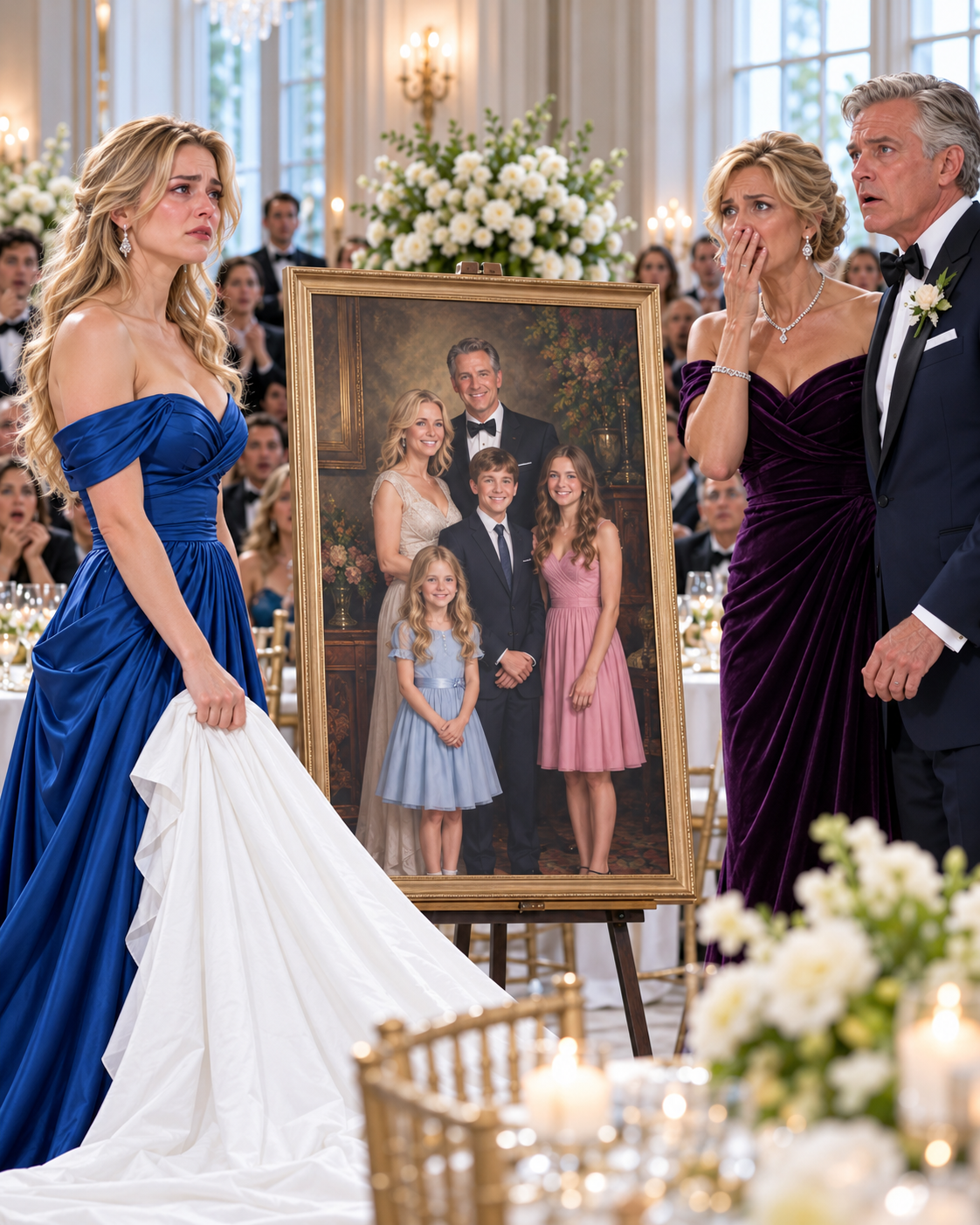
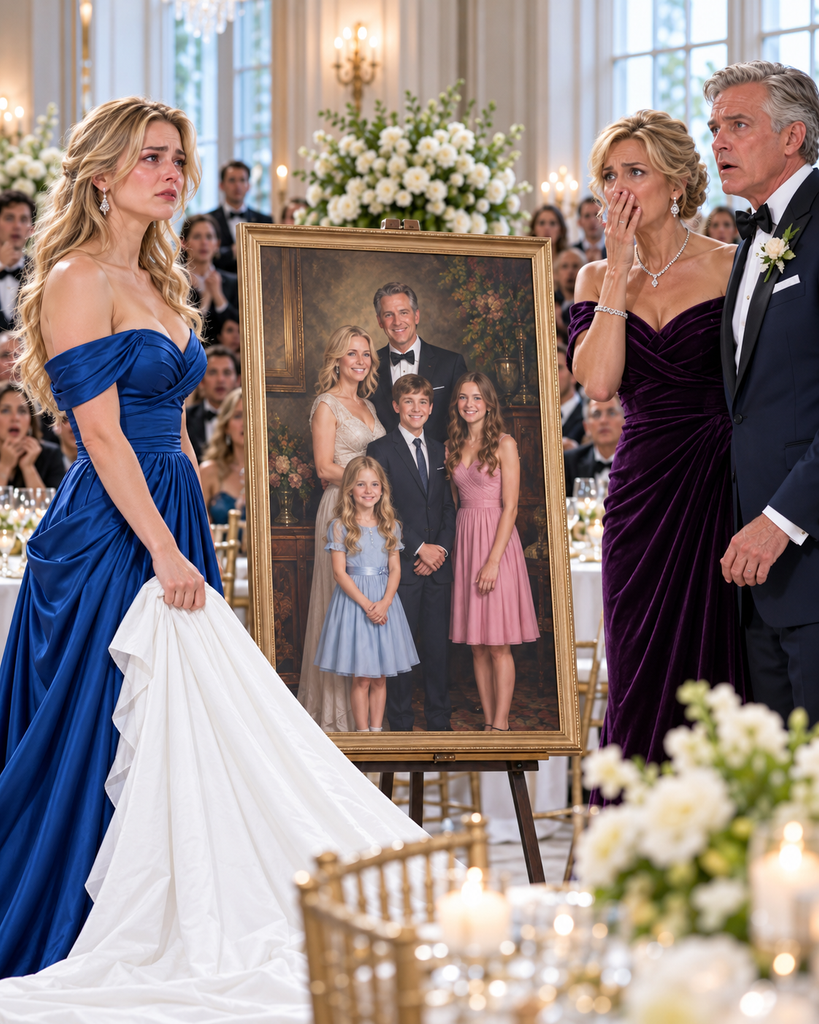
The painting revealed a family enjoying dinner beneath a warm golden light. Dad was speaking, Mom was smiling, and Brandon and Chloe sat comfortably beside them.
Beyond the table, through a dark window, a small female figure stood outside, watching.
A plaque beneath the painting read:
“The Parkers at Home. The Artist Outside the Frame.”
For 21 years, I’d heard entire rooms erupt in laughter because of me.
But that evening, something entirely different happened.
Complete silence.
Dad jumped to his feet so suddenly that his chair scraped loudly against the floor.
“Oh, come on, Allison. It was just a joke!”
He forced a little laugh, clearly expecting others to follow.
Nobody did.
Then Aunt Patricia spoke from a table near the front.
“Enough, Richard.”
My father stopped moving.
I returned the microphone to its stand.
“You wanted an honest painting of our family,” I said. “This is the only version I could create without pretending.”
Then I stepped off the stage before anyone had the opportunity to make me the punch line again.
PART 3
By the time I reached the parking lot, my hands were trembling uncontrollably.
Ethan, my boyfriend, was waiting beside his pickup truck.
He didn’t ask whether I’d spoiled the celebration.
He didn’t ask whether my parents were angry.
He simply opened the passenger door and helped me inside.
We remained parked for several minutes without turning on the engine.
“I think I just ruined their entire anniversary,” I whispered.
Ethan rested his hands on the steering wheel.
“I think you finally said what you’ve been trying to tell them for years.”
He didn’t promise that everything would work out.
I appreciated that more than he knew.
Because nothing felt okay.
For nearly 2 months afterward, my parents barely communicated with me.
Dad didn’t contact me at all.
Mom sent one brief message to say some mail had been delivered to their house.
Our family group chat carried on as usual, full of dinner photographs and everyday conversations, but nobody brought up the anniversary party.
Then Brandon called.
I was cleaning my paintbrushes at the sink.
He skipped the greeting entirely.
“Do you have any idea how much you embarrassed Mom and Dad?”
“Yes.”
“You planned to humiliate them.”
I watched the dirty paint water disappear down the drain.
“Yes, Brandon. I deliberately painted that picture. And I deliberately said everything I said.”
He accused me of turning a private family disagreement into a public performance.
“They’ve been making that joke publicly for 21 years,” I answered. “At birthdays, Christmas parties, neighborhood gatherings, and even at an awards ceremony where I was being honored. I asked them for one thing: not to do it that night.”
Brandon argued:
“You should have handled it privately.”
“I tried.”
He knew I’d tried.
Every one of them knew.
“I’m not apologizing for a situation I didn’t create,” I told him. “The people in that painting are standing exactly where our family has always placed them.”
He ended the call.
And that hurt more than I expected.
Brandon was the brother who’d taught me to ride a bicycle. We’d shared candy, whispered secrets, and looked after each other when we were little. Learning that someone can care about you in small, familiar ways while overlooking a wound you’ve carried for years is a peculiar kind of heartbreak.
3 weeks later, Chloe appeared at my studio.
It was her first visit.
She studied the canvases leaning against the walls, the children’s book illustrations, and the sketches for upcoming murals as though she were discovering the life of someone she’d never met.
After some time, she took out her phone.
“I’ve been looking through our old family pictures.”
She showed me photographs from birthdays, vacations, holiday dinners, and the portrait displayed at Dad’s office.
“I never noticed you weren’t there.”
Tears gathered in her eyes.
“And that’s what makes it so awful, Allison. It always seemed perfectly normal.”
She made no excuses.
That made it possible for me to hear her.
The next week, she returned with coffee.
Then she came back again.
Little by little, we started discovering who we were as sisters beyond the roles our family had assigned us.
Not long afterward, Mom sent me a text.
“Would you consider coming to family counseling with me?”
I called her instead of texting back.
“Yes. But I need you to understand something first. The hospital joke is finished. Not just when I’m present. I don’t want it repeated at all.”
She paused.
“All right, Allison.”
“And if anyone starts it again, I’ll leave. I won’t debate whether they meant to hurt me. I’ll simply walk away.”
“I understand.”
For the first time, I wondered whether she truly did.
Dad refused to attend the first several counseling appointments.
Mom came by herself.
During one session, the therapist asked her to explain how she remembered the hospital joke.
Mom described it as an old family tradition.
“Allison always laughed with us,” she said.
I turned toward her.
“Because when everyone was laughing at me, laughing along was the quickest way to get them to stop staring.”
Mom fell silent.
At another appointment, we discussed the night of my gallery exhibition.
She started explaining that Chloe’s game had mattered too, but halfway through, she stopped.
“I never asked you how important that night was.”
She reached for a tissue.
“I should have come.”
She didn’t offer any excuses afterward.
Those were her only words.
And they meant more than any carefully rehearsed apology ever could.
A month later, Dad finally agreed to attend a session.
He sat in his chair, staring down at the carpet.
His first complaint was that my anniversary painting had been a deliberate ambush.
“I asked you twice not to tell that joke,” I reminded him.
The therapist asked why he’d disregarded my request.
Dad sat quietly for a long time.
Eventually, he admitted:
“I don’t know how to have a conversation with Allison without making jokes.”
The therapist regarded him calmly.
“Then you need to learn to be comfortable with silence.”
Several seconds passed without anyone speaking.
And for once, my father didn’t try to rescue himself from the discomfort with another joke.
I thought about something Aunt Patricia had told me before the anniversary celebration.
As a teenager, Dad had loved to draw.
But when his own father discovered his sketchbooks, he’d ridiculed them in front of the whole family.
Not long afterward, Dad stopped drawing altogether.
For the first time, I could see where some of his behavior might have originated.
But recognizing the source of someone’s hurt doesn’t mean allowing them to pass that hurt on to you.
The changes that came afterward weren’t dramatic.
That was what made them believable.
One Sunday, during lunch, Dad started saying:
“You know, sometimes I still wonder about that hospital…”
I set my fork on the table.
He stopped himself.
Then he took a breath.
“I’m sorry. I shouldn’t have gone there.”
And we went back to eating.
Nobody cried.
Nobody embraced in some grand, cinematic moment.
It was simply a person choosing to stop before hurting someone again.
I also began spending less time at my parents’ house, and whenever I visited, I drove my own car.
Loving my family no longer meant surrendering my right to be treated with respect.
Almost a year after the anniversary celebration, San Antonio officially unveiled one of the biggest murals I’d ever created.
I’d spent weeks working high above the ground on scaffolding, blending colors as the changing daylight moved across the wall.
It was exactly the kind of opportunity the little 7-year-old girl drawing horses with blue chalk had once imagined.
I invited my family to the unveiling.
But this time, I didn’t spend the day wondering whether they’d come.
Ethan stood beside me.
Aunt Patricia arrived early.
And shortly before the ceremony began, I spotted Mom among the crowd.
Chloe was beside her.
Then I saw Brandon.
And finally, Dad.
They didn’t arrive with any grand gestures.
They simply joined the other visitors and stood quietly admiring the mural.
After the speeches ended, Dad remained in front of the artwork for several minutes.
I approached him.
For an instant, I expected him to repeat that familiar line about nobody in our family being able to draw.
But he surprised me.
He pointed to a section of the mural where sunlight appeared to filter through painted leaves.
“How did you make it look like actual sunlight is coming through there?”
I almost couldn’t believe what I’d heard.
I explained how I’d built up the layers of paint, used cooler tones for the shadows, and added warmer shades to create the illusion of light.
Dad listened attentively.
When I finished, he studied the wall again.
“I had no idea there was so much planning involved in making something like this.”
I could have reminded him that he’d had my entire life to ask about my work.
But I chose not to.
Instead, we kept discussing the mural.
A little later, someone offered to take a family photograph.
Without thinking, I stepped away to let my parents pose with Brandon and Chloe.
It was an old habit.
Almost as automatic as the smile I’d once put on whenever the hospital joke began.
Chloe gently took hold of my wrist.
“No.”
I looked at her.
“You’re going to be in this picture.”
Mom shifted to make room.
Dad moved over too.
For a moment, I hesitated.
Then I stepped into place.
The photographer lifted the camera.
That photograph couldn’t erase 21 years of hurt.
And it certainly didn’t mean my family had suddenly become perfect.
Dad still occasionally said insensitive things. Mom sometimes tried to defend herself before truly listening. Brandon never gave me a genuine apology for that phone call. And I still caught myself wanting to laugh whenever a conversation became uncomfortable.
But when I saw the photograph afterward, I noticed something I’d never experienced before.
There wasn’t an empty space where I should have been.
For most of my life, I’d believed that if I stayed patient, made myself useful, and became easy enough to love, my family would eventually find room for me.
I had been wrong.
Our family didn’t begin changing because I’d finally discovered how to deserve a place among them.
It began changing when I realized that place should never have been something I had to earn.
My painting didn’t miraculously repair every broken part of our family.
It simply made everyone stop laughing long enough, for the first time in 21 years, to finally notice the daughter they’d left outside the picture.