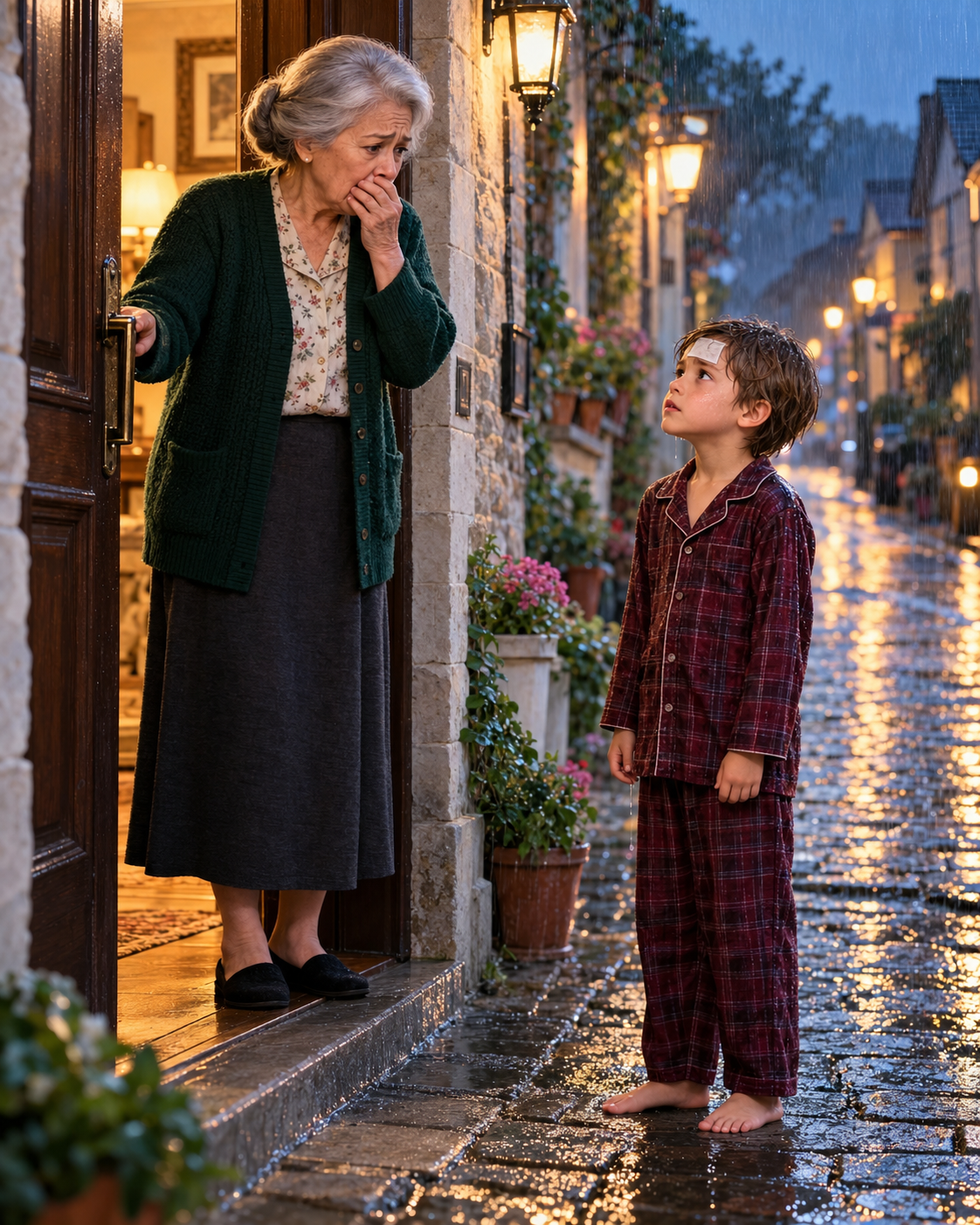

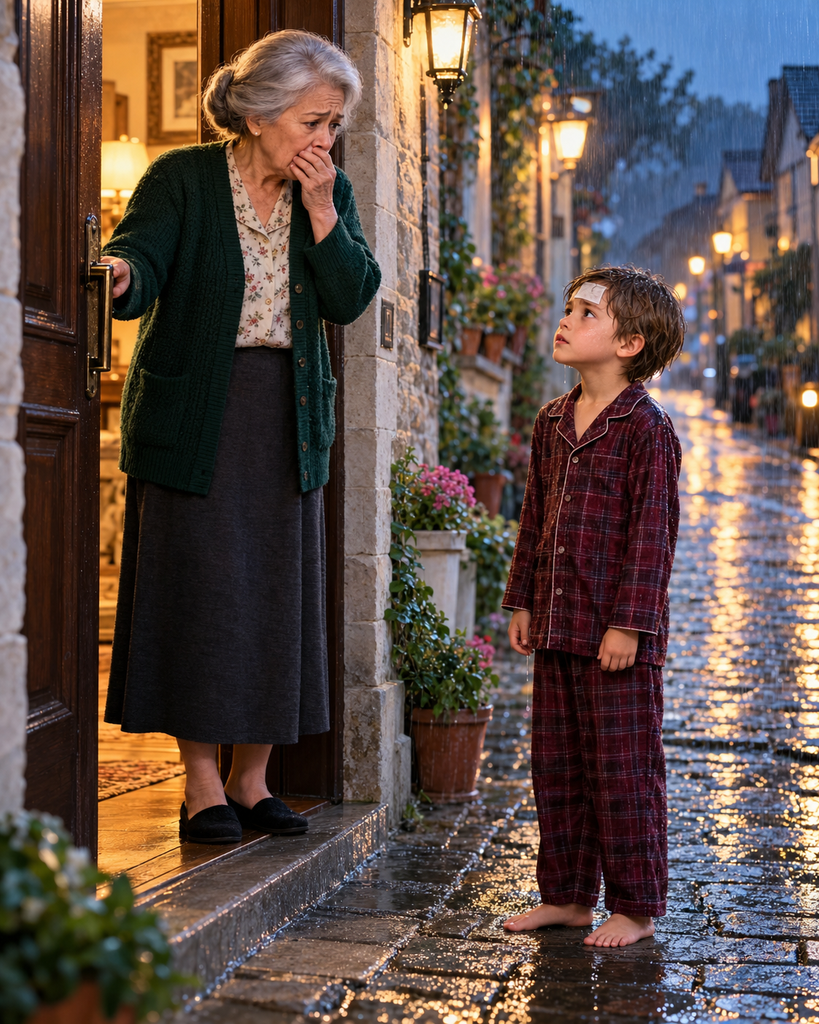
“Grandma, help me… I’m so cold.”
At two in the morning, in the middle of a storm, I opened the door of my house in Austin and found my grandson Mason, seven years old, standing in the rain with his pajamas stuck to his body. He was barefoot, he was trembling, and his face was flushed with fever.
“Mason? My God! Where are your parents?”
I carried him inside as best I could. When I placed my hand on his forehead, it was burning.
“Mom said Dad was with you… and Dad said Mom was with you. I thought you were both here.”
I felt a hollow drop in my stomach.
My son Alex and his wife Danielle lived almost twenty minutes away on foot. That child had walked alone through several dark streets, with a fever of almost 104 degrees, because he believed his parents were at my house.
I dried him off, put clean clothes on him, gave him the medicine his pediatrician had prescribed before, and immediately called Alex.
A young woman answered.
“Your wife again, Alex?” she said, laughing. “Tell her to stop ruining our weekend.”
I froze.
“I’m Eleanor, Alex’s mother. Put him on the phone.”
There was a silence.
“His… mother?”
The call was cut off.
I dialed again. Phone turned off.
Then I opened the family location app we had been using ever since Mason started elementary school. Alex’s dot was not in Austin.
It was in Fredericksburg, sitting exactly on top of a boutique hotel with a spa.
I tried calling Danielle.
Nothing.
I searched for her location.
Danielle wasn’t home either. Her phone appeared at a hotel in San Antonio, more than eighty miles from where her husband was.
I looked at Mason, curled up under my blankets.
“Mom told me Dad would be working with you,” he murmured, half asleep. “And Dad said Mom would help you tonight. Since you were both with you… I came.”
Then I understood.
They hadn’t gone out together.
Each one was cheating on the other.
And both of them had used me as their alibi.
I took screenshots of the locations and waited until Mason’s fever came down. At dawn, I called my neighbor Linda Parker, my friend of thirty years, to watch him for an hour.
With the emergency key Alex had given me years before, I went to their apartment.
What I found turned my stomach.
The heating was off. The refrigerator held beer, soda, and two old takeout containers. On the dining table were two twenty-dollar bills and two notes.
The first was from Alex:
“Mason: Dad will be working late with your grandma. Mom comes home tonight. Don’t open the door.”
The second, written by Danielle:
“My love: I’m going to help your grandma and sleep over there. Your dad will be back later. I’m leaving you $20 so you can buy something.”
I sat down.
Each of them had assumed the other would come back.
Neither one checked anything.
Mason had read both notes and had reached the most innocent conclusion possible: his parents were together at Grandma’s house.
I photographed everything.
I went into his room. His pajamas were too small, his sneakers were worn out, and several school notebooks were still inside his backpack.
I packed clothes, books, toys, and his documents into two bags. I didn’t know yet what I could legally do, but I knew one thing: that night, Mason was not going back there.
When I returned home, I made chicken soup.
Mason took the spoon with both hands and began to eat desperately.
“This is so good, Grandma. I haven’t had hot food in a long time.”
It hurt to hear him.
“Doesn’t your mom cook anymore?”
“When they work, they leave me twenty dollars.”
“When does that happen?”
Mason said it with absolute naturalness:
“Tuesdays and Fridays. I call them ‘the twenty-dollar days.'”
I opened the school platform.
There were notes from his teacher: Wednesday, Mason fell asleep during class. The Saturday before a school festival, he arrived hungry. Several Fridays he had asked for a second serving in the cafeteria.
This was not one night of irresponsibility.
It was a routine.
Then, among his papers, I found a bank folder with Mason’s name on it.
I had opened that account when he was born. Every birthday I deposited money for his education.
I checked the latest statement.
Available balance: $6.
Over the years they had withdrawn thousands and thousands.
And on Friday, just a few hours before abandoning Mason, someone had withdrawn $1,200.
I looked at the two twenty-dollar bills I had photographed on that table.
They had emptied their son’s savings to finance their secret lives… and they had left him forty dollars so a seven-year-old could feed himself alone.
But when I reviewed the complete history of transactions, I discovered that those $1,200 were only a small part of what had disappeared.
And what I was about to discover about my own children made me understand that this storm was only beginning.
PART 2
Over seven years, more than $9,000 had left Mason’s account.
There were withdrawals that matched expensive dinners, weekend getaways, and Danielle’s posts from restaurants. Others appeared right before Alex’s trips.
While their son ate bread, instant soup, or whatever he could buy with twenty dollars, they were using his savings as a personal piggy bank.
I called CPS in my county and explained everything: the sick child walking alone in the middle of the night, the two notes, the locations, the missing food, and the missing money.
The caseworker who took my call went silent for several seconds.
“Mrs. Mitchell, keep absolutely all of the evidence. This needs an immediate child protection assessment.”
Afterward, I changed the locks on my house.
Alex had kept a copy of my key for years, and I was not willing to take any risks.
When Mason saw the new keys on the table, he asked: “What are those for?”
I crouched down in front of him.
“Because from today on, this house is your house too. Nobody comes in here to take you unless it’s safe for you.”
His eyes filled with tears.
“Not even my dad?”
“Nobody is going to force you to leave tonight.”
Mason hugged me.
“I don’t want to stay alone in the dark again.”
On Sunday afternoon, Alex’s and Danielle’s location dots began to move.
They were both coming back.
At five o’clock, my phone rang.
“Mom!” Alex shouted. “Is Mason with you?”
“Yes.”
I heard his sigh of relief.
“Thank God. Danielle was supposed to take care of him, but—”
“How was Fredericksburg?”
Silence.
“What?”
“The hotel. The spa. And the young lady who answered your phone.”
Danielle shouted in the background: “What young lady, Alex?”
I smiled without joy.
“Danielle, don’t act surprised either. I saw your post from the hotel in San Antonio. Two glasses of champagne and a man’s hand that wasn’t your husband’s.”
Now they were both shouting.
I continued:
“I also found your notes. I photographed them. I have the locations and the transactions from Mason’s account.”
“Mom, listen…”
“No. You listen to me. Mason arrived here alone, in the rain, with a fever of almost 104 degrees. And meanwhile you were in hotels with other people.”
“It was a misunderstanding!” Danielle shouted.
“A misunderstanding happens once. Mason told me about ‘the twenty-dollar days.’ The school has months of records showing he arrives tired and hungry.”
Nobody answered.
“Tomorrow I’ll deliver everything to child protective services and consult a lawyer.”
Alex exploded:
“You’re going to destroy my career!”
He didn’t even ask about his son’s health.
That finished breaking something inside me.
At seven they pounded on my door.
“Mom, open up!”
Mason shrank into the couch.
“Grandma… did they come because I was bad?”
I knelt in front of him.
“You didn’t do anything bad.”
“I left without permission…”
“Because you were sick and alone. The adults were the ones who were supposed to take care of you.”
The pounding continued.
I answered through the intercom.
“If you keep banging on that door, I’ll call 911. There’s already a report for possible child neglect. You can explain to them yourselves why you left a sick child alone all night.”
Alex’s face changed.
Danielle stopped shouting.
A minute later they left.
On Monday I took the evidence to CPS, spoke with the school, and went to a family lawyer, Diane Whitaker.
She studied the photographs, the screenshots, the school file, and the bank transactions.
“Eleanor, this isn’t resolved by hiding the boy,” she explained to me. “We have to request formal protective measures and let a judge determine who Mason should remain with.”
I nodded.
“Do everything that’s necessary.”
That afternoon the proceedings began.
But the next day, while I was at the bank requesting the complete seven-year history, I received a call from the school principal.
Alex had just shown up at the elementary school.
He had tried to take Mason out early.
And when the school told him he had to wait for the authorities because of the open case, he ran out.
That’s when I knew I was no longer facing only two irresponsible parents.
I was facing two cornered people, terrified of losing their reputation, their money, and their son.
And they still didn’t know what the most devastating piece of evidence was — the one the bank had just handed me.
PART 3
The bank history took up dozens of pages.
It wasn’t $9,000.
After adding up the withdrawals, transfers, and charges linked to the account, the amount came to more than $12,000.
I found payments made directly to one of Danielle’s cards, withdrawals before Alex’s vacations, and transactions carried out over years on dates that matched those Tuesdays and Fridays when Mason stayed home alone.
I took everything to Diane.
“With this, they can no longer argue it was an isolated emergency,” she said. “There’s a pattern.”
She also asked me to do something difficult: not to exaggerate, not to insult them, and not to try to take revenge.
“The center of this case has to be Mason. Not the affairs.”
She was right.
The problem wasn’t that Alex and Danielle had destroyed their marriage.
The problem was that they had used their son as if he were a suitcase they could drop in some corner while they lived another life.
Child protective services intervened, and temporary measures were requested so that Mason would remain with me while the situation was investigated.
The school received clear instructions: if either of his parents appeared without authorization under the case, they were to contact the authorities immediately.
For the first time since that night, I felt the door protecting Mason was no longer held up only by my hands.
There were institutions behind it too.
However, the emotional battle was only beginning.
Danielle went to her parents’ house and told them I had “kidnapped” her son.
Her mother, Theresa, called me furious.
“How dare you take the boy away from my daughter over a marital argument?”
“Mrs. Lawson, ask her where she was from Friday until Sunday.”
“She told me she was helping you.”
“She was never here.”
There was silence.
I explained what had happened.
I told her about Mason’s fever, his walk in the rain, the hotel, the notes, and the bank account.
“That can’t be true.”
“Check her social media. Then ask her about the $12,000.”
I heard Danielle crying in the background.
“Mom, she’s exaggerating!”
“Then she can explain the bank statements,” I answered.
Theresa stopped arguing.
Two days later she called me again.
Her voice was completely different.
“Eleanor… we reviewed everything. My husband spoke with Danielle too. We didn’t know anything.”
“I didn’t want to believe it either.”
“I’m not going to defend her. Take care of Mason.”
It was strange to hear that. For years I had been afraid of causing conflict between the families. Now I understood that staying silent had never kept the peace. It had only left a child unprotected.
Alex’s and Danielle’s employers also learned that an investigation existed, not because I had called to humiliate them, but because the authorities needed to verify schedules, time-off requests, and versions of events.
The lies began to fall one behind the other.
Alex had requested days off saying he would celebrate his anniversary with Danielle.
Danielle had told coworkers that Mason would spend the weekend “with Grandma.”
They had both built different alibis on top of the same lie.
Their marriage practically ended that week.
They blamed each other.
Alex said Danielle should have come home.
Danielle said Alex was the father and should have stayed.
Neither could answer the simplest question:
“Why didn’t either of you call to check where your son was?”
The answer was painful.
Because checking would have meant interrupting their plans.
Meanwhile, Mason began to change.
In the first days, he asked before opening the refrigerator.
“Grandma, can I have a yogurt?”
“Of course.”
“Even though I already had one yesterday?”
“You can eat whenever you’re hungry.”
He asked permission to turn on the TV, to take another pancake, even to use the colored paper.
One afternoon he accidentally broke a glass and went pale.
“I’m sorry, I’m sorry, I’ll pay for it with my twenty dollars.”
I hugged him.
“Glasses break. You don’t have to pay to exist in this house.”
He stood completely still.
Then he began to cry.
That was when I understood that being abandoned for hours was only the visible part of the damage. Mason had learned to make himself small so he wouldn’t be a bother. To not ask for food. To not get sick. To not cry.
I took him to a child psychology evaluation as part of the process.
The psychologist confirmed that he showed anxiety associated with being left alone, and an intense fear of being considered a burden.
That hurt me more than any bank statement.
I was sixty-two years old. I worked a few days at a dry cleaner’s and lived on a modest pension. So that I could be there for him every day after school, I reduced my work hours.
Money began to worry me.
Uniforms, food, school supplies, doctor’s visits, transportation.
But every afternoon, when Mason came running in shouting “Grandma, I’m home!”, I remembered that first night.
I would rather count coins for the rest of my life than see him trembling in front of a closed door again.
A month later, Diane gathered Alex, Danielle, and their lawyers.
I attended too.
My son looked as if he had aged years. Danielle no longer wore the impeccable clothes or the perfect makeup from her photographs.
They sat apart from each other.
Diane placed a folder in front of them.
“There is a family proceeding in progress. In addition, Mrs. Mitchell is claiming restitution of the money used from the account set aside for Mason. The amount documented so far is $12,000.”
Alex put his hands to his head.
“I don’t have that money.”
Danielle pointed at him.
“He spent much more than I did!”
“Me? What about your hotels? Your restaurants?”
They began attacking each other.
I watched them for several minutes.
Until I asked:
“Does either of you want to know how Mason is doing?”
They went quiet.
Alex looked at me.
“Mom, I was under so much pressure. Work demanded too much of me. Danielle and I fought every day. I needed to escape.”
Danielle began to cry.
“I felt invisible. I was only a wife and a mom. I wanted to feel like I still had a life.”
“You can get divorced,” I answered. “You can change jobs. You can end a relationship. You can ask for help. What you cannot do is make a seven-year-old boy pay the price for your frustrations.”
I pushed a copy of the medical report toward them.
“Mason arrived at my house with a high fever after walking alone through a storm.”
Then I set down the school reports.
“He was arriving tired and hungry.”
Finally, I placed the bank transactions.
“And while he was learning to live on twenty dollars, you were spending the money that had been saved for years for his future.”
Alex lowered his head.
For the first time he said: “I want to ask for his forgiveness.”
“Maybe one day Mason will decide to listen to that apology. But you won’t do it to make yourself feel better. It will happen when the professionals consider it won’t harm him.”
The meeting itself didn’t decide custody; that was the judge’s role. However, both accepted not to fight Mason remaining provisionally in my care, and they signed an agreement to repay the money, subject to the corresponding review.
Months later came the decisive hearing.
I carried an enormous folder.
By then there was almost no need to open it.
There were school reports, psychological evaluations, location records, photographs, bank statements, and the child protection report.
The judge listened to everyone.
He also listened to Mason through specialized staff, without placing him in front of his parents.
The boy said something very simple:
“With my grandma, I know that when I get back from school, there’s someone waiting for me.”
That sentence broke my heart.
A child wasn’t asking for toys or trips.
He was asking for someone to be home.
The court determined that Mason would continue in my care, established the corresponding legal measures regarding his parents, and left any possible future contact conditioned on professional evaluation and the best interests of the child.
When I received the ruling, my hands were trembling.
I didn’t feel victorious.
I felt relief.
I left the building and sat for a few minutes on a bench.
All my life I had believed that a good mother should defend her son even when he was wrong.
That day I understood something different.
Alex was still my son.
But Mason was also a child who depended on adults to survive.
And protecting the most vulnerable meant, this time, standing up to my own son.
The restitution of the money was made in monthly payments.
I opened a new account for Mason, with safeguards so nobody could use it the way they had before.
The first month, two deposits arrived.
One from Alex.
Another from Danielle.
They weren’t large amounts, but I kept the receipts.
Not because I enjoyed watching them pay.
Because that money had never been theirs.
Over time I learned that Alex had ended up living in a cheap room and that he lost the sales position he used to brag about at his company. He and Danielle divorced. She began working extra hours to meet her financial obligations.
I didn’t celebrate any of those things.
The consequences belonged to their decisions.
My job was something else.
Every morning I woke Mason up.
We made eggs, bacon, or pancakes. I cut fruit for him while he filled his backpack.
In the afternoons we did homework at a new desk I bought in installments.
Little by little, he stopped asking if he could open the refrigerator.
He stopped hiding food in his backpack.
He stopped waking up in the middle of the night to check that I was still home.
One rainy night I heard his footsteps in the hallway.
He appeared in front of my bedroom hugging his stuffed dinosaur.
My heart raced.
“What’s wrong, my love?”
“It’s raining hard.”
I prepared to hold him, thinking he was remembering that night.
But Mason smiled.
“I just wanted to see if you’d closed the window, because the living room could get wet.”
That was all.
He wasn’t terrified.
He didn’t think someone would abandon him.
The rain was just rain again.
I got up, and together we closed the window.
Before going back to his room, Mason pointed to the new keys that still hung by the front door.
“Grandma, do you remember when you said they were magic keys?”
“Of course.”
“I know they’re not magic now.”
I laughed.
“Oh, they’re not?”
He shook his head.
“You’re the one who protects me.”
I had to look away so he wouldn’t see me cry.
I hugged him tightly.
“No, Mason. Someday you’re going to understand something even more important. This house protects you because here you know that you matter. And when you grow up, I want you to never let anyone make you believe otherwise.”
That night I walked him to his bed, tucked in his blanket, and turned off the light.
Before I closed the door, I heard his voice.
“Good night, Grandma.”
“Good night, my boy.”
“Tomorrow I want pancakes.”
“Tomorrow there will be pancakes.”
He smiled and closed his eyes.
I went back to the dining room.
On the table was the latest bank statement. The money his parents had taken would take a long time to come back in full.
But there was something we had already recovered, something no bank could measure.
Mason had recovered the right to be hungry without feeling guilty, to break a glass without thinking they would stop loving him, and to sleep without wondering if the adults would disappear during the night.
I had lost part of my income, my peace, and the relationship I once believed I had with my son.
In exchange, a child felt safe again.
And if anyone ever asks me whether a mother should protect her son no matter what he does, my answer will no longer be the same.
Sometimes loving your own child means stopping him from continuing to cause harm.
And sometimes family isn’t who shares your blood, but who opens the door at two in the morning, wraps you in a blanket, and decides that you will never have to walk alone in the rain again.