
“I didn’t take the drops, doctor. I put them all in Victor’s tea.”
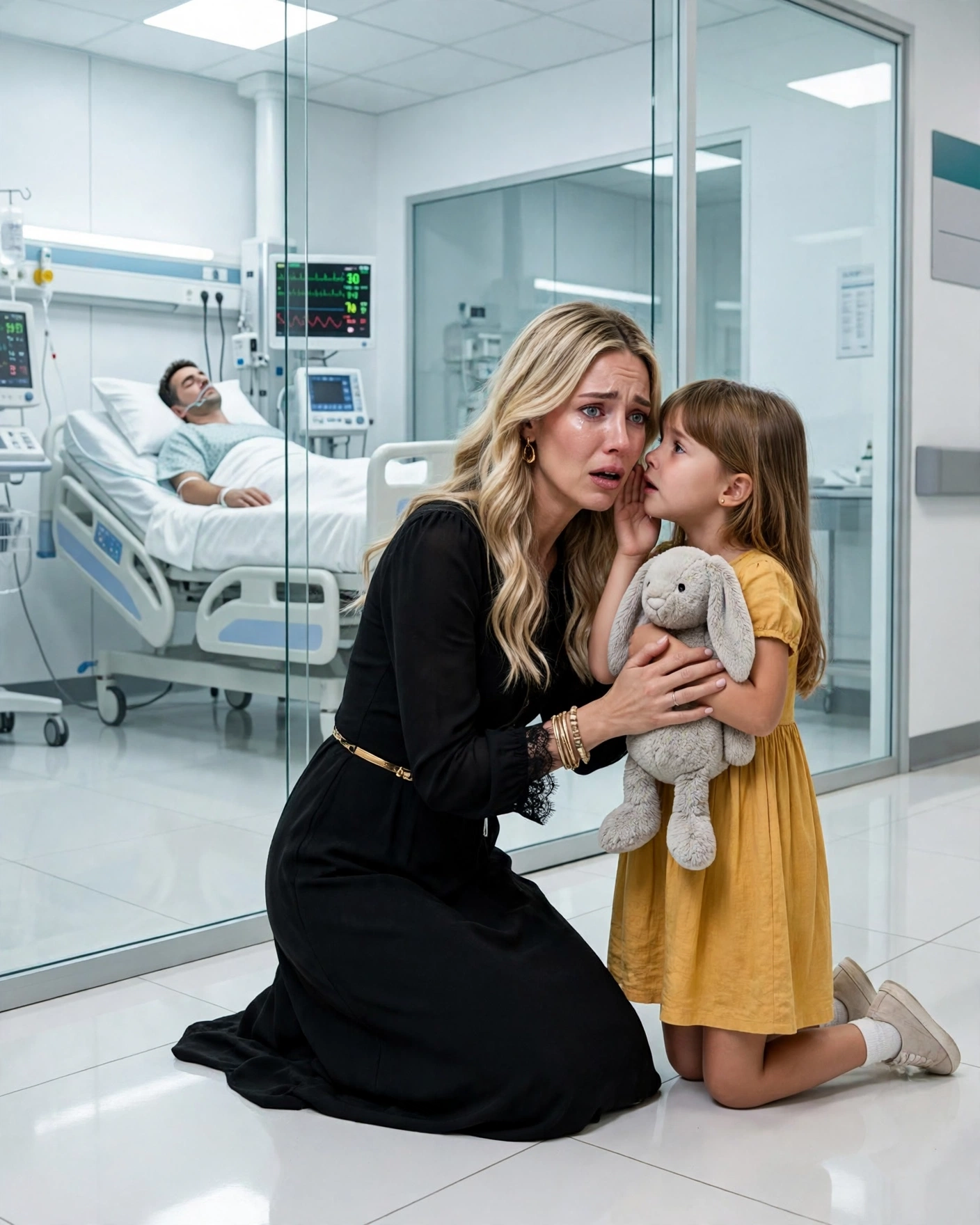
The little girl said it hugging a gray bunny against her chest, as if she had just confessed to breaking a glass.
Dr. Nathan Reed looked up from the metal tray. It was 3:40 p.m. in the emergency room of a hospital in Houston. Ten minutes earlier he had intubated Victor Hale, a forty-four-year-old businessman, admitted with seizures, a dangerously slow pulse and loss of consciousness.
“Chloe, how many drops did you put in?”
“All of them. Mom takes ten. I emptied the whole bottle.”
Hannah, sitting on the exam table, went rigid.
“Chloe, you don’t make things like that up.”
“I’m not making it up. You said those drops make you feel worse. I didn’t want your heart to hurt again.”
Nathan looked at Hannah. Thirty-one years old. Diagnosed with cardiomyopathy for almost two years. Fatigue, arrhythmias, weakness, hair loss. In her purse there were two unlabeled bottles: one for her and another, supposedly “to strengthen the immune system” of Chloe’s.
There was also a child’s comb full of light hairs.
“Is your daughter losing her hair too?”
Hannah swallowed.
“For months. Dr. Miriam Shaw said it was stress. Chloe lost her dad two years ago. She recommended vitamins and rest for us.”
“Miriam Shaw, head of Cardiology?”
“Yes. She’s been treating me since I started getting sick. Victor took me to her.”
Nathan turned toward the nurse.
“Tammy, order urgent heavy metal tests for Victor, Hannah and the girl. And nobody from Cardiology touches these bottles.”
“Doctor… Dr. Shaw is already on her way down.”
Miriam appeared impeccable, white coat closed and hair perfectly pulled back.
“Nathan, Hannah is my patient. She has a serious heart disease. I’ll take her up to my floor.”
“No.”
Miriam blinked.
Nathan raised one of the bottles.
“Her husband is in intensive care after drinking the entire contents of this.”
“It’s an herbal preparation.”
“There’s no list of ingredients.”
“The pharmacy works by prescription.”
“Then you won’t have a problem with us analyzing it.”
Miriam’s face stayed motionless.
“Children say anything.”
Nathan looked at her fixedly.
“That’s why I’m not going to believe the child. I’m going to believe the laboratory.”
Twenty minutes later, the reagent in the first bottle changed to an intense yellow.
The technician went pale.
“Doctor… positive for thallium. In a very high concentration.”
He repeated the test with Chloe’s bottle.
Yellow again.
Nathan felt a deep cold in his stomach.
A toxin in the drops of a sick woman.
The same toxin in the “vitamins” of a five-year-old girl.
When he returned to the cubicle, Hannah was still looking at her daughter.
“Hannah, did you make a will?”
She went pale.
“Yes. Victor insisted. Miriam too. They said my heart could fail at any moment.”
“Who inherits?”
“My hotels go to Chloe, but Victor manages everything until she turns eighteen.”
“And if something happens to Chloe?”
Hannah closed her eyes.
“Then everything goes to Victor.”
Chloe hugged the bunny harder.
Nathan understood that the little girl had not committed a prank.
She had interrupted a plan that had been working for almost two years.
And the worst was not even that.
PART 2
Nathan ordered Prussian blue started immediately for Hannah and Chloe. He explained it was an antidote used to trap thallium in the intestine and help the body eliminate it. Hannah barely listened. She looked at her hands, her nails, the locks of hair on the pillow.
“So my heart wasn’t dying on its own,” she murmured.
“It’s sick,” Nathan answered, “but the cause may be prolonged poisoning. And that changes everything.”
Chloe, from the exam table next door, raised her face.
“Is Mom going to get better?”
“We’re going to do everything so she does.”
The girl nodded, satisfied with a simple answer.
Then she said:
“Victor said Mom would soon go to heaven with my dad.”
Hannah turned her head.
“What?”
“He told me I had to behave because afterward it would just be him and me left.”
Hannah’s breathing broke.
Nathan said nothing. There was no need.
An hour later two agents from the prosecutor’s office arrived. The lead investigator, Sarah Mitchell, asked for the bottles, the prescriptions and the clinical file.
Miriam Shaw tried to stop her from her office.
“This is absurd. You’re destroying the hospital’s reputation over a preliminary test.”
Sarah placed a copy of the pharmacy record on the desk.
“The pharmacy that prepared these bottles belongs to Victor Hale’s cousin.”
For the first time, Miriam lost color.
“That doesn’t prove I knew anything.”
“We also didn’t find any echocardiograms of Hannah’s on the server,” Nathan said. “Two years of supposed cardiomyopathy and not a single study saved.”
“They were in an external archive.”
“No.”
Miriam fixed her eyes on him.
Nathan continued:
“I reviewed the electrocardiograms. Bradycardia, alterations compatible with poisoning. And even so you wrote ‘progression of heart failure.'”
Sarah opened a folder.
“We also spoke with the notary. He remembers perfectly that you were present when Hannah signed her will.”
Miriam fell silent.
“He remembers something else,” Sarah added. “Victor Hale was not holding his wife’s hand that day. He was holding yours.”
The silence turned thick.
Nathan watched the doctor lower her eyes.
“I loved him,” she said at last.
Nobody answered.
“I met him years before Hannah. He told me his marriage was a mistake, that he needed time, that when everything was over we would be together.”
“‘Everything’ what?” Sarah asked.
Miriam clenched her jaw.
“I didn’t know he wanted to kill the girl.”
Nathan took a step toward her.
“But you prescribed the drops.”
“He told me they were vitamins.”
“You are a cardiologist. You saw a girl with hair loss, weakness and pains in her legs. You saw the mother get worse while she kept taking exactly what you prescribed.”
Miriam stayed motionless.
Sarah spoke without raising her voice: “Doctor, stand up.”
At the same time, in intensive care, Victor remained unconscious.
But the phone seized by the investigators had already revealed deleted messages.
One of them, recovered from an automatic backup, had been sent by Victor to Miriam three months earlier:
“Her first. Then the girl. No hurry. It has to look natural.”
There was another.
“When Hannah signs the modification of the trust, we accelerate.”
And a third, much older, addressed to the pharmacy owner:
“My same concentrations. Two different bottles. The little one’s, half.”
Sarah read the messages in front of the chief physician.
The man sat down as if the strength had been taken from his legs.
“This is going to sink us.”
Nathan looked at him.
“No. What would have sunk you was hiding it.”
Then a new report arrived.
The laboratory had compared a sample of Hannah’s hair with another saved from a checkup eighteen months earlier.
The thallium levels were old, repeated, constant.
This was not a recent attempt.
It was not a sudden crisis.
Someone had been poisoning her since a few weeks after her wedding.
Sarah looked up from the report.
“There’s one more thing.”
Nathan felt the room grow cold.
“What?”
“Hannah’s first husband drowned in Lake Conroe. Victor was with him that day.”
Hannah, from the doorway, managed to hear that sentence.
And the scream she let out made the entire hallway fall silent.
PART 3
Hannah didn’t remember arriving at the office.
She remembered only the word “Conroe.”
Her first husband, David, had died two and a half years earlier during a boat outing with several partners. They said he fell into the water when he tried to secure a rope. Victor had been the one who called Hannah. He was also the one who organized the funeral, spoke with employees, resolved pending payments and stayed at her side when she could no longer even answer the phone.
For months, Hannah thought she owed him her life.
Later she believed she owed him love.
Now she didn’t know if she owed her dead husband an explanation.
“Why are you reviewing that?” she asked with a broken voice.
Sarah opened another folder.
“Because we found messages from Victor from three years ago with one of the men who was on the boat. They don’t clearly say he committed a homicide. But they talk about ‘making sure David doesn’t come back’ and ‘leaving the matter in the hands of the water.'”
Hannah covered her mouth.
Nathan held her arm before she collapsed.
“We don’t know yet what happened,” Sarah said. “I’m not going to lie to you. There could be another explanation. But we’re going to investigate.”
Chloe appeared in the hallway accompanied by Tammy, still clutching the gray bunny against her chest.
“Mom.”
Hannah knelt and hugged her.
For the first time since arriving at the hospital, she cried without trying to hold back.
Not for the money.
Not for the hotels.
Not for the will.
She cried because for two years she had taught her daughter to trust a man who may have destroyed her family from the beginning.
That same night, the investigators searched Victor and Hannah’s house in Houston.
They found prescriptions, cash payments to the pharmacy, copies of the will, insurance policies and a folder with printed calculations about the value of six boutique hotels Hannah had inherited from her father and expanded with David.
They also found a prepared document, still unsigned, to modify Chloe’s trust.
With that change, Victor would have been able to sell two properties before the girl reached legal age.
The plan was not just to wait.
It was to take everything.
Meanwhile, Victor remained in intensive care.
The dose he had drunk was enormous. The thallium had already begun to affect his nerves, his heart and his digestive system, but treatment began a few hours after ingestion.
He survived.
He woke on the fourth day.
Nathan was checking the monitors when he saw him open his eyes.
Victor tried to move. He couldn’t.
Then he saw the police officer sitting next to the door.
His pulse rose.
“Don’t try to talk yet,” Nathan said. “You have a tube in your throat. We’ll remove it in about an hour.”
Victor looked at him with terror.
Nathan leaned a little.
“You were poisoned with thallium. The contents of the bottle supposedly bought for your wife.”
The man’s eyes opened wider.
“Hannah is alive. Chloe too. Miriam Shaw was arrested. The pharmacy is shut down. The notary testified. Your phone was reviewed.”
A tear came out of Victor’s right eye.
Nathan didn’t know if it was pain, fear or rage.
“The girl poured the entire bottle into your tea,” he continued. “If she hadn’t done it, maybe nobody would have discovered anything yet.”
Victor closed his eyes.
Nathan adjusted the sheet and straightened up.
“The police say you have the right to remain silent. I only came to tell you that you’re going to live.”
Victor opened his eyes again.
For an instant he seemed relieved.
Nathan finished:
“And you’re going to have time to hear everything they found.”
Then he left the cubicle.
Tammy was waiting outside with coffee.
“Do you feel sorry for him?” she asked.
Nathan drank a sip.
“I’m a doctor. My job is for him to survive.”
“That wasn’t what I asked.”
Nathan looked through the glass.
“No. I don’t feel sorry for him.”
During the following weeks, Hannah and Chloe improved slowly.
The girl’s hair stopped falling. Her leg pains diminished. She recovered her appetite and went back to running through the hallways until Tammy forbade her to do it because she almost knocked over a medication cart.
Hannah took longer.
Her heart had endured almost two years of poisoning. She needed follow-up, rehabilitation and treatment. But the supposed terminal illness stopped seeming terminal.
One morning, the cardiologist who replaced Miriam entered with a smile.
“Your ejection fraction is improving.”
Hannah looked at him distrustfully.
“Does that mean I’m not going to die?”
The doctor turned serious.
“It means nobody should have made you believe you had an expiration date.”
Hannah turned her face toward the window and cried in silence.
For two years she had lived saying goodbye. She recorded videos for Chloe “in case one day Mom is no longer here” and wrote letters for her graduation, her fifteenth birthday and college.
Victor had read some of those letters.
He had even told her they were “a beautiful idea.”
Now Hannah understood that while she wrote farewells, he calculated inheritances.
The judicial process began months later.
Miriam Shaw lost her medical license and faced charges for participation in attempted homicide, falsification of records and deliberate administration of toxic substances.
During her statement she maintained that Victor manipulated her.
She said at first she believed he only wanted to weaken Hannah to control the businesses. Then she admitted she knew the plan could kill her.
About Chloe she repeated again and again: “That was his idea.”
But the messages showed she had asked what dose would be “enough to make it look like a childhood illness.”
The judge did not believe she was a simple spectator.
Victor faced even more serious charges.
In addition to the poisoning of Hannah and Chloe, the prosecutor’s office reopened the investigation into David’s death.
One of the men who had been on the boat asked for protection and changed his statement.
He said David argued with Victor about financial movements in the company. He claimed that, minutes before falling into the water, Victor hit him.
The witness had lied out of fear and for money.
There was no perfect proof, but transfers, messages and contradictions appeared that allowed charges to be filed.
The trial was long.
For Hannah, each hearing was like reliving the same day.
Sometimes she left furious; others, empty, unable to start the car.
Nathan began accompanying her after one afternoon when he found her at the hospital, waiting for a routine checkup, looking at the floor for almost an hour.
“You don’t have to prove you can do it alone,” he told her.
“For two years I decided nothing alone,” she answered. “Victor chose the lawyer, the notary, the doctor, the investments, even when Chloe should go with the nanny.”
Nathan sat at her side.
“Then start with one small thing.”
“Which one?”
“Choose where you want to have coffee.”
Hannah let out an unexpected laugh.
It was the first time Nathan saw her laugh.
Then bigger decisions came.
Hannah sold the Houston house.
She bought a smaller house near Lake Conroe, surrounded by pines. She kept an apartment in Houston for school, work and medical appointments.
Nathan went first to help her with a leak in the roof. Then he came back for some boxes. Later, Chloe insisted that “the bunny doctor” had to see her blue room.
One Saturday he stayed for dinner. Months later, he also stayed to sleep in the guest room.
Nobody said anything.
Until Chloe appeared one morning dragging her gray bunny and left it on Nathan’s pillow.
“It’s going to live here.”
“Why?”
“Because it feels lonely downstairs.”
“Did the bunny tell you that?”
“No. I know.”
Nathan didn’t argue.
A year after that day in the emergency room, Hannah returned to Lake Conroe for the first time.
Chloe had asked to see the lake where “the memory of her dad David lived.”
The three of them went. Hannah left flowers near the dock.
“I should have asked more questions,” she said.
Nathan, at her side, answered:
“People who deceive well work to make the questions seem absurd.”
Hannah looked at him.
“Chloe did ask.”
A few feet away, the girl was crouched looking at fish.
“Chloe didn’t ask,” Nathan said. “Chloe felt something was wrong and acted.”
Hannah smiled sadly.
“That’s scarier.”
“It also saved her.”
The sentence arrived in May.
Victor was convicted for the poisonings and for property crimes. The process for David’s death followed a separate path and years later added a new conviction.
Miriam also received a prison sentence.
The pharmacy owner agreed to cooperate in exchange for a reduction and confirmed he had prepared the bottles following concentrations given by Victor.
The hospital was sanctioned for failures of supervision.
The director resigned.
Nathan received an administrative reprimand for having sent medication to the laboratory without following the internal channel.
When Hannah found out, she was indignant.
“They punished you for discovering it?”
“For skipping a procedure.”
“And are you going to appeal?”
“No.”
“Why?”
Nathan shrugged.
“Because the paper says I disobeyed. And I did disobey.”
“But you saved two people.”
He looked at Chloe, who was drawing on the garden floor with blue chalk.
“She saved two people.”
Chloe raised her head.
“Three.”
Nathan frowned.
“Three?”
“Victor too.”
Hannah went motionless.
Chloe went back to drawing.
“If he hadn’t taken the drops, he would have died later in prison or something. Now he’s alive.”
Nathan observed her a moment.
“You have strange logic.”
“But I’m right.”
Hannah began to laugh.
Nathan did too.
That afternoon, Chloe drew three figures: a woman, a girl, and a man in a white coat. Beside them she put an enormous bunny.
Below she wrote in crooked letters: “THE ONES WHO BELIEVED.”
Nathan corrected:
“Didn’t you want to write ‘the ones who believed each other’?”
Chloe shook her head.
“No. The ones who believed. Mom believed me. You believed me. I believed Mom.”
Hannah stared at the drawing a long time.
Because that was exactly what Victor had destroyed first: Hannah’s confidence in herself.
Every time she felt worse, he said it was anxiety.
Every time she doubted Miriam, he answered that doctors knew more.
Every time Chloe rejected his hugs, he said the girl was jealous.
Every time Hannah wanted to review an account, Victor asked her to rest.
He had made her depend on him before trying to take her assets.
And recovering her life didn’t mean only surviving the thallium.
It meant believing in her own judgment again.
Two years later, Chloe grew three and a half inches, recovered all her hair and stopped sleeping with the bunny every night.
She still carried it on important trips.
One afternoon, the three of them walked along the Lake Conroe boardwalk. The sun was low and the lake looked like copper.
Chloe ran to the railing.
“Dad Nathan, come!”
Nathan stopped.
Hannah did too.
It was the first time the girl called him that.
Chloe didn’t even seem to realize.
“Come quick! There’s a huge pelican!”
Nathan looked at Hannah.
She had wet eyes, but she was smiling.
“Go,” she said.
Nathan walked toward the girl.
Chloe took his hand and began to explain to him, very seriously, why that pelican must have a family nearby.
Hannah watched them from a few steps behind.
For years she had believed her story ended with a slow death, a will and a daughter learning to live without her.
But life had changed because of a five-year-old girl who looked at a dark bottle and thought something wasn’t right.
Sometimes, the truth doesn’t enter a room with sirens or lawyers.
Sometimes it arrives with a stuffed bunny, a small voice, and a phrase nobody wants to believe.
And sometimes the most important act is not discovering the lie.
It’s believing the one everyone else was willing to ignore.