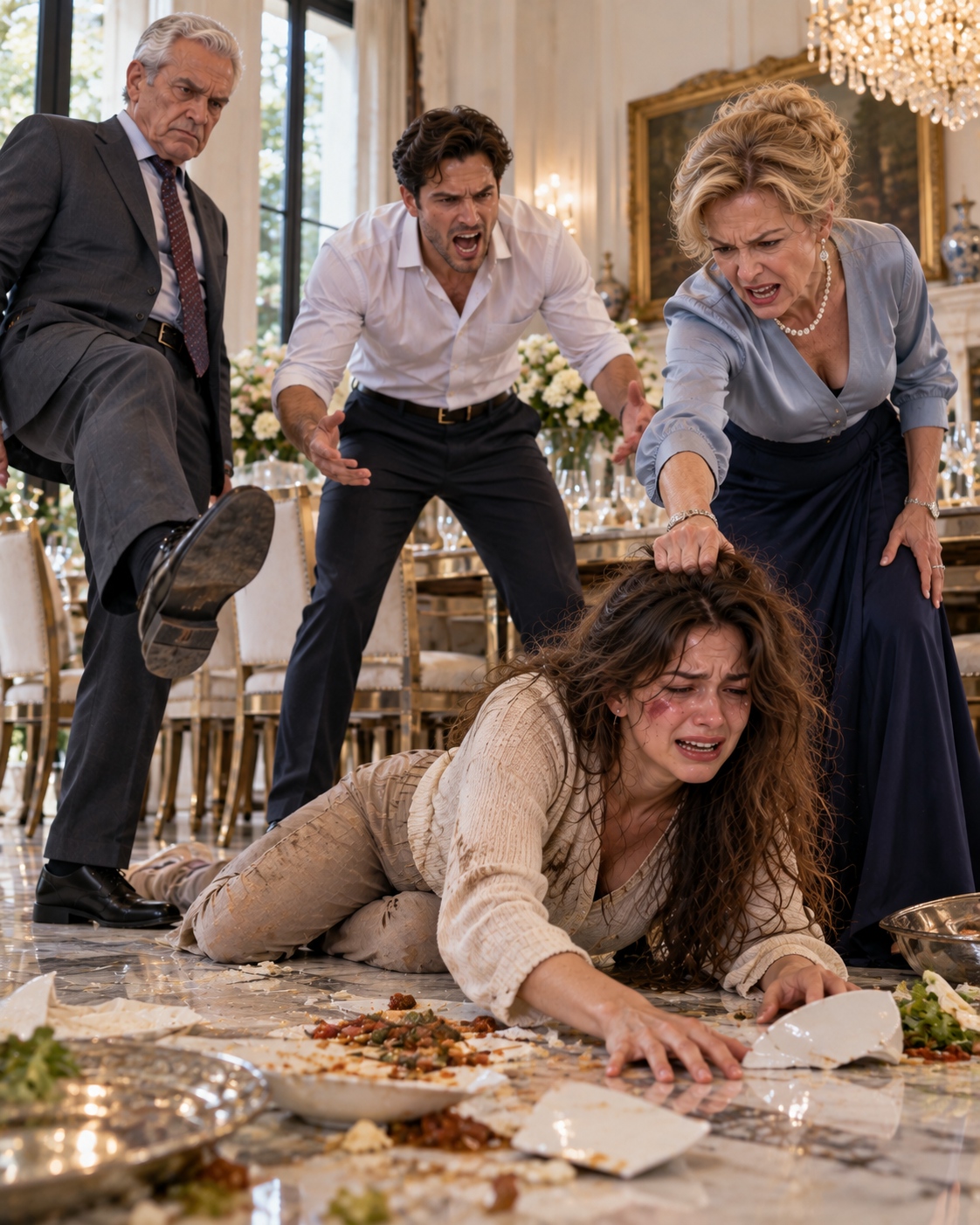

“If you ever talk to my mother that way again, you’ll regret it,” Michael warned without even leaving his chair, while I lay helpless on the kitchen floor, my leg throbbing with unbearable pain.
We were living in Columbus, Ohio, with my mother-in-law, Margaret, and my father-in-law, Robert. Michael had always insisted the arrangement would only last a little while, but nearly four years had gone by, and every dollar I earned somehow ended up under their control.
That Sunday, I’d prepared beef stew, seasoned rice, and roasted chicken. Margaret struggled with high blood pressure, so I’d deliberately used less salt. She barely tasted her dinner before slamming her spoon onto the table.
“Are you trying to starve me now? This food tastes like absolutely nothing.”
I explained that her physician had advised her to reduce her sodium intake.
Her face hardened immediately.
“So now you’re calling me sick? You’re probably waiting for me to drop dead so you can claim this house.”
“No, ma’am, that’s not what I…”
I didn’t get another word out.
She stormed into the kitchen, grabbed a wooden rolling pin, and marched back toward me. The first strike landed on my shoulder. The next sent me stumbling, and my bowl of stew crashed onto the floor. Then she kept hitting me.
But the most devastating part was seeing my husband.
Michael continued eating.
Robert simply raised the television volume.
When I couldn’t stand anymore, I begged Michael to take me to the emergency room. He finally approached, bent down, and gripped my chin.
“Emily, you will respect my mother in this house. If you can’t learn that, don’t complain about the consequences.”
Then he went back to his chair.
The three of them finished their meal while I remained sprawled across the floor.
I couldn’t move my left leg. Even breathing sent sharp pain through my body. And suddenly, a horrifying thought became clear: if I depended on their mercy, I might not make it through the night.
I pulled myself toward the kitchen window. Months earlier, Michael had nailed boards across it, claiming they were necessary “for our protection.” I found an old metal can opener and began working the nails loose with shaking fingers.
Their laughter drifted in from the dining room.
Not one of them checked on me.
Eventually, I created a gap wide enough to squeeze through. I dropped into the little backyard and dragged myself across the dirt toward Mrs. Wilson’s house. She was a neighbor approaching seventy.
Using the last strength I had, I knocked on her door.
When she opened it, both hands flew to her mouth.
“Oh, dear God, Emily! What happened to you?”
The next thing I remember is the sound of an ambulance siren.
I regained consciousness in a hospital the following morning. My leg had been immobilized, two ribs were fractured, and bruises covered my body.
A nurse named Sarah asked whether there was someone I trusted who could be contacted. I borrowed her phone and called my mother. We’d barely spoken since I’d married Michael against my parents’ wishes.
When she picked up, I could barely form the words.
“Mom… they almost killed me.”
Three days later, I recognized Margaret’s voice outside my hospital room.
“I’m her mother-in-law! You can’t keep me from seeing her!”
Sarah closed the door, and Dr. Bennett summoned security. Then Michael spoke.
“My wife has emotional problems. She probably fell and decided to blame us.”
The doctor’s response was so calm that I remember every word.
“The forensic assessment has already confirmed that her injuries are inconsistent with an accidental fall. The hospital has also notified the district attorney’s office.”
Silence followed.
For the first time in our marriage, I could hear fear in Michael’s voice.
But I had no idea that hidden inside their house was evidence that would eventually expose every lie they’d told.
PART 2
My parents reached the hospital later that afternoon. My mother started crying the moment she saw me. My father, usually the calmest person in any room, had to step into the hallway before his anger overwhelmed him.
I told them everything.
Not only what had happened that Sunday.
I described the constant insults, the way Michael took control of my wages “for our future,” the times Margaret had deliberately locked me outside as punishment, and something I’d spent an entire year trying not to think about: when I suffered a miscarriage, Margaret had refused to take me to the emergency room for hours because she believed “women make a fuss over everything.”
My father contacted Daniel Carter, the son of an old friend and an attorney experienced in domestic abuse cases.
Daniel arrived the following morning carrying a notebook and gave me one clear instruction.
“Don’t erase a thing. Financial records, texts, photographs, hospital documents—every detail matters. And from now on, don’t have any private conversations with that family.”
Investigators took my statement. The hospital preserved my scans, examination results, and official documentation of my injuries. My parents also produced records of a large financial gift they’d given me when I married, which Michael had secretly transferred into Robert’s account.
Once Michael’s family realized I wasn’t coming home, their behavior changed.
Margaret returned to the hospital pretending she was worried about me. When staff refused to let her upstairs, she caused a scene at reception, shouting that I was “mentally unstable” and trying to ruin her son’s life.
Michael called from a number I didn’t recognize.
“Withdraw your complaint and sign the divorce papers. Don’t ask for a cent.”
I switched on the call recorder.
“What happens if I refuse?”
His voice became quieter.
“Then your parents are going to suffer for what you’re doing.”
Two days later, someone splashed red paint across my parents’ front door. Footage from a nearby convenience store identified the man responsible. Investigators traced the intimidation attempt back to Michael.
I assumed nothing could be more damaging than that evidence.
I was mistaken.
One afternoon, Sarah entered my hospital room with a woman in her early fifties. Her name was Rebecca, and she was Michael’s aunt.
She carried an old smartphone with a badly cracked screen.
“I found this tucked away at my brother’s place,” she explained. “It belonged to Michael. I haven’t looked through everything, but I think you should see what’s on it.”
The moment we switched it on, a chill ran through me.
There were photographs of me asleep, pictures of bruises taken without my knowledge, and a concealed folder containing audio files.
In one recording, Margaret’s voice was unmistakable.
“Take a picture. If she ever reports us, we’ll tell everyone she did it to herself.”
Then came Michael’s laughter.
“And if she files for divorce, we’ll tell people she’s mentally ill. Nobody’s going to believe her.”
My stomach turned.
Daniel came straight to the hospital and began preserving copies of the files.
At the end of the folder, we discovered a recording lasting nearly an hour. Its timestamp matched the night Margaret attacked me.
We pressed play.
First, we heard me explaining why I’d reduced the salt.
Then Margaret yelling.
Then the sound of the blows.
Then my voice begging her to stop.
And behind it all, Michael speaking as casually as if nothing were happening.
“Dad, pass me another dinner roll.”
Daniel paused the audio.
For several moments, the room was completely silent.
“Emily,” he finally said, “they created a record of their own abuse.”
I thought the worst revelations were behind us.
But that night, shortly before midnight, I heard someone turning the handle of my hospital room door.
My mother was asleep in a chair near the window.
I opened my eyes.
The door edged inward.
And Michael appeared, his clothes dripping rainwater, his eyes strangely empty, and a knife gripped tightly in one hand.
PART 3
For a few terrifying seconds, I couldn’t draw a breath.
Michael shut the door and started moving toward my hospital bed.
“You’ve destroyed my career, my reputation, and my home,” he whispered. “Now you’re going to make it right.”
My mother stirred when she heard him. She was about to scream, but I lifted my hand, silently begging her to stay still.
Because of Michael’s earlier threats, hospital staff had tightened security and installed an emergency call button beside my bed. I reached beneath the blanket and pressed it.
Michael saw the movement.
“You really think someone can get here fast enough?”
He lifted the knife.
I seized the metal water pitcher beside my bed and hurled it toward his arm. It didn’t injure him, but it knocked his movement off course. My mother began screaming.
The door burst open almost immediately.
Two security officers rushed inside and restrained Michael before he could reach me again. Police officers who had already been assigned to monitor the hospital because of the threats arrived moments later.
Even as they escorted him away in handcuffs, Michael never apologized.
He simply screamed that I’d caused everything.
Hearing those words erased the last doubt I’d been carrying.
For years, I’d convinced myself that if I showed more patience, made better meals, spoke less, surrendered my earnings without questioning him, and tolerated Margaret’s cruelty, Michael would eventually become the affectionate man I’d fallen in love with before our wedding.
That night, I finally accepted something painful.
Perhaps that man had never been real.
Perhaps he’d only been pretending.
With Michael under arrest, the investigation gained momentum. Authorities seized the old phone, verified the recordings, and retrieved deleted messages. Several exchanges showed Michael and Margaret discussing my injuries as deliberate ways to keep me under control.
“Don’t let her wear anything sleeveless this week.”
“Save the picture in case she decides to act like the victim.”
“Remind her nobody will believe her because she went to counseling in college.”
That final message helped me understand another part of their plan.
Years before, Michael had found documentation showing that I’d received counseling for anxiety and depression during college. I’d never considered that treatment something to hide, but he intended to twist it into evidence that I was “unstable.”
His attorney followed exactly that strategy.
When the trial began, the defense introduced my counseling records and even a carefully cropped graduation photograph showing me beside a male classmate. They tried to portray me as dishonest and irresponsible, a woman who harmed herself and then invented accusations to punish her husband’s family.
Daniel listened without saying a word.
Then he stood to address the court.
He began with the medical findings: a badly fractured leg, cracked ribs, and extensive injuries consistent with repeated physical assaults.
Next came the bank records documenting how my earnings had been diverted, month after month, into accounts controlled by Michael.
He followed with medical evidence of my miscarriage and the delay before I was taken for emergency treatment.
Finally, he asked the judge to allow part of the recovered audio recording to be played.
The courtroom became completely quiet.
My own frightened voice filled the room.
“Please… don’t hit me anymore.”
Margaret’s voice followed.
Then Michael’s.
“That’s what happens when you refuse to obey my mother.”
I shut my eyes.
I desperately wanted to avoid reliving that kitchen, but I knew I had to endure hearing it one final time.
Dr. Bennett testified that my injuries matched a physical assault. He also explained that receiving treatment for depression did not make someone dishonest or undermine the credibility of their account. Sarah described the condition I was in when I arrived at the hospital and the terror I showed whenever Michael’s relatives tried to reach me.
Rebecca, Michael’s aunt, testified as well.
She revealed that Margaret herself had been mistreated by her mother-in-law decades earlier. Rather than ending that pattern, Margaret had eventually inflicted the same cruelty on me.
That revelation wounded me in an unexpected way.
I’d spent years assuming Margaret simply couldn’t comprehend another person’s suffering. Learning that she understood it firsthand and had still chosen to cause it made her actions feel even more cruel.
Robert tried to defend himself by claiming he never interfered in “women’s disagreements.”
Daniel questioned him directly.
“Did you hear Emily pleading for someone to help her that evening?”
“I don’t recall.”
Daniel played another portion of the recording.
My crying echoed through the courtroom.
Immediately afterward, Robert’s voice could be heard.
“Michael, pass the chicken.”
Robert lowered his head.
No further explanation was necessary.
Investigators also confirmed that some of the money my parents had given me as a wedding gift had been deposited into Robert’s account. He had helped hide additional assets after the family learned I intended to pursue legal action.
The court proceedings continued for months.
Nothing was magically fixed overnight. I endured surgeries, physical therapy, sleepless nights, and weeks when the sound of someone walking heavily behind me could send me into a panic.
Gradually, I learned to walk again without assistance.
And I learned something even more difficult.
I stopped feeling the need to apologize simply for being alive.
When the verdict was finally delivered, I entered the courtroom leaning on a cane.
Michael sat across the room. He was thinner now. He no longer resembled the man who had controlled virtually every part of my existence.
He looked diminished.
The judge described years of repeated abuse, financial manipulation, intimidation, and threats. Michael’s attempt to attack me inside the hospital further aggravated the charges. He was convicted of multiple offenses involving domestic violence, serious physical injury, criminal threats, and the later attack. His punishment included several years in prison and financial restitution.
Margaret also faced criminal penalties for assaulting me. Her medical condition became part of the proceedings because she’d suffered a stroke weeks earlier that left her with serious lasting complications. But her illness did not erase her responsibility.
Robert faced penalties for helping conceal my money and for other wrongdoing established during the investigation.
When I heard the decisions, I didn’t smile.
I didn’t feel triumphant.
What I felt was relief.
It was as though I’d spent years carrying an enormous iron weight across my shoulders, and someone had finally taken it away.
My divorce was finalized not long afterward. I recovered the funds I could prove were mine and received financial compensation. The remaining property issues were settled using the records of our marriage and the money that had been improperly transferred.
Michael tried to negotiate through his lawyer.
“If Emily signs a forgiveness statement, we may be able to seek a shorter sentence,” Daniel told me.
“No.”
“You don’t need to give me an answer today.”
“I’ve already made my choice.”
I remembered lying on the cold kitchen floor. I remembered clutching Michael’s pant leg and begging him to take me to the hospital.
And I remembered what he’d said.
“That’s what you get for disobeying.”
“When I pleaded with him to save me, he chose to sit down and finish eating,” I replied. “Now he can live with the consequences of what he chose to do.”
My parents remained beside me throughout my recovery. Before returning home, my mother stocked my freezer with homemade meals. My father inspected the door locks three separate times and insisted that I promise to call whenever I felt unsafe.
One morning, after they left, I found myself alone in my apartment.
For the first few minutes, the quiet made me nervous.
Then something extraordinary occurred to me.
For once, silence wasn’t a warning that something terrible was about to happen.
It was peace.
I began sharing parts of my experience online. I kept the private details of the legal case to myself, but I wrote openly about the warning signs I’d overlooked: financial control, isolation from loved ones, cruel remarks disguised as “jokes,” and the belief that a wife should tolerate anything to preserve her marriage.
Messages started arriving from women in Cleveland, Indianapolis, Pittsburgh, Detroit, and Chicago.
“My husband monitors every dollar I spend.”
“My mother-in-law attacked me, and my husband says I provoked her.”
“I have children and nowhere safe to take them.”
“How did you know it was finally time to leave?”
As I read their words, I recognized the woman I’d once been.
So I reached out to Sarah and Daniel.
“I don’t want telling my story to be the only thing I do.”
With their help and the support of other volunteers, we established a small assistance organization in Columbus. We named it Open Door.
It wasn’t an enormous shelter or a wealthy charitable foundation. We had a modest office with two private rooms, a space for consultations, connections with established domestic violence shelters, and a volunteer network of therapists, medical professionals, and attorneys.
The first woman to seek our help was named Hannah.
She arrived wearing sunglasses despite the cloudy weather. One hand was wrapped in a bandage, and her eyes kept darting toward the entrance.
“You’re not going to tell my husband I’m here, are you?”
“No,” I assured her. “Every decision about what happens next belongs to you.”
She studied my face.
“I’m terrified.”
I knew those words intimately.
I sat down across from her.
“Being frightened doesn’t mean you should go back. It means you deserve support and a safe plan for what comes next.”
Hannah began crying.
I waited until she asked before putting my arms around her.
That day, I understood that my story hadn’t ended when the judge announced the verdict.
Several months later, Hannah secured a protective order, found employment, and moved into a safer home with her children. More women began coming to us. Some chose to report the abuse. Others simply needed guidance. Some returned to their partners, only to come back to us weeks afterward. We learned to welcome them without judgment.
Leaving an abusive relationship rarely happens through one flawless, decisive moment.
Sometimes freedom comes one inch at a time.
Just as mine had when I crawled through that kitchen window.
A year later, Open Door was collaborating with several community organizations. Sarah continued volunteering. Daniel offered legal consultations on designated days each month. Dr. Bennett helped us explain how women could obtain appropriate medical documentation of their injuries.
Around that time, I met Nathan, who owned a little bookstore a couple of blocks from downtown.
For months, he was simply my friend. He brought coffee, donated books, and never questioned why conversations about marriage made me uncomfortable.
One afternoon, he asked whether I’d like to have dinner with him.
My immediate instinct was to refuse.
But then I thought about everything Michael had taken from me and something I wasn’t willing to let him take as well: the possibility of trusting another person someday, on my own terms.
So I said yes.
There were no dramatic declarations.
No promises of “forever.”
Just an easy conversation and an unfamiliar sense of comfort: sitting beside a man without constantly listening for anger in his voice.
Later, Michael’s attorney contacted me again. He wanted my support for a request to shorten Michael’s prison sentence based on medical concerns and good behavior.
I listened until he’d finished.
“I won’t be participating,” I answered.
I no longer felt any need to seek revenge.
But I didn’t feel obligated to rescue him, either.
His future was no longer mine to manage.
I ended the call and stepped into Open Door’s small courtyard. Hannah was helping a new visitor complete some forms. Sarah was scolding Daniel because he’d forgotten to eat lunch again. Across the street, Nathan stood outside his bookstore and lifted his coffee cup in greeting.
I glanced down at my leg.
The scar hadn’t disappeared.
Cold weather could still make it ache.
But I no longer thought of it as the reminder of a night when I nearly lost my life.
I saw it as evidence of the night I decided to save it.
For years, I’d believed that family meant enduring mistreatment so you wouldn’t have to face the world alone. Now I understood that family could also be a mother traveling hundreds of miles to sit beside your hospital bed, a father holding your hand while struggling with his own fear, a nurse willing to believe you, an elderly neighbor opening her door in the middle of the night, or strangers helping one another find a way out of the same darkness.
People sometimes ask what my revenge looked like.
It wasn’t watching Michael being taken away in handcuffs.
It wasn’t recovering the money he’d stolen.
It wasn’t hearing a judge pronounce his sentence.
My answer was the life I built afterward—a life in which none of those people would ever again have the power to determine my worth.
And whenever a frightened woman enters our center and whispers, “Have I waited too long to leave?”, I give her the answer I desperately needed that night when I was dragging myself across the dirt, searching for someone who would help me.
“No. As long as you’re alive, it’s never too late.”