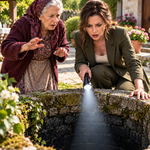


“Leave her here, and don’t bother calling me again. I’ve already done my part by bringing her. I have absolutely no intention of coming back for her.”
That was what the man said when he entered my nursing home at 8:30 on a Monday morning, pushing his elderly mother toward the front desk as though he were delivering a package he couldn’t wait to get rid of.
From the window of my office, I’d seen his black SUV stop near the ambulance entrance. He stepped out while speaking on his cellphone, opened the rear passenger door, and helped a small, gray-haired woman out of the vehicle. She wore a tan coat that was much too heavy for the warm California weather. Then he carelessly dropped a checkered travel bag onto the pavement.
“My name is Brandon Hayes,” he announced as I came downstairs. “Her documents are in the bag, along with payment for six months. Get her settled as quickly as possible. I’ve got a business meeting.”
“Before we admit her, we need to speak with your mother and determine what kind of assistance she’ll need,” I explained.
“There’s nothing wrong with her mind. She can walk, eat, and take care of herself. She won’t give you any trouble unless you indulge her dramatic behavior. And whatever you do, don’t give her my phone number. She’ll call me twenty times a day.”
The elderly woman beside a large potted plant lowered her head.
“Brandon, honey, you told me we were coming somewhere I could relax for a little while, just a few weeks…”
“Mom, please don’t start. They’ll feed you here, and there’s a television. What more could you possibly need?”
She reached toward his sleeve, hoping to stop him. As her coat opened, I noticed the brooch attached to her blouse: a silver dragonfly decorated with a green stone, its left wing broken.
The pen fell from my hand.
I recognized that dragonfly immediately. Thirty years earlier, I’d stared at it for almost an hour while riding a bus on my mother’s lap. I was six, and I’d asked whether a dragonfly could still fly if one of its wings was damaged. My mother had quickly moved my hand away.
“Keep your hands off it. You’ll end up breaking it completely.”
It was February 1996. My father had walked out on us, and the factory employing my mother had failed to pay its workers for several months. Brandon, who was four years older than I was, sat in a car with someone our family knew. I could still picture him eating a popsicle while my mother guided me toward a building with a large gray gate.
I believed we were going to visit somebody.
Inside an office, a woman asked my mother whether any relatives might be willing to help. Without even glancing in my direction, she replied:
“Taking care of my son is already enough. My daughter is nothing but a burden. Let this place deal with her.”
She pressed a tamarind candy into my palm and walked away. I tried to chase after her, but a caregiver caught me before I reached the door. I screamed “Mommy!” until my throat was so sore that I couldn’t make another sound. My mother never looked back.
Three decades later, that very same woman stood inside the nursing home my husband and I had worked so hard to establish. She had no idea who I was. In her mind, I was still the little girl who had vanished from her life thirty years ago.
“Are you running this place?” she demanded with an air of superiority. “I expect a private room. My son is a successful businessman. Money isn’t an issue for him.”
I crouched to retrieve my pen and slowly steadied my breathing.
“I’m Olivia Carter, the director of Maple Grove Residence. We’ll make sure you’re comfortable here, Mrs. Margaret.”
Brandon walked out without so much as a farewell. The automatic glass doors closed behind him, and my mother whispered with unmistakable pride:
“My son is the only person I have left in this world.”
I stood less than six feet from her. What I couldn’t have imagined was that, before the month ended, I’d be forced to decide whether to protect the very woman who had once decided I wasn’t worth keeping.
PART 2
During her first seven days, Margaret Hayes made life at Maple Grove Residence almost unbearable. She complained about the meals, spoke harshly to our nurse, Rachel, and insisted that we move her roommate, Mrs. Helen, an eighty-year-old former schoolteacher.
“I certainly didn’t come here to sleep in the same room as some old stranger.”
“Well, that makes two of us,” Helen answered, keeping her attention on her crossword. “I never asked to share a room with an ill-mannered woman.”
My mother threatened almost daily to contact Brandon and have our facility closed. One afternoon, she studied my professional certificate and a framed picture of Aunt Martha, the woman who had cared for me growing up, before making a cutting remark.
“You’re awfully young to be in charge of a place like this. I imagine some rich husband gave you everything without your having to work for it.”
She didn’t know that my husband, Thomas, had spent countless weekends repairing the old building’s roof himself, or that I’d worked back-to-back nursing shifts to make our loan payments. She also had no idea how often Aunt Martha had reminded me as a child, “Being abandoned by someone doesn’t mean you should abandon other people.”
The money Brandon had left in the envelope was nowhere near enough for six months. It barely covered the first month. After several unanswered calls, we discovered he’d blocked the facility’s telephone number.
That Saturday, Margaret borrowed a cellphone and tried reaching him herself. He didn’t answer. Eventually, she called Mrs. Linda, who had lived near her old apartment. As I listened, her voice began to tremble.
“What do you mean he sold my apartment? Who’s living there now? What happened to my photographs, Linda? Where did he put my mother’s belongings?”
She collapsed before the conversation was over.
Her blood pressure had climbed to a dangerously high level. We followed our emergency procedures and summoned an ambulance. After she received medical treatment, I stayed close to her throughout the night. Around three in the morning, she began crying in her sleep.
“My little Olivia, please forgive me. I meant to come back for you…”
I felt my heart shatter. She’d gone thirty years without trying to find me, yet she hadn’t forgotten my name.
The following morning, she wanted to know why I’d remained beside her instead of leaving her alone.
“Because we don’t abandon people here when they need medical attention,” I told her.
From then on, her angry outbursts gradually stopped. She began spending time with the other residents, and some afternoons she visited my office to tell me about Brandon. She described the money she’d loaned him, the company she’d helped him establish, and the apartment she’d allowed him to use.
“I devoted my whole life to him. He’s the only son I have.”
“Did you ever have a daughter?” I asked one afternoon.
Her expression immediately turned cold.
“I had a little girl once. She died from pneumonia when she was very young. I don’t want to discuss it.”
Hearing that lie was more painful than remembering the gray gate.
Several days later, she brought me a power-of-attorney document. Brandon had told her it was necessary so he could collect her pension payments. But the document actually gave him authority to sell her apartment and carry out financial transactions involving her assets. I called an attorney I trusted, Mr. Bennett, who advised us to revoke the authorization and report the suspected fraud.
We also learned that Margaret had recently inherited a modest house and a parcel of land near Lake Tahoe. A property developer had been offering more than $50,000 for land in that area. Fortunately, that inheritance wasn’t covered by the authorization Brandon had used when selling her apartment.
Four days afterward, Brandon arrived with his wife, Vanessa, and a notary. He didn’t even bother greeting his mother with a hug.
“Sign these papers so the property can be transferred to me, Mom. I don’t have all day.”
Margaret looked over the documents.
“Not until you tell me where my apartment went.”
“I sold it. What’s the big deal? I needed the cash. Besides, I’ve already arranged a place where you can sleep and get meals.”
“But my daughter’s photographs were there…”
“Just a pile of useless garbage. Everything got thrown away. Sign the papers.”
I intervened and reminded Margaret that she was under no obligation to sign anything. Brandon turned toward me and pointed angrily.
“Keep your mouth shut. I pay you to change diapers, not interfere in my affairs.”
“You paid for a single month, not half a year,” I replied. “And your mother is entitled to make her own choices.”
With the notary watching, Margaret firmly refused to sign. Brandon struck the bedside table so hard that a drinking glass fell and shattered.
“Fine! I’ll have a court declare you incompetent! Then I’ll dump you in some facility where nobody will ever bother visiting you!”
After he stormed away, my mother reached for my hand. Her fingers were shaking.
“Why are you trying so hard to protect me, Mrs. Olivia? I’m not even related to you.”
I couldn’t bring myself to answer. Locked away in my office was a photograph and a collection of documents that could expose the lie Margaret had maintained for thirty years.
PART 3
Within forty-eight hours, Brandon began making good on his threats. Vanessa published dishonest online reviews accusing us of withholding food from residents, stealing pension money, and refusing to obtain medical assistance for my mother. She circulated photographs of Maple Grove Residence through local community groups.
The accusations were devastating. Thirty-two elderly people depended on our facility, and many had nobody else to care for them. Thomas found me sitting awake at midnight, reading the posts.
Soon afterward, inspectors arrived. They reviewed residents’ medical files, checked our food supplies, and examined the records of emergency incidents. I answered their questions carefully and without losing my composure.
Mrs. Helen requested an opportunity to speak with them.
“I get fresh fruit every morning here. When I lived with my son, I spent months eating crackers for breakfast because nobody could spare the time to buy groceries. Please don’t let a personal vendetta destroy this home.”
Then Margaret approached with the help of her walking cane.
“My son and his wife invented those accusations because I refused to hand over a property. This director called an ambulance when I became ill and stayed awake all night making sure I was all right. If you want a written statement, I’ll sign one.”
For the first time in my life, I heard my mother stand up for somebody else. The inspectors found nothing to substantiate the complaints, and Margaret thanked me for the first time.
Later that week, I returned to the children’s home where I’d spent my childhood. The building had been painted blue, but the old entrance gate remained. My knees shook as I stepped through it.
I submitted the necessary request and was allowed to review my childhood records. Among the documents was a picture of a little girl with white ribbons in her hair and a statement bearing Margaret’s signature, dated February 1996.
“I request that my daughter, Olivia, be admitted to this institution. I lack the financial means and have no desire to take responsibility for raising her.”
My eyes returned to the words “no desire” again and again. I could forgive someone for being poor. What I couldn’t understand was how a mother could decide one of her children deserved a home while the other didn’t.
Another page contained a note written by Aunt Martha.
“Olivia has been waiting beside the window for three months. Please don’t tell her that her mother is coming unless someone has actually heard from her. Every promise that goes unfulfilled breaks her heart all over again.”
I broke down crying in that office. I remembered how Aunt Martha baked a little cake for my birthdays and helped me blow out the candles. We always placed an extra chair at the table because I insisted my mother might be running late. The final time we set out that chair, I was ten. I was the one who asked for it to be removed. I left the building with certified copies of the records and the knowledge that the pain I’d carried since childhood was real.
That afternoon, Mrs. Helen approached me in the corridor.
“You’re that little girl, aren’t you?”
I stopped moving.
“She says ‘my little Olivia’ in her sleep, and there’s a scar on your chin identical to the one on the girl in her photograph. I spent forty years teaching children. I know when I’m looking at a story that hasn’t reached its ending.”
“I’m not sure I want to hear the rest of it,” I admitted.
“Then you don’t have to hear it now. Just don’t allow that man to control what happens to either of you.”
Mr. Bennett explained to Margaret that she had the right to cancel the power of attorney, report the money that had disappeared, and refuse to transfer the land. Her age alone didn’t give anyone permission to take control of her decisions.
On Monday morning, she came into my office holding the documents tightly.
“I want to file a complaint against my son,” she said. “But I can’t face it alone. I need somebody to come with me because I’m scared.”
“Are you absolutely sure?”
“I paid for his schooling, gave him money, and even covered his wedding expenses. He took my apartment and all my photographs. If I stay silent, he’ll take the land my parents left me as well.”
We submitted the complaint and started the process of canceling his legal authorization. Requests were made for financial records and paperwork connected to the apartment sale. Nobody pretended the situation could be resolved overnight.
Brandon’s attorney responded by asserting that Margaret was mentally confused and needed her son to manage her affairs. He included a report from a private physician and announced that Brandon intended to collect her on Friday and move her far away.
Mr. Bennett arranged an independent assessment by geriatric and neuropsychological specialists. Margaret accurately recalled important dates, the medications she took, and even the exact payments she’d made to support Brandon’s company.
“I’m sad, Doctor,” she said when the examination ended. “Please don’t confuse heartbreak with an inability to think clearly.”
The specialists determined that she understood the choices she was making. Mr. Bennett explained that Brandon would need a proper legal proceeding to restrict her decision-making rights, not simply a medical opinion obtained privately.
On Thursday evening, as I was preparing to leave work, my mother knocked softly on my office door. For the first time, she didn’t enter without being invited.
“How did you get that scar beneath your chin?” she asked.
“I was struck by a swing when I was five.”
Her mouth opened slightly.
“Was it in the yard outside a factory?”
I gave a faint nod.
“And your name is Olivia…” she whispered. “Tell me, did your mother…?”
“Good night, Mrs. Margaret.”
I walked away before she could finish her question. Thomas was waiting at home with a cup of chamomile tea. He’d known about my childhood ever since we began dating.
“I always thought that if I ever saw her again, I’d shout everything I’d wanted to say,” I confessed. “But when I see her sitting with her travel bag, all I can picture is my own bag beside that gate.”
“You don’t owe her forgiveness,” he reminded me. “Choosing to help her doesn’t make the past disappear.”
I arrived at the facility early Friday morning. Rachel had organized the medical assessments, and Mr. Bennett was scheduled to join us. We’d already informed the district attorney’s office about Brandon’s threats.
At 10:58, his black SUV appeared outside. Brandon entered with Vanessa, a lawyer, and the doctor responsible for the private medical report.
My mother sat beside the same potted plant where she’d stood on the day she arrived. She wore her tan coat, with the silver dragonfly pinned over her chest, and her checkered bag was resting beside her shoes.
“Excellent. You’ve packed already,” Brandon said mockingly. “Time to go.”
“I’m not leaving,” she replied.
“I wasn’t asking permission. I’ve got the doctor and all the necessary documents. You’re confused, and somebody needs to take charge of you.”
Mr. Bennett explained that there was no court order allowing Brandon to remove her. He produced the paperwork revoking the power of attorney and the findings from the independent assessment. The private doctor quietly moved closer to the exit.
Brandon turned toward me and jabbed a finger in my direction.
“What gives you the right to interfere between a mother and her only son? The minute her money disappears, you’ll throw her out, too. She’s nothing but a burden to anyone who has to look after her.”
A burden.
The word struck me like a physical blow. I’d heard it thirty years earlier. My mother recoiled, looking at me as though the same memory had suddenly returned to her.
I stepped behind the reception counter, retrieved the gray folder, and placed it open in front of Brandon.
“Read what’s inside,” I said. “Pay particular attention to the signature.”
He laughed at first. But when he noticed the photograph of the little girl with white ribbons, the date, and his mother’s signed declaration, his expression changed. He began reading aloud, slowly.
“‘I lack the financial means and have no desire to take responsibility for raising her…’ Olivia? But Olivia died. Mom said she died of pneumonia.”
“I never died, Brandon. I grew up waiting for somebody to return for me. I’m Olivia, your sister. Do you remember sitting in the car eating a popsicle while you watched Mom lead a little girl away?”
He stepped backward as though I’d struck him. Looking at him, I recognized the older brother who had never come looking for me. I remembered all the explanations I’d invented while living at the children’s home: perhaps he was searching for me, perhaps Mom had forgotten our address, perhaps one day they’d both arrive together. None of those hopes had ever come true. Vanessa lowered the phone she’d been using to film the confrontation.
“You have a sister?” she asked Brandon. “You told me your entire life that you were an only child.”
“Shut your mouth!” he snapped.
My mother picked up the document. She recognized her handwriting and slowly ran a finger across the child’s photograph. The silence lasted so long that I could hear the water dispenser humming nearby.
“I left you there in your little boots,” she whispered. “I handed you a piece of candy so you’d stop crying. I told myself I’d return as soon as I found another job… But the months went by. I was ashamed of what I’d done, and I couldn’t face going back. Eventually, I started telling everyone you’d died because then nobody would ask questions.”
“But I kept asking about you,” I said. “Every single afternoon, year after year. Aunt Martha finally had to tell me that I needed to stop waiting.”
Margaret covered her mouth. She looked as though she wanted to reach for me, but she remained where she stood. For the first time, she seemed to realize that no amount of remorse could restore the childhood she’d taken from me.
Brandon shattered the silence.
“Are you finished with this ridiculous family drama? I’m not giving up valuable land just because some sister nobody knew about suddenly appears.”
“You will not control my property,” Margaret declared, standing up. “And you will not control my life. I gave you everything I had, yet you still tried to steal the last thing that belonged to me. I’m going to defend myself today, even if that means standing against my own son.”
An investigator from the district attorney’s office entered, having been informed about the threats. She verified that Margaret didn’t wish to leave and advised Brandon of the requirements connected to the property investigation. Nobody was dramatically dragged away in handcuffs, but he had no choice but to listen.
Brandon left while shouting insults, and Vanessa hurried after him, looking far less confident than when she’d arrived. My mother let her bag fall to the floor, and Mrs. Helen brought her a glass of water.
The months that followed involved financial examinations and court hearings. Investigators established that Brandon had received the proceeds from the apartment sale and collected pension money without providing an accounting. Through legal proceedings and a supervised agreement with the purchasers, the transaction was reversed after they received a refund. Brandon had to sell his SUV and part of his business to raise the necessary funds. The criminal investigation continued.
The apartment itself was empty. However, Mrs. Linda, the former neighbor, had rescued a shoebox from the belongings that had been thrown away. My mother brought it to me.
“I believe this should be yours,” she said.
Inside were a photograph of me as an infant, a small lock of hair, and thirty New Year’s greeting cards. Every card contained the same message: “My little Olivia, please forgive me. I hope life has been kind to you.”
None of them had ever been mailed. Each was marked with a different year. Some had coffee stains, while others were creased around the edges. I imagined Margaret writing my name every year and then putting the card away, choosing the temporary comfort of avoiding me for thirty long years. For the first time, my anger was accompanied by an enormous sadness for both of us and the women we’d become.
“I wrote them every December,” Margaret admitted. “But I was never brave enough to send one. I kept convincing myself too much time had passed and that you would hate me. I used that fear as an excuse to hide for thirty years.”
I stared at her, caught between wanting to cry and wanting to scream.
“A little girl didn’t need thirty greeting cards locked away in a box, Mom. She needed you to visit her just once.”
That was the first time I’d called her Mom while standing in front of her. Margaret pressed her hand against her heart but made no attempt to embrace me. Instead, she nodded quietly.
“You’re right. And I’m not going to ask you to pretend that none of it ever happened.”
She asked whether she could move into our family home. I explained that I wasn’t emotionally ready. She was welcome to remain at Maple Grove Residence, under the same rules as every other resident, while we slowly learned how to know each other again.
And that’s what happened. She stayed and rented out her apartment to cover her residential care expenses. Every Sunday, I bring my daughter, Chloe, to see her. Margaret has learned to apologize to Rachel when she speaks disrespectfully and to share meals with Mrs. Helen, although the two women still bicker about nearly everything. One afternoon, while we were making cinnamon cookies, Chloe asked if she could call Margaret Grandma. Tears filled Margaret’s eyes, but she waited for me to answer before embracing her. I nodded. It was a small step forward, not a declaration that everything had been forgiven.
Several weeks ago, when I brought my mother a cup of tea, she carefully removed the silver dragonfly from her coat. Its green gemstone was unchanged, and its left wing was still broken.
“I spent my entire life worrying that you might damage this little dragonfly,” she told me. “Yet I was the one who destroyed the very thing I should have protected more than anything.”
Her hands trembled as she fastened the brooch to my blouse. I didn’t tell her that I’d forgiven everything, because I still sometimes woke from dreams about that gray gate. But I didn’t move away from her, either.
I’ve learned that taking care of somebody doesn’t require excusing their mistakes, and that forgiveness, if it eventually comes, can never be demanded as payment for being a devoted daughter.
The dragonfly still has its damaged wing. But whenever Chloe looks at it, she smiles and says it seems ready to spread its wings and fly.