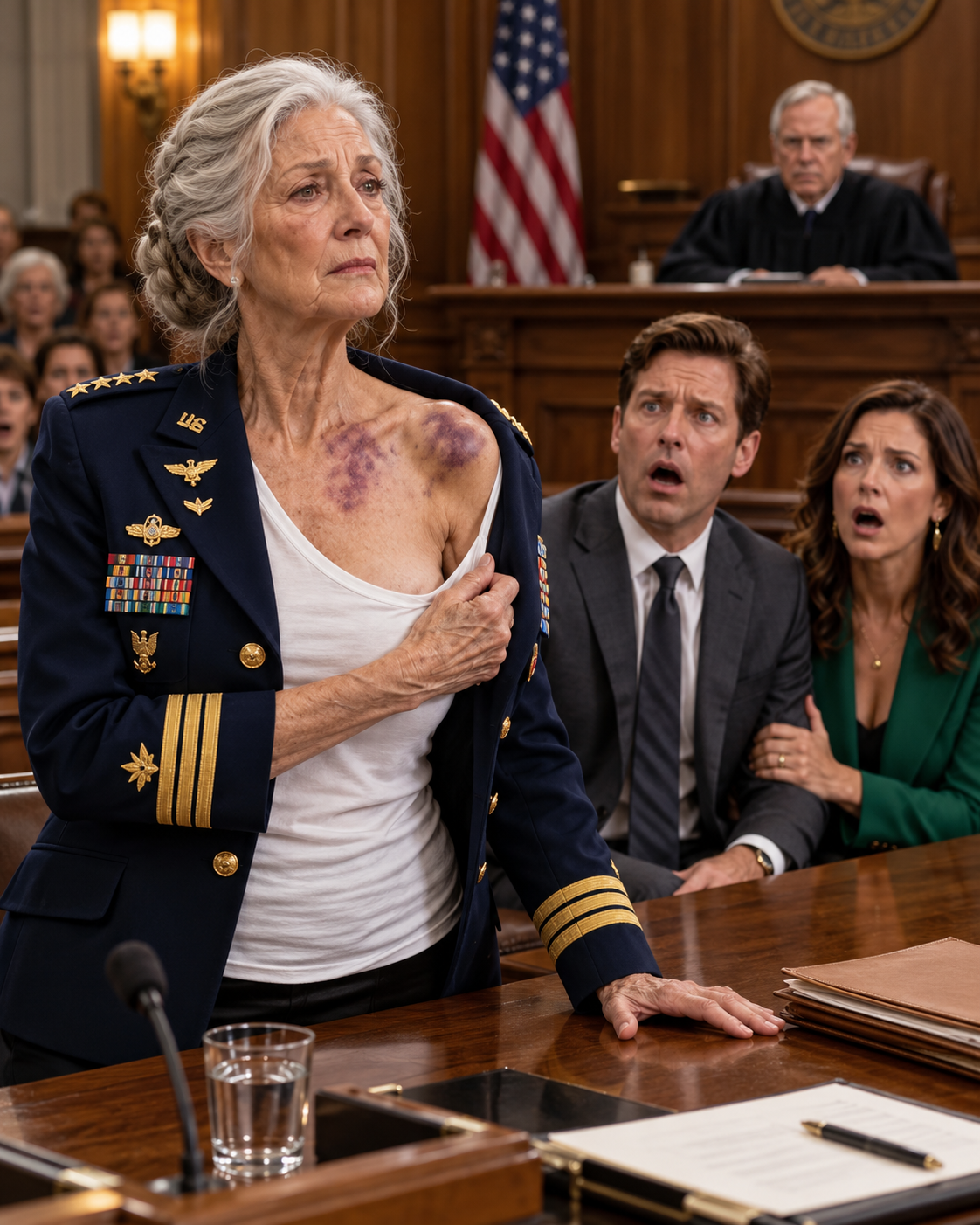

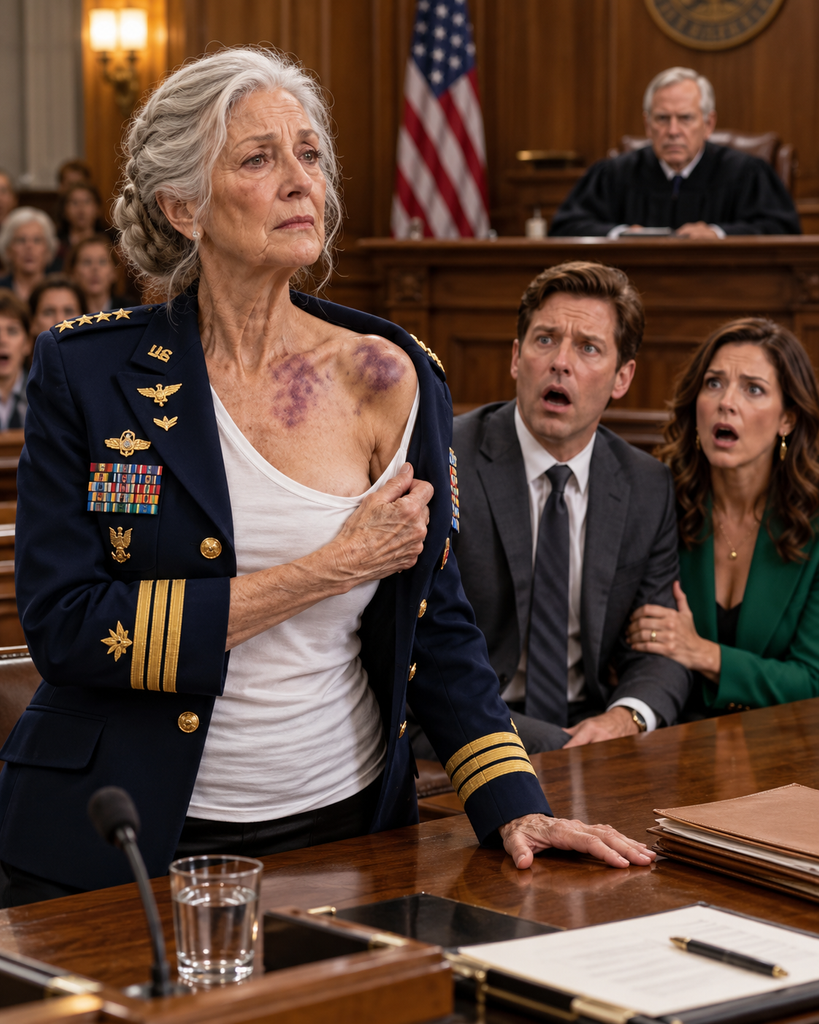
Because the photographs weren’t the only proof I’d brought with me.
I reached into the inner pocket of my coat and took out a small black recording device.
Michael’s expression shifted.
Only slightly.
But enough for me to notice.
His jaw grew tense.
Rebecca seemed to hold her breath for a moment.
Their lawyer noticed the change.
Bradley Collins immediately rose to his feet.
“Your Honor, if Mrs. Whitmore intends to present an audio recording, we must first determine whether it’s admissible and—”
Judge Harrison lifted his hand.
“You’ll have your chance to address that, Mr. Collins.”
Then he turned his attention to me.
“Mrs. Whitmore?”
I set the recorder on the table before me.
“This device contains conversations that took place inside my own home.”
Michael leaned closer to his attorney.
He whispered something.
Bradley shook his head.
I went on.
“I’ve also brought copies of financial statements, property documents, medical evaluations, photographs containing their original metadata, text messages, and a detailed written account of everything that happened over the past eleven weeks.”
An extraordinary silence settled over the courtroom.
Michael stared at me as though he no longer recognized the woman sitting before him.
I nearly laughed.
For years, my son had convinced himself that growing older meant becoming less intelligent.
That silver hair was proof of helplessness.
That losing someone you loved somehow destroyed your ability to think.
He seemed to have forgotten who had taught him how to manage his first checking account.
Who discovered that he’d taken twenty dollars from my handbag at fourteen because he’d put the remaining bills back facing the wrong way.
Who uncovered a pension fraud worth millions after noticing three figures that failed to match on a quarterly financial report.
Patterns were something I never overlooked.
They were the foundation of my entire career.
And Michael had left a trail of them wherever he went.
Judge Harrison glanced at the vacant chair next to mine.
“Mrs. Whitmore, are you appearing without legal representation?”
“At this hearing, yes.”
Bradley allowed himself a faint smile of relief.
I noticed.
Judge Harrison noticed too.
I faced the court clerk.
“But that doesn’t mean I came here without preparation.”
I pushed a folder across the table.
The clerk delivered it to the judge.
Judge Harrison opened it.
The first item was a neurological assessment.
His gaze traveled down the document.
Then stopped abruptly.
Bradley rose once more.
“We haven’t received a copy of—”
“Actually, you have,” I interrupted.
He turned toward me.
“I delivered it to your office two days ago through both certified courier and email. Your receptionist, Allison Brooks, accepted the physical package at precisely 9:14 on Tuesday morning.”
Bradley remained silent.
I added softly, “You’ll find the signed delivery confirmation on page two.”
Judge Harrison looked at him.
“Mr. Collins?”
Bradley lowered himself into his chair.
I’d almost forgotten how rewarding silence could feel.
The assessment had been performed by Dr. Claire Bennett, a board-certified neurologist specializing in cognitive health among older adults.
The examination lasted three hours.
Memory.
Reasoning.
Executive functioning.
Spatial recognition.
Language skills.
The ability to make independent decisions.
My results placed me in the ninety-fourth percentile among people my age.
More importantly, Dr. Bennett had emphasized one particular conclusion in bold lettering.
There is no medical evidence indicating that Margaret Whitmore is incapable of independently managing her personal, medical, legal, or financial matters.
Judge Harrison examined that conclusion twice.
Michael shifted uncomfortably.
Rebecca murmured, “That still doesn’t mean she isn’t injuring herself.”
I turned toward her.
She immediately averted her gaze.
But Judge Harrison had heard.
“Then we should address those injuries.”
I opened a second folder.
“The photograph Michael submitted showing my swollen wrist was taken on March eighteenth.”
Bradley examined his paperwork.
“Correct.”
“At 6:42 that evening.”
His forehead creased.
“I can’t confirm the precise—”
“I can.”
I passed another document to the clerk.
“The original photograph was retrieved from Michael’s cloud storage through a preservation request made after I received notice of this petition.”
Michael suddenly sat upright.
“What?”
Bradley turned toward me.
“You accessed his private account?”
“No.”
I addressed Judge Harrison.
“My investigator recovered files that Michael had voluntarily synchronized with a shared family storage account. He gave me administrative authority over that account six years ago and never revoked it.”
Michael stared at me.
The memory had returned.
Holiday photographs.
Income tax documents.
Family recordings.
A shared cloud subscription that I’d continued paying for every month.
People seldom pay attention to the access they leave behind when they assume the person holding it poses no threat.
“The wrist photograph was captured at 6:42,” I explained. “However, its metadata reveals another photograph taken forty-seven seconds before it.”
The clerk placed the printed image before Judge Harrison.
Michael’s face turned pale.
The photograph showed the hallway of my home.
Rebecca had wrapped her hand tightly around my wrist.
Her fingers were visibly digging into my skin.
I was attempting to pull away.
The following photograph, the one they’d presented as evidence, showed nothing except the bruising.
Bradley stood.
“My client’s wife could have been attempting to support Mrs. Whitmore and prevent her from falling—”
“Then perhaps the security footage will clarify what happened,” I replied.
Rebecca turned toward me so abruptly that her chair moved.
And there it was.
Fear.
Genuine fear.
I took out a small USB drive.
Michael whispered, “Don’t.”
Judge Harrison looked directly at him.
“Mr. Whitmore?”
Michael dropped his gaze.
There were six surveillance cameras installed throughout my house.
Michael knew about them.
What he didn’t know was that I’d replaced two cameras after my husband, Thomas, became seriously ill.
The replacement devices automatically stored their footage on an encrypted remote server.
Michael had unplugged the obvious hallway camera.
He never discovered the smaller camera concealed inside the smoke detector.
The footage appeared on the courtroom monitor.
There was no dramatic soundtrack.
No hysterical shouting.
Real acts of cruelty often appear disturbingly ordinary when viewed from a distance.
Rebecca was standing in the hallway, holding several documents.
I stood outside my husband’s study.
“Sign these,” she demanded.
“No.”
“It’s only temporary authorization.”
“No.”
“Michael is trying to take care of you.”
“He can take care of me by leaving my house.”
Rebecca seized my wrist.
Forcefully.
Even through the grainy recording, the whitening of her knuckles was unmistakable.
I grimaced.
She twisted my arm.
“Stop making everything difficult.”
Then Michael entered the picture.
He made no effort to pull his wife away.
Instead, he looked at me.
“Mom, you’re only making things worse.”
The recording ended.
Nobody spoke.
Rebecca’s attorney—
No.
She didn’t have a separate lawyer.
Not yet.
Judging by her expression, that realization had just occurred to her as well.
Bradley leaned toward Michael and whispered urgently.
Judge Harrison clasped his hands together.
“Mrs. Whitmore, is that the incident that caused the injury to your wrist?”
“Yes.”
“And what happened to your shoulder?”
“That occurred on another day.”
I played the next recording.
It was considerably shorter.
Michael stood in the hallway, preventing me from passing.
I was trying to enter Thomas’s study.
His voice was quiet.
“Where did you put the original trust documents?”
“I’ve already told you. That’s not your concern.”
“I’m your son.”
“And you’re forty-four years old. Stop acting like someone waiting impatiently for a funeral.”
He pushed me.
Not hard enough to send me flying.
Only hard enough to hurt.
My shoulder struck the wall.
The impact made Rebecca flinch in her courtroom seat.
In the video, Michael immediately said, “Mom, why did you suddenly step backward?”
That statement was important.
Before I’d even regained my balance, he was already inventing an explanation that would protect him.
Judge Harrison understood.
I could see the recognition in his eyes.
Bradley understood too.
His expression had become stiff.
“Your Honor,” Bradley said, “I’d like a short recess to consult privately with my client.”
“Not yet.”
Judge Harrison turned back toward me.
“What about the injury above your eyebrow?”
I swallowed.
That incident was more difficult to revisit.
Not because the physical pain had been worse.
But because Thomas’s study had remained exactly as he’d left it after his death.
His reading glasses were still beside the desk lamp.
An unfinished crossword puzzle remained tucked into the upper drawer.
Michael understood how precious that room was to me.
Yet he entered it anyway.
I started the final recording.
Michael was searching through desk drawers.
Rebecca stood nearby with several folders in her arms.
Then I appeared.
“What are you doing in here?”
Michael didn’t bother turning around.
“Looking for the insurance documents.”
“Those aren’t insurance documents.”
He removed a red folder.
When I’d seen it that day, my heart had nearly stopped.
Thomas’s estate planning paperwork.
A personal letter.
Amendments to our trust.
A list of financial accounts.
I reached for the folder.
Michael jerked it away.
Rebecca positioned herself between us.
I tried to step around her.
Then Michael pushed me backward with his forearm.
My heel caught the edge of the rug.
My forehead struck the corner of the bookshelf.
I collapsed.
Rebecca screamed.
Not out of concern for my pain.
But because she’d seen the blood.
Michael stood over me.
And then he spoke the words that would eventually ruin everything.
“Take a photograph before she wipes the blood away.”
The courtroom seemed to stop breathing.
On the recording, Rebecca took out her phone.
She photographed me.
Bleeding.
Still lying on the floor.
Michael crouched beside me.
For one foolish moment, I believed he was finally going to help.
Instead, he leaned close and whispered, “Mom, you seriously need help.”
Then he glanced at Rebecca.
“Write down that she had another fall.”
Judge Harrison personally stopped the footage.
Bradley Collins slowly took off his glasses.
Michael looked physically ill.
Rebecca was crying.
Real tears this time.
But she was crying for herself.
Not for me.
Judge Harrison announced a ten-minute recess.
He instructed Michael and Rebecca to remain inside the courthouse.
A deputy moved toward the exit.
Michael stood.
“Your Honor, are you holding us here?”
“For now, I’m directing you to remain available to this court.”
“But—”
“Take your seat, Mr. Whitmore.”
Michael sat.
I remained in my chair.
He leaned across the aisle.
“Mom.”
I didn’t respond.
“Mom, please listen.”
I finally looked at him.
He lowered his voice.
“This whole situation has gotten completely out of hand.”
I almost admired his choice of words.
As though everything had somehow happened by itself.
As though bruises formed naturally, like changes in the weather.
As though confidential financial papers simply wandered out of locked drawers.
As though petitions for guardianship appeared without anyone filing them.
“You can put an end to this,” he whispered.
Rebecca caught his sleeve.
“Michael.”
He shook her off.
“You’ve made your point.”
I watched my son for several seconds.
“My point?”
His expression hardened.
There was the person I remembered.
Not afraid.
Furious that his actions were finally bringing consequences.
“You want to punish me because Dad left everything so complicated.”
I remained quiet.
“You never believed in me.”
“No.”
He opened his mouth.
But I continued.
“I stopped believing in you when you showed me I couldn’t.”
The judge returned before Michael could answer.
Everyone rose.
Once we were seated again, Judge Harrison did something I hadn’t anticipated.
He turned toward Bradley Collins.
“Counsel, before continuing, I need to know whether you were aware these recordings existed.”
Bradley glanced at Michael.
“No, Your Honor.”
“Did you know that the injuries your petition describes as accidental falls may have resulted from physical altercations involving your client and his wife?”
Bradley’s jaw tightened.
“No, Your Honor.”
Michael leaned forward.
“That’s not entirely fair. He knew we were having family disagreements.”
Bradley turned toward him.
“Michael.”
One word.
Cold and sharp.
A warning.
Michael fell silent.
I opened my final folder.
“This is where the guardianship petition becomes the least disturbing part of this case.”
Rebecca closed her eyes.
She understood.
Michael apparently didn’t.
I found that interesting.
I gave the clerk a financial transaction report.
“For four decades, Thomas and I kept our main financial accounts at Atlantic Heritage Bank. After Thomas passed away, Michael volunteered to help organize my paperwork.”
“I was trying to help you!” he interrupted.
Judge Harrison stared at him.
Michael stopped talking.
“Six weeks after Thomas’s funeral,” I continued, “someone attempted to make Michael a joint owner of my high-interest savings account.”
Bradley looked at his client.
Michael kept his eyes on me.
“You signed the authorization.”
“No, I didn’t.”
“Yes, you did.”
I produced a copy.
“The form does contain what appears to be my signature.”
I paused.
“But it isn’t mine.”
I’d spent most of my professional life investigating falsified financial records.
People often think forging a signature simply means copying someone’s name.
It isn’t that simple.
A convincing forgery depends on rhythm.
Pressure.
The order of pen strokes.
The natural pauses of a person’s hand.
The false signature looked remarkably authentic.
But the person responsible had made one tiny mistake.
They signed it “Margaret L. Whitmore.”
I hadn’t included my middle initial on bank documents since 1998.
Thomas knew that.
My accountant knew it.
My bank knew it.
Michael didn’t.
“The bank refused the ownership modification because its automated signature verification system detected a discrepancy,” I explained.
Michael appeared confused.
I faced him.
“You had no idea the application was rejected, did you?”
His confusion vanished.
Rebecca turned to stare at him.
And that was when I realized something.
She hadn’t known about that application.
Interesting.
Their carefully constructed story was beginning to fracture.
I submitted another document.
“Fourteen days later, someone prepared a durable financial power of attorney appointing Michael to act on my behalf.”
Bradley went pale.
Michael muttered, “Dad wanted me to manage those things.”
“Your father had already been dead for nearly two months.”
“I meant he’d said that before he died.”
“The notary named on the document was Caroline Foster.”
Judge Harrison examined the paperwork.
I continued.
“Caroline Foster’s notary commission had expired eighteen months before the supposed signing date.”
Michael looked toward Bradley.
His attorney refused to meet his eyes.
“And yesterday morning,” I added, “Ms. Foster provided a sworn statement confirming that she never notarized this document.”
Michael jumped to his feet.
“This is ridiculous!”
The deputy immediately stepped forward.
Judge Harrison’s voice grew stern.
“Sit down.”
Michael pointed toward me.
“She’s manipulating everything! That’s what she always does! She plays with figures until innocent people look guilty!”
I nearly smiled.
Twenty-six years earlier, an executive involved in the Westbridge pension scandal had shouted almost those exact words.
Numbers don’t manipulate the truth.
People do.
Judge Harrison waited until Michael returned to his chair.
Then he nodded toward me.
“Please continue.”
“The fraudulent power of attorney was presented on three separate occasions.”
Rebecca looked at Michael.
“What?”
He whispered, “Not now.”
I heard him.
So did the people sitting nearby.
“The first attempt involved gaining access to my investment portfolio. That request was denied. The second sought information about my life insurance coverage. That request succeeded.”
I paused to let the significance settle.
“The third was submitted to a real estate agent.”
Judge Harrison frowned.
“For what reason?”
“To begin preparing my home for sale.”
Rebecca started shaking her head.
“No. That’s not what he told me. He said Margaret had agreed to move.”
Michael hissed, “Be quiet.”
Everyone turned toward them.
Rebecca stared at her husband.
“What did you just say?”
“Nothing.”
“You told me she agreed to the condominium.”
Judge Harrison addressed me.
“Mrs. Whitmore?”
I answered calmly.
“I never agreed to sell my house.”
Michael raised his voice.
“You can’t stay in that place forever!”
There it was.
Not worry.
Not misunderstanding.
Possession.
In his mind, my home had already become part of his future wealth.
I looked toward Judge Harrison.
“My property is currently estimated to be worth approximately 1.8 million dollars.”
Even Bradley turned to look at Michael.
“The savings and investment accounts they attempted to control contain approximately 2.4 million dollars.”
Rebecca’s mouth fell open.
Apparently, that figure surprised her as well.
Michael had been deceiving everyone.
Different people received different stories.
Different amounts.
Different promises.
For one brief moment, I almost pitied Bradley.
Almost.
Judge Harrison asked, “Why didn’t you report these matters sooner?”
“Because I wanted to discover how far they intended to go.”
Michael laughed bitterly.
“Naturally. She was setting us up.”
“Yes.”
I looked directly at him.
“That’s exactly what I was doing.”
After discovering the forged power of attorney, I stopped challenging them openly.
I pretended to be exhausted.
Forgetful.
I allowed Michael to think I was misplacing bank statements.
One afternoon, I deliberately asked him the same question twice.
I left an outdated financial statement in an unlocked drawer.
The balance was deliberately overstated by precisely eighty thousand dollars.
Three days later, Michael repeated that same incorrect figure during a private conversation with Rebecca.
Now I knew exactly where they’d been searching.
So I prepared another document.
A fabricated letter supposedly written by my investment adviser.
It referred to a nonexistent certificate of deposit valued at $600,000.
I left it inside Thomas’s desk.
Two evenings later, Michael forced his way into the study.
He discovered the letter.
Then he tried to locate the account.
Of course, no such account existed.
But his online search left a digital record.
It came from Michael’s home internet connection.
At 11:48 p.m.
And he’d used a scanned image of my driver’s license.
A copy that had been kept in my locked desk.
By then, I understood this was no longer simply about an impatient son expecting an inheritance.
It was financial exploitation.
Possibly fraud.
Possibly identity theft.
So I contacted someone I’d mentored years earlier.
Samantha Rivera.
A forensic investigator whose specialty was financial abuse of older adults.
For three weeks, Samantha followed the evidence.
She uncovered the forged power of attorney.
The communication with the real estate agent.
The attempts to access my bank accounts.
And the altered medical records Michael had attached to his guardianship petition.
That last discovery made Judge Harrison interrupt.
“Altered medical records?”
I gave him two documents.
“The first is the medical appointment summary Michael presented to the court.”
His version contained an additional statement.
Patient displays worsening confusion and an inability to remember recent injuries.
“The second,” I explained, “is the authenticated record provided directly by my physician’s office.”
That statement wasn’t there.
Bradley stood so abruptly that his chair scraped against the floor.
“Your Honor, I want the record to reflect that my office received this medical document from Mr. Whitmore as an already completed exhibit.”
Judge Harrison turned toward Michael.
Michael looked at Rebecca.
She stared at him.
“No,” she whispered.
Michael said, “You assembled those documents.”
“I scanned the paperwork you gave me.”
“You changed the PDF.”
“You told me those were corrections!”
Bradley moved away from their table.
He actually took several steps backward.
Physically separating himself from the people he represented.
That was when Michael began to panic.
“She’s lying! Rebecca is lying!”
Rebecca stared at him.
“You told me your mother’s doctor forgot to include the diagnosis!”
“There was never any diagnosis,” I said.
Rebecca turned toward me.
She suddenly looked much smaller.
“You told me she had dementia,” she said to Michael.
“I said her condition was getting worse.”
“You said a neurologist had confirmed it!”
Judge Harrison struck the bench.
“Enough.”
Silence returned.
Then he asked, “Mrs. Whitmore, can you provide evidence showing how this medical document was altered?”
“Yes.”
Michael closed his eyes.
Rebecca began sobbing more loudly.
A week before the hearing, their printer had stopped working.
Rebecca had emailed the altered document to a local printing service.
Using her personal email account.
The message said:
Michael says to print this updated version because Mom’s doctor forgot to include the part about her mental condition.
Samantha obtained that correspondence because Rebecca had later forwarded the same email chain to Bradley Collins’s office.
Bradley looked nauseated.
He’d received the attachment.
But apparently the earlier messages in the conversation hadn’t been reviewed until the discovery process.
Or someone on his staff had overlooked them.
Either way, the email was real.
Judge Harrison summoned the clerk.
They exchanged a few quiet words.
Then he announced another recess.
This time, two additional officers entered the courtroom.
Michael noticed immediately.
“So that’s what you want?” he asked me. “You’re going to have your own son arrested?”
I looked at him.
“You’re still thinking about what you believe I’m doing to you.”
He stared at me.
“You entered my study without permission. You forged my name. You attempted to take my savings. You arranged to sell my home. You photographed injuries you helped inflict and presented those injuries as proof that I couldn’t care for myself.”
I didn’t raise my voice.
“Those were your decisions, Michael.”
He leaned closer.
“I’m your son.”
“Yes.”
For the first time that morning, my voice trembled.
“And you were my child long before you decided to exploit me.”
His expression crumbled.
For a brief second.
Then the anger returned.
“You always cared more about Dad.”
I blinked.
Of all the excuses I’d anticipated, that one hadn’t crossed my mind.
He continued.
“He respected you. He always listened to you. It was always Thomas and Margaret. Thomas and Margaret. The perfect couple. The perfect marriage. The brilliant financial minds.”
“Your father loved you.”
“He was always judging me.”
“He was always saving you.”
Michael stopped.
Rebecca looked at him.
So did Bradley.
I hadn’t intended to reveal those things.
But sometimes the truth arrives before we’re ready to speak it.
“When your construction business collapsed six years ago, your father paid the overdue wages so twelve workers wouldn’t go without their Christmas paychecks.”
Rebecca whispered, “What?”
“When you got into trouble over unpaid taxes, he covered your legal fees.”
Michael’s jaw tightened.
“And when you lost forty-three thousand dollars trading stock options, he made your mortgage payment because Rebecca was pregnant.”
Rebecca rose.
“You told me your company had given you a bonus.”
Michael caught her arm.
“Sit down.”
She pulled away violently.
“You told me you paid that mortgage yourself.”
The deputy moved between them.
I looked at Rebecca.
For the first time, she wasn’t staring at me with hatred.
She was staring at Michael.
As though she were finally seeing him clearly.
I realized their marriage had been constructed from the same things they’d used against me.
Manipulated records.
Incomplete truths.
Fabricated memories.
Michael had persuaded Rebecca that I was selfishly holding onto money while they suffered.
Rebecca had convinced herself that forcing an elderly widow from her home was a reasonable solution.
Each falsehood made another easier to accept.
Until neither of them could separate reality from the stories they’d invented.
The hearing resumed.
Judge Harrison needed less than three minutes to announce his decision regarding the guardianship petition.
Denied.
In its entirety.
He found no evidence that I lacked the mental capacity to manage my own affairs.
He found substantial evidence suggesting that the petition had been filed to obtain improper financial control.
Then he addressed Michael and Rebecca.
“This court will refer the medical evidence submitted, the disputed power-of-attorney document, and the allegations of physical abuse to the district attorney and the relevant adult protective services authorities.”
Michael stood again.
“Your Honor—”
“Sit down.”
He obeyed.
Judge Harrison continued.
“A temporary protective order will prevent both petitioners from entering Mrs. Whitmore’s residence, accessing her financial accounts, contacting institutions that manage her assets, or transferring property removed from her home.”
My heart was pounding.
Not because the ruling surprised me.
But because hearing it spoken aloud made everything real.
Michael had lost.
But there was still one more thing.
“Your Honor?”
Judge Harrison looked toward me.
“I have one additional matter to present.”
Michael let out a bitter laugh.
“Naturally.”
I reached beneath my chair and lifted a thin brown envelope.
Thomas’s handwriting appeared across the front.
For Margaret, if Michael ever attempts to take control.
Michael saw the envelope.
His expression went completely still.
He recognized that handwriting immediately.
His father’s.
I’d discovered the envelope inside a concealed, locked compartment in Thomas’s desk after Michael and Rebecca had been ordered out of the house.
Thomas had placed it behind a removable wooden panel.
Until three nights before the hearing, I’d had no idea it existed.
Inside was a letter.
And an amendment to our family trust.
Thomas had signed the amendment eleven months before he died.
Long before Michael started claiming I was confused.
Long before the injuries.
Long before the petition.
My husband had apparently recognized something I’d refused to acknowledge.
I unfolded the letter.
Michael whispered, “Mom, please don’t.”
I turned toward him.
“You knew this existed?”
He remained silent.
That told me enough.
I read only the portion relevant to the hearing.
Margaret,
If you are reading this because Michael has attempted to pressure you into surrendering control of our property or finances, then my concerns were justified.
I love our son.
But loving him does not mean refusing to see the truth.
Michael has repeatedly questioned me about the trust, the house, and whether your signature alone would be enough to authorize transactions after my death.
I kept these concerns from you because you were caring for me and already carrying more than anyone should.
I have therefore amended our trust to provide that any beneficiary who attempts to obtain control over you or the trust through fraud, intimidation, abuse, or a guardianship petition filed in bad faith shall lose his inheritance.
Michael made a faint sound.
“No.”
I continued reading.
His portion shall instead be transferred into protected trusts for his lawful descendants. If no descendants survive, the funds shall pass to the Thomas and Margaret Whitmore Foundation for the Prevention of Elder Financial Abuse.
For a moment, everything around me seemed to disappear.
Thomas had known.
My husband had been approaching death, yet he’d still been trying to protect me.
Not from some unknown criminal.
From our own son.
Michael took a step backward.
“No. That can’t be legally binding.”
Bradley no longer responded to him.
“You changed it,” Michael accused.
I folded the letter.
“Thomas changed it.”
“You pressured him.”
“He recorded the signing.”
Michael froze.
Of course Thomas had recorded it.
He’d been married to a forensic accountant for forty-six years.
We documented important decisions.
Always.
The recording showed Thomas sitting in his study with his attorney and two witnesses.
He looked frail.
Thin.
Exhausted.
But his mind was perfectly clear.
He explained the amendment in his own words.
Then, near the end, he looked straight into the camera.
“If Michael never chooses to cross that boundary, this amendment will never matter. I sincerely hope he doesn’t.”
He coughed.
Then continued.
“But if he attempts to exploit Margaret’s age, her grief, or her health to take control of her property, he will inherit nothing from me.”
Michael slowly lowered himself into his chair.
Rebecca stared at him.
“How much?” she whispered.
He didn’t respond.
She turned toward me.
“How much was he supposed to inherit?”
I hesitated.
Not because I thought she deserved an explanation.
But because suddenly the entire tragedy seemed to have been reduced to a dollar amount.
“Approximately 3.2 million dollars, depending on the final valuation.”
Rebecca stared at Michael.
Three point two million dollars.
Lost.
Not because I’d taken the money away.
Not because Judge Harrison had confiscated it.
But because Thomas had established one simple condition.
Do not exploit your mother.
Michael had violated it.
Rebecca began laughing.
The sound was almost hysterical.
“You told me we had to act before she changed the trust.”
Michael remained silent.
“You said that once the court granted guardianship, the inheritance would be protected.”
“Rebecca.”
“You knew.”
“Stop talking.”
“You knew your father had included that provision.”
Michael seized her arm again.
This time, the deputy immediately intervened and restrained him.
Rebecca screamed.
“You knew!”
And there was the final revelation.
Michael had known.
Perhaps not every detail.
But enough.
Thomas had apparently confronted him before dying.
Michael knew that coercing me could cost him his inheritance.
That explained why he hadn’t simply demanded money.
He needed a judge to declare me incapable of managing my affairs.
If the court gave him authority, he intended to argue that he’d acted legally.
Out of concern.
Not intimidation.
Not abuse.
The bruises were meant to suggest I couldn’t protect myself.
The falsified medical records were intended to convince the judge that my mind was deteriorating.
The forged power of attorney served as his alternative plan.
Every scheme pointed toward the same objective.
My savings.
My home.
His inheritance.
But Thomas had already placed a barrier in his path.
Officers approached Michael after the hearing.
He wasn’t convicted or sentenced that day.
The justice system doesn’t operate as quickly as television dramas suggest.
Investigations take time.
Prosecutors must establish evidence.
Attorneys submit motions.
And people continue lying.
Michael certainly did.
For months.
He blamed Rebecca.
Rebecca blamed Michael.
Bradley Collins eventually withdrew from representing them both after a court order required him to surrender his complete case file.
The altered medical report proved particularly difficult to explain.
So did the fraudulent power of attorney.
The security recordings.
The emails.
The bank access records.
And my injuries.
Eventually, Michael pleaded guilty to several financial offenses and one charge involving the forged document.
Rebecca entered a separate plea concerning falsification of evidence and unlawful restraint.
Neither received the spectacular punishment people might expect from a television courtroom.
But both lost things they valued.
Their reputations.
Their home.
Their marriage.
And Michael forfeited the inheritance he’d been so desperate to secure.
I never claimed that inheritance for myself.
Thomas’s trust amendment determined its distribution.
Michael’s portion was placed in protected trusts for his two children.
My grandchildren.
The money could support their education, healthcare, housing, and eventually their needs as adults.
Michael couldn’t access a single dollar.
When I signed the final paperwork, my attorney asked whether I wanted to challenge that arrangement.
“No.”
“Even considering everything that happened?”
“Especially considering everything that happened.”
Children shouldn’t be forced to carry the consequences of their parents’ wrongdoing.
One year later, I sold the house.
Not because Michael had wanted me to leave.
Because I’d decided I was ready.
Those are two very different things.
I walked through each room for the final time.
The kitchen where Thomas used to make awful pancakes every Sunday morning.
The dining room where Michael had opened his birthday presents as a child.
The hallway where Rebecca had bruised my wrist.
The study where my son had pushed me.
I remained in that last room longer than anywhere else.
Thomas’s chair was still behind the desk.
I rested my hand against its back.
“You knew,” I whispered.
For a moment, I felt angry with him.
Angry that he hadn’t confided in me.
Angry that he’d carried those fears alone.
Then I understood.
He’d desperately hoped his suspicions were wrong.
And so had I.
That may be the cruelest thing about loving another person.
Sometimes the evidence is obvious long before your heart can accept what it means.
I moved into a smaller house twelve miles away.
Everything was on one level.
Large windows.
A garden small enough for me to care for myself.
Then I did something Michael would never have anticipated.
I returned to work.
Not full-time.
Just three days each week.
I established a small consulting practice devoted exclusively to fraudulent guardianship cases and financial exploitation of older adults.
My first client was seventy-eight years old.
Her niece had persuaded everyone around her that she was becoming confused.
Over eight months, ninety thousand dollars had disappeared from her bank account.
When she sat opposite me, she kept apologizing.
For being elderly.
For trusting a relative.
For failing to recognize the warning signs earlier.
I reached across my desk.
“Please stop apologizing.”
She looked up.
I smiled.
“Now, let’s look at those bank statements.”
Six months later, we recovered most of what she’d lost.
Then another client arrived.
And another.
Eventually, Judge Harrison invited me to address a judicial conference about the misuse of guardianship proceedings.
My first instinct was to refuse.
Then I remembered Michael laughing when I walked into that courtroom.
So I accepted the invitation.
At the conclusion of my presentation, a young attorney raised a question.
“How can a family recognize the moment assistance turns into control?”
I considered the question carefully.
Then I answered.
“Real help gives a person more choices.”
The room became quiet.
“Control takes those choices away.”
Three years have passed since that morning in court.
Michael occasionally sends letters.
At first, he blamed Rebecca.
Then his lawyer.
Then me.
Then his father.
But the most recent letter was different.
Only four sentences.
Mom,
I finally understand that I kept calling my actions concern because admitting what I truly wanted would have forced me to despise myself.
I convinced myself I was entitled to everything you and Dad worked for.
I understand why you won’t respond.
I’m sorry.
I read the letter twice.
Then put it away in a drawer.
Forgiveness and access are not the same thing.
Perhaps one day I’ll forgive Michael.
Perhaps part of me already has.
But he will never again possess a key to my home.
Or have access to my bank accounts.
Or hold authority over my decisions.
Last month, my granddaughter celebrated her eighteenth birthday.
Thomas’s trust paid her first college tuition bill.
Afterward, she visited my house carrying a little cake from a bakery.
We sat together in the garden.
She asked about her grandfather.
Not about his fortune.
About Thomas himself.
“What was Grandpa really like?”
I laughed.
“He cheated when we played Scrabble.”
She looked horrified.
“No way.”
“Every single time.”
We talked until the sun began setting.
Before leaving, she hugged me.
Then she asked one final question.
“Grandma, were you afraid that day in court?”
I remembered the navy coat.
My walking cane.
Michael laughing.
Rebecca smiling.
Photographs of my bruises being displayed as evidence against me.
Judge Harrison opening the case file.
And the little recorder tucked inside my coat.
“Yes,” I answered.
“I was absolutely terrified.”
She seemed surprised.
“But you looked incredibly brave.”
I smiled.
“There’s something people rarely explain about courage.”
I held her hand.
“It doesn’t mean you never feel afraid.”
Behind us, the porch light switched on.
“It means you don’t allow fear to decide what happens next.”
After she left, I remained outside by myself.
The evening breeze was cool.
Somewhere farther down the street, someone was laughing.
For most of my career, I’d believed the greatest lesson I’d learned was that numbers always reveal a story.
But I’d been mistaken.
People create stories.
Numbers reveal which stories are false.
Michael had constructed a version of my life in which I was elderly, confused, emotionally unstable, and unable to protect myself.
He gathered photographs.
Manufactured records.
Submitted legal petitions.
Hired an attorney.
Changed the locks.
He was convinced that when I entered the courtroom, everyone would see precisely the person he wanted them to see.
A helpless seventy-one-year-old widow.
He was correct about one thing.
I was seventy-one.
I was grieving.
And on certain mornings, I genuinely needed a walking cane.
But he’d forgotten something Thomas understood until the very end.
Growing older hadn’t erased forty years of professional knowledge.
Grief hadn’t destroyed my ability to reason.
And love hadn’t made the evidence disappear.
Michael believed those bruises would leave me powerless.
Instead, every bruise became a record of when something happened.
Every lie created another document.
Every fraudulent signature left behind another clue.
Every photograph became evidence.
And the courtroom where my son expected to strip away my independence became the very place where I reclaimed it.
I never watched Michael’s expression as the officers eventually escorted him through the courthouse doors.
I’d already turned away.
Because by then, I’d discovered something far more meaningful than revenge.
Victory was never about standing there and watching my son lose everything.
Victory was stepping outside into the sunlight, feeling its warmth against my face, slipping my hand into my own pocket, taking out the key to my own home, and knowing that nobody would ever again have the right to make decisions about my life without my consent.