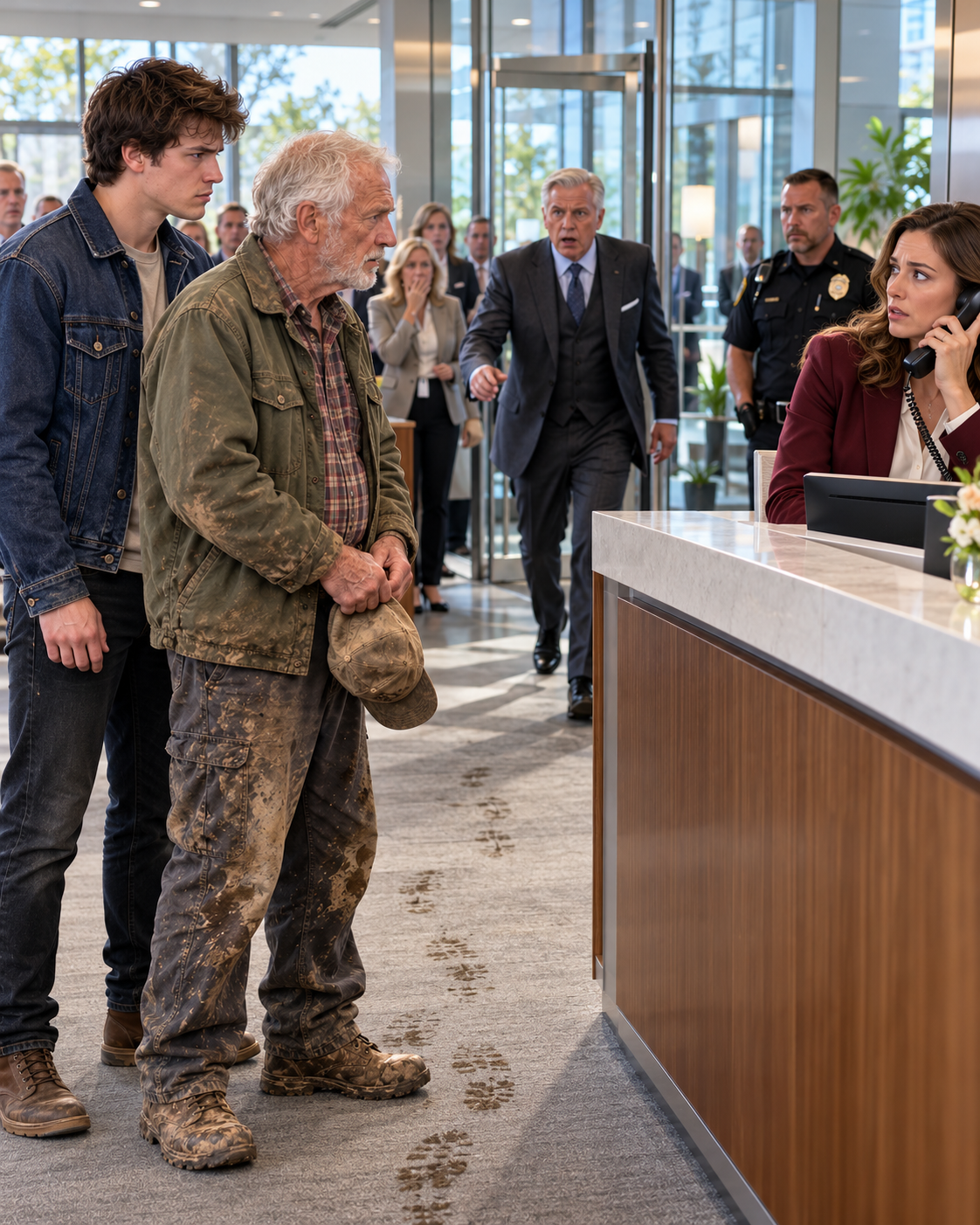

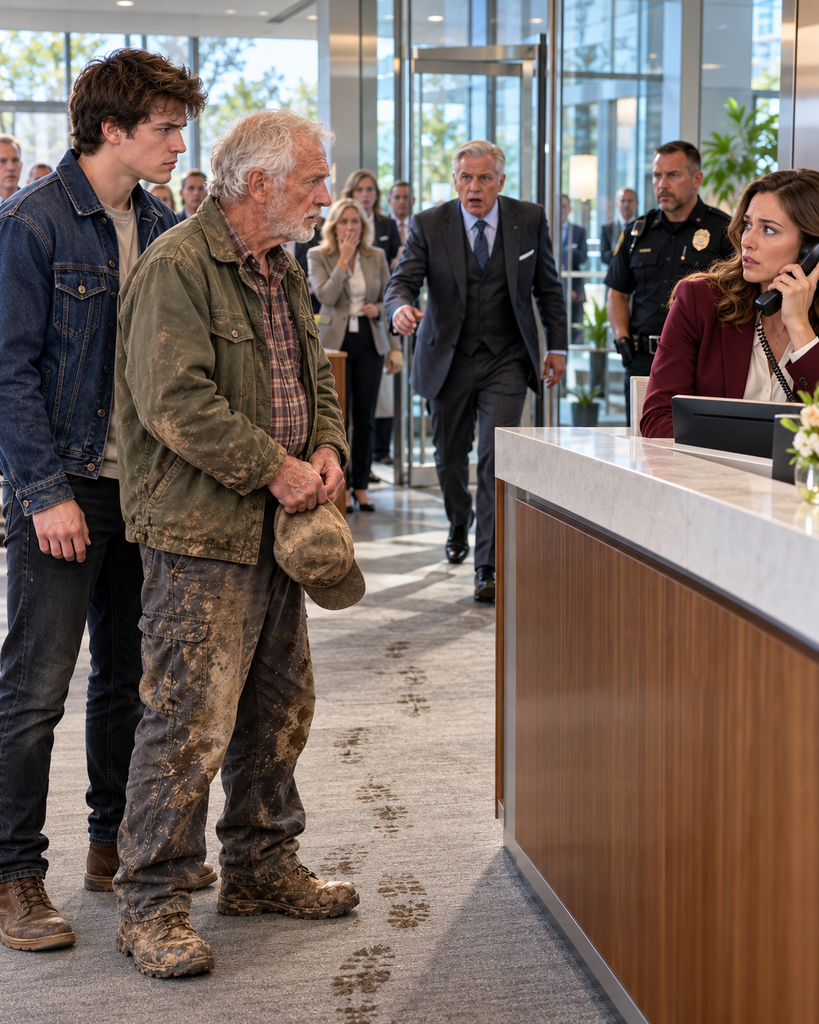
“Take your hand off him, Doug,” Greg Sullivan said.
He didn’t shout. The security guard’s fingers came off his belt like they’d been burned, and the lobby, which had been humming with the hiss of the latte machine and the shuffle of people in line, went so quiet I could hear the wall clock.
Greg looked at the mud on the gray carpet. He looked at Grandpa’s boots. Then he turned, slowly, to the teller, whose nameplate read Kayla, and the color began to leave her face from the top down.
“Do you know who this is?” he asked.
“He, he said Amos Brennan.”
“Amos Brennan,” Greg said, “co-signed the note that opened this bank’s second branch in 1974. He put up his north quarter-section as collateral when the board wouldn’t. Without that signature, there is no corner office. There is no carpet.” He drew a breath. “There is no me.”
At the back of the line, the woman who had snickered looked at her purse, then at the door. She walked out without a word. The glass doors sighed shut behind her.
My name is Caleb Brennan. I’m twenty, a sophomore at Iowa State studying agronomy, and I was home for harvest the way I’ve been every October since I was nine, which is to say I was exactly where I wanted to be.
Grandpa is Amos Brennan. He’s eighty-four. He farms six hundred and forty acres outside Hartley, Iowa, corn and soybeans, the same ground his father broke in 1936. He is five foot eight and built like a fence post, with hands the size of skillets and a face so weathered it looks carved. He wears bib overalls, a feed-store cap, and boots he resoles instead of replacing. He has been to exactly three weddings in forty years and left two of them early.
Grandma Mabel died six years ago. Since then it’s been the two of us in the kitchen at five a.m., him with black coffee, me with whatever’s left of the pot, listening to the farm report on a radio older than my father.
That Tuesday the combine had thrown a belt. Not a clean break either, but a tangle of rubber and bent pulley that meant a special-order part from a dealer in Boone who, as of 2019, took cash only on special orders. “Cheaper that way,” Grandpa said. “He doesn’t pay the card people. I don’t hear about it.”
Two thousand dollars. We drove into town in the old Ford with mud up to the door handles. He didn’t change clothes. Grandpa doesn’t change clothes for anybody.
I hadn’t been inside the bank in years. It used to be a low brick building with a cracked linoleum floor and a candy dish at every window. Now it had glass doors and a coffee station and a poster of a smiling couple on a sailboat. The tellers sat behind a long white counter like a row of museum guards.
Kayla was new. Twenty-five, maybe, with long perfect nails and a lanyard of little enamel charms. I’d later learn she’d come from a call center in Des Moines, and been on the floor eleven days.
You know what happened. The boots. The ID held up to the light like a counterfeit bill. People in your situation usually find the ATM easier. The snicker from behind us.
I’d like to tell you I stayed calm. I said, “He’s asking for his own money,” in a voice that cracked on own, and she picked up the phone for the guard.
Grandpa stood there with his cap in both hands. I’ve seen him stand that way at funerals. I’ve seen him stand that way in front of a hailstorm that took forty acres of beans. It isn’t weakness. It’s the posture of a man who has decided to let the other person finish.
Then he looked past the guard, past the coffee machine, at the glass office in the back.
“Miss,” he said, “is Greg Sullivan still in the corner office?”
Kayla smirked. “Mr. Sullivan is the bank president. He doesn’t come out for withdrawals.”
“Would you tell him Amos Brennan is out front?”
“Sir…”
“Just my name. That’s all I’m asking.”
She let out a loud sigh, picked up the phone, and made it a joke for the whole line. “Mr. Sullivan, sorry to bother you. There’s an Amos Brennan out here. Says you know him?”
Ten seconds later, the corner office door flew open and hit the wall.
Greg Sullivan came across that lobby at nearly a run, a tall man of sixty in a gray three-piece suit with a pocket square and the stoop of someone who’s spent decades leaning toward other people’s problems. I’d known him all my life. He’d handed me lollipops at that same counter when I was five.
He stopped in front of Grandpa and took the older man’s hand in both of his.
“Amos. My God. I’m so sorry.”
“Morning, Greg.”
“Why didn’t you call? I’d have come to the house.”
“Wasn’t a house kind of errand.” Grandpa nodded toward the teller. “Just wanted two thousand for the combine.”
Greg’s jaw tightened. He turned. His voice, when it came, was quiet and very even, the voice of a man who has fired people and hated every time.
“Kayla. Step out from behind the counter, please.”
She did. She stood on the gray carpet with her hands pinched together, and I saw the little charms on her lanyard tremble.
“I didn’t know,” she whispered.
“That’s the point.” Greg didn’t raise his voice. “You didn’t know who he was. So you decided, from his boots, who he was. And then you called a guard.”
“He was, I thought he might be, the mud, and the cash…”
“It’s his cash.”
She flinched.
“Kayla,” Greg said. “I want to ask you one question, and I want an honest answer. If a man in a suit had come to your window and asked for two thousand dollars, what would you have said?”
She opened her mouth. Closed it.
“I’d have asked how he wanted it,” she said, barely audible.
“Yes.”
“I’m sorry.”
“Not to me.”
PART 2
She turned. It took her a long time. She faced my grandfather, a small, weathered man in a feed-store cap, and I watched her try three times to say something.
“Mr. Brennan,” she finally managed. “I’m so sorry. I was rude. I judged you, and I shouldn’t have, and I, I’m so sorry.”
Grandpa studied her. His eyes are pale blue, almost gray, the color of a winter sky over a stubble field.
“How long you been here, miss?”
“Eleven days.”
“Where were you before?”
“A call center. Insurance.”
“And before that?”
“I, I grew up in Mason City. My mom cleaned offices.”
Grandpa nodded slowly. “Then you’ve seen what it looks like when somebody gets looked down on.”
Her face crumpled. “Yes, sir.”
“I figured.” He turned his cap over in his hands. “I’m not going to tell you it’s all right. It wasn’t. But I’ll tell you something my wife used to say. ‘Everybody’s got one bad day with the door open. What counts is whether they shut it.'”
Kayla pressed her fingers to her lips. Tears were running down her cheeks.
“I’d like to shut it,” she whispered.
“Then do.”
I want to tell you what Greg did next, because it’s the part I think about.
He didn’t fire her. He could have. Every instinct in that lobby, from the line of onlookers to the silent guard to my own hot, hurt face, wanted him to. A girl who’d treated an eighty-four-year-old man like a criminal in front of his grandson. It would’ve been simple.
Instead he said, “Kayla, take the rest of the morning. Go home. Come see me at eight tomorrow.”
“Mr. Sullivan, am I…”
“We’ll talk.”
She nodded, pale. She took her purse from under the counter and walked out through the glass doors, carefully, as if the floor might tilt.
Greg turned back to Grandpa. He put a hand on his shoulder.
“Amos. Come into my office. Please. Let me get you a real cup of coffee.”
“I’ll take the two thousand first.”
“Of course.” Greg beckoned to a young man at the next window. “Tyler. Count out two thousand for Mr. Brennan. And pull his account history, I’d like to see it.”
“Yes, Mr. Sullivan.”
“Why do you need my history?” Grandpa asked.
“Because I’ve been meaning to show you something for years,” Greg said, “and I keep losing my nerve.”
The corner office hadn’t changed. Same oak desk, same green banker’s lamp, same framed black-and-white photograph on the wall. A dozen men in suits and hats, standing in front of a brick building with a hand-painted sign. Hartley Farmers & Merchants Bank, Est. 1952.
I’d seen that photograph a hundred times. I’d never noticed the man in the second row, small, thin, in a worn work jacket, holding his hat against his chest.
“That’s you,” I said.
Grandpa glanced at it. “I was thirty-one.”
“You’re in the founders’ photo.”
“I was a depositor. They let me stand there for the sunlight.” He took the coffee Greg handed him in a real ceramic mug. “It’s a long story, Caleb. Doesn’t matter.”
“It matters,” Greg said. His voice shook. “Amos, it’s the only reason I’m here.”
I’ll tell you the story the way Greg told it, in that office, with the winter light going gold across the oak.
In 1973, the Hartley Farmers & Merchants Bank was dying. The town had lost its cannery. Two grain elevators had closed. The bank had one branch, one vault, and a board of five men who believed, with the stubbornness of the doomed, that if they waited long enough, things would improve. Greg’s father, Frank Sullivan, was a loan officer then. He’d sit at his desk at night with the lights off, doing arithmetic that didn’t come out.
The bank needed a second branch, in Elkton, eighteen miles east, where the new highway was going in. But the state wouldn’t approve the charter without a guarantee. Collateral. A man with land and a spotless name, willing to sign.
The board asked six farmers. Five said no.
“Your grandfather,” Greg said, “was twenty-nine, with a baby on the way and a mortgage on the home place. He didn’t have to. He’d barely met my father. He came to the bank on a Sunday, in that same work jacket, and sat in the kitchen with Dad for three hours. And at the end of it, he said, ‘Frank, I don’t know much about banking. But I know that a town without a bank is just a place people leave.'”
Grandpa was looking at his coffee.
“He put up the north quarter. A hundred and sixty acres, free and clear, all he owned outright. If the branch failed, he’d have lost it. And with the baby coming, he’d have lost, well.” Greg’s voice caught. “He never told anyone.”
“Wasn’t a big thing,” Grandpa murmured.
“It was the biggest thing anyone ever did for this bank. The Elkton branch opened in March 1974. It was profitable by 1976. By 1980, it carried the whole institution.” Greg spread his hands. “My father rose to president on the strength of it. I grew up in this building. I went to college on a scholarship he funded with the profits. Everything I have comes from one signature on a Sunday afternoon.”
“You’d have done the same.”
“I wouldn’t.” Greg’s eyes were wet. “I’ve thought about it, Amos. I’m not sure I would have. And I’ve been trying to thank you for forty-nine years, and you won’t let me.”
I looked at my grandfather.
I’d known him my whole life, and I hadn’t known this. I’d known him as a man of weather and soil. A man who fixed fences in a thunderstorm and refused to buy a new truck because the old one “still runs.” I’d known him as a man who never said I love you, but left the porch light on until I got home.
“Why didn’t you ever tell me?” I asked.
He shrugged, small and awkward. “It’s not a story. It’s just what you do.”
“You risked the farm.”
“I risked a quarter-section. The farm’s got six.”
“Grandpa.”
“Caleb.” He set the mug down. “I’ll tell you a thing my father told me. He said, ‘A man who counts what he gives is running a store, not living a life.'” He smiled faintly. “I never wanted to run a store.”
Greg made a sound halfway between a laugh and a sob. He crossed the office and stood in front of the framed photograph.
“My father hung this the day you signed,” he said. “He put you in the second row. I always wondered why you weren’t in the front. He told me once. He said you’d stepped back, and that he’d never met a man more reluctant to take credit.”
“I had hay down.”
“You had hay down.” Greg laughed, wetly. He took the frame off the wall and turned it over. On the back, in faded fountain pen, a line of Frank Sullivan’s small, upright script. “He wrote this the night before he died. I’ve never shown anyone.”
He handed it to Grandpa.
Grandpa held it at arm’s length, squinting, then fished a pair of reading glasses from his bib pocket. He read it for a long time. I watched his lips move.
Then he handed it to me.
Amos Brennan is the reason this bank exists. If anyone ever treats him as less than the founder he is, I’d like the person who runs this place to remember who really built it. — F.S.
PART 3
Back in the lobby, ten minutes later, the staff had assembled.
Greg had asked them to. Eleven tellers and loan officers and clerks stood in a loose semicircle on the gray carpet, some in pressed blazers, some in cardigans. The security guard, Doug, a heavyset man with a gray mustache, stood at the end with his cap in his hands.
Grandpa had said no. He’d said, “Greg, I’d rather you didn’t make a thing.” Greg had said, “Amos, it’s not for you. It’s for them.”
So we stood there, Grandpa in his overalls and me in my college sweatshirt, in the middle of a lobby that smelled like new carpet and espresso, while the president of the bank told a story most of them had never heard.
He told it plainly. He didn’t embellish. When he reached the part about the north quarter, a young loan officer near the front put her hand over her mouth.
“This man,” Greg said, “walked into our bank this morning in his work clothes. Because that’s what he was wearing when he was working. And he was treated, by one of us, as someone who didn’t belong.” He paused. “I’d like us all to think about what that means.”
Nobody spoke.
“It’s not about Amos. It’s not because he’s a founder, or because he’s old, or because he happens to be my friend. It’s because every person who walks through that door is somebody’s grandfather. Somebody’s mother. Somebody who’s put in sixty-one years, or sixty-one days, of honest work.” He looked at Doug. “We don’t know who they are. We’ll never know. So we treat everyone like Amos Brennan.”
Doug coughed. He shifted his weight. Then, in a voice rough with embarrassment, he said:
“Mr. Brennan. I’m sorry, sir. I put my hand on my belt. I shouldn’t have.”
Grandpa looked at him.
“You were doing your job.”
“I was doing it wrong.”
“Maybe.” Grandpa shrugged. “But you stopped when Greg told you. That’s something.”
Doug’s mustache twitched. He nodded, once, and stepped back.
I had the strangest moment then.
I’d been standing there angry for an hour, holding it like a hot coal. I’d been planning what I’d say to the teller, what I’d say to Greg, what I’d write in a review. And now the anger just, went, like air from a tire. I looked around at eleven chastened bank employees, and the cracked, careful humanity of the whole scene hit me.
They weren’t villains. They were people who’d forgotten to look.
I thought of Kayla, pale in her lanyard, walking out through the glass doors. My mom cleaned offices. I thought of how fast we judge, and how fast we’re judged, and how rarely anyone gets to stand in a lobby and have it explained.
“Grandpa,” I whispered. “Can I ask something?”
“Mm.”
“Are you mad?”
He considered. The question, I think, was genuinely new to him.
“No,” he said. “I’m a little tired. But I’m not mad.”
“Why not?”
“Because I’ve been looked down on by better than that girl.” He smiled. “And I’ve been looked up to by worse.”
Kayla came back the next morning at eight.
I wasn’t there. But Greg told me, and Kayla told me later, and between them I’ve assembled it.
She’d been up all night. She’d rehearsed a resignation, then an apology, then a defense, then rehearsed all three again. She arrived in a plain gray blouse, no lanyard, no charms, her nails bitten down to the quick. She sat across from Greg’s desk in the green banker’s light.
“I’d like to resign,” she said. “Before you tell me to.”
“I’m not going to tell you to.”
She blinked. “What?”
“Kayla, I’ve been president of this bank for twenty-two years. I’ve fired seventeen people. I’ve never once enjoyed it.” He folded his hands. “I’m not going to fire you for being young and scared and wrong. I’d be firing a lot of myself.”
She stared.
“I’ll ask you a question. And I want the truth.”
“Yes, sir.”
“Why did you call the guard?”
She was quiet a long time. The lamp hummed.
“Because I was afraid,” she said. “Of getting it wrong. The cash, the amount, the ID. I’d been trained on a checklist. A man comes in, he’s dirty, he’s old, he wants a lot of cash. It matched the, the fraud flags in my head. I panicked.” Her voice shook. “And then I said the thing about the ATM. And I don’t know why. I think I wanted to sound like I belonged.”
“Belonged where?”
“Here.” She wiped her eyes. “At a bank. In a nice blouse. I grew up in a trailer, Mr. Sullivan. My mom scrubbed floors at the insurance company. I got this job because I fake-smile well. And when I saw him, in the boots, I thought, that’s my mother. And I, I hated it. I hated that I thought it.”
Greg said nothing.
“So I did what I’d have wanted nobody to do to her,” she whispered. “I judged him first.”
I won’t pretend it was neat. Greg didn’t forgive her on the spot and hand her a bonus. He put her on a ninety-day plan. A mentor, a veteran teller named Marlene, sixty-two years old, with reading glasses on a beaded chain and thirty-one years at the bank. Kayla’s job, for those ninety days, was to listen. To sit at Marlene’s elbow, and learn every customer’s name, and pull out the old paper ledgers in the vault and read about the people who’d built the town.
She read about Grandpa. She told me later it took her a whole afternoon, hunched over a brittle ledger from 1974, reading a single line in Frank Sullivan’s tidy hand. A. Brennan, collateral, north quarter. Never missed a payment. Never asked for thanks.
“I cried in the vault,” she told me. “Marlene found me. She didn’t say anything. She just handed me a Kleenex.”
She came to the farm the following Saturday.
I was in the yard, hosing mud off the Ford. I heard a car in the lane, a little white sedan, slowing at the gate. A young woman climbed out in jeans and sneakers, holding a pie in both hands.
“Hi,” she said. “I’m, I’m Kayla. From the bank.”
“I remember.”
“Is your grandfather home?”
He was on the porch. He’d been watching from his rocker, in his overalls, with a glass of iced tea. He didn’t get up. He nodded at the other chair.
She sat. She set the pie on her knees. It was apple, with a lattice top, slightly scorched at one corner.
“I made it myself,” she said. “It’s not good.”
“Looks fine.”
“It’s burnt.”
“Looks fine,” Grandpa said again.
She laughed, damply. For a few minutes, nobody said anything. A meadowlark sang from the fence. The corn on the south ridge rattled in the wind.
“I wanted to say sorry properly,” Kayla said. “Not at work. Not in front of people.”
“You said it.”
“I said it in a lobby. I wanted to say it at your house.”
Grandpa studied her. Then he smiled, slow and creased.
“Girl, you want to see a real apology?”
“Sir?”
“Come on.”
He rose, with a hand on the rail. He led her down the porch steps and across the yard, to the machine shed, where the combine sat with its belt hanging like a broken tendon. He rolled up his sleeves.
“I’ve got a part to put in. Takes two people. You hold the pulley while I thread the belt.”
Kayla blinked at him. “I don’t know anything about combines.”
“Good. Then you’ll listen.”
She held the pulley. For forty minutes, in the cool of the machine shed, with the smell of grease and old hay, my grandfather taught a twenty-five-year-old bank teller how to thread a drive belt. He said almost nothing except hold it there, now ease it, that’s it. She did exactly what she was told. At the end, when the belt snapped into place with a clean metallic thunk, she looked up, with grease on her cheek, and grinned.
“That’s it?”
“That’s it.”
“It’s, I did that.”
“You did.”
“It’s so, physical.” She stared at her hands. “I’ve never made anything with my hands. My whole life I’ve been, I don’t know. Typing.”
“Everybody makes something,” Grandpa said. “You just got to find out what.”
It’s been a year.
Kayla is still at the bank. She’s a loan officer now, in the little office beside Marlene’s. She specializes in agricultural credit, which she says is the most honest work she’s ever done. She drives out to farms. She learns the names of fields. She once spent a whole Saturday helping a family in Elkton sort out a drainage problem with a county engineer, and brought the husband a casserole.
“I used to think the job was about money,” she told me last spring, at the county fair, over a funnel cake. “It’s about, I don’t know. Whose turn it is to be scared.”
“Whose turn?”
“Everybody’s scared of something. A farmer’s scared of a bad year. A bank’s scared of a bad loan. My job is to stand between the two and say, ‘We can work this out.'” She licked sugar from her thumb. “Your grandfather taught me that.”
“He doesn’t say much.”
“He doesn’t have to.”
Greg retired in June. He’s seventy now, and he’s taken up fishing, badly. Before he left, he did one more thing. He had the founders’ photograph rehung in the lobby, in the center of the main wall, with a brass plaque beneath it. The second row, the small man in the work jacket, holding his hat.
The plaque reads:
Amos Brennan. Who risked the north quarter. Who stood in the back, and held the bank up.
Grandpa has never looked at it. He says he’s embarrassed. Whenever we drive past, he looks out the other window.
But last month, on a Tuesday morning, I caught him. We’d come in for a deposit, in the old Ford, with mud up to the doors. He’d walked in ahead of me, in his overalls and feed-store cap, and stopped in the middle of the lobby, in front of the photograph.
He stood there a long time. His hands were behind his back. A few customers glanced at him, curious, and moved on.
“Grandpa?”
“Mm.”
“You okay?”
“I’m thinking about Frank.” His voice was low. “He was a good man. He had a stutter. When he got nervous, he’d tap his pencil. You could hear it across the room. Tap-tap-tap.” He smiled faintly. “He never tapped it around me.”
“Why not?”
“I think he trusted me.” He turned his cap over. “That’s all anybody wants. Somebody they don’t have to tap around.”
At the counter, Kayla looked up from the window. She saw him. She straightened, in her gray blouse, and smiled, small and genuine and a little shy.
“Morning, Mr. Brennan.”
“Morning, miss.”
“What can I do for you?”
He walked to the window. He took off his cap. And with the same quiet, grave courtesy he’d shown a year before, he said:
“I’d like to deposit a check, please.”
“Of course.”
She took it. She looked at it, and then at him, and then, deliberately, so that I could see, she turned the screen toward him so he could watch her enter the numbers.
“I’ll get you a receipt,” she said.
“Thank you.”
“It’s my pleasure, sir.”
He nodded. He put the receipt in his bib pocket, between the pencil and the little notebook where he keeps the rainfall totals.
We went out into the October light. The Ford waited at the curb, mud-streaked and ancient, ticking as it cooled. Grandpa climbed in, slow, a hand on the doorframe.
“You know,” he said, as I started the engine, “I never did get that latte.”
“You want one?”
“Not particularly.”
“Then why bring it up?”
He shrugged, looking out at the street.
“Just thought I might try it,” he said. “Once. Since they went to the trouble.”
I laughed. I put the truck in gear.
And we drove home, the two of us, through the long gold afternoon, past fields of stubble and the red barn and the north quarter, which sat there as it had for fifty years, quiet and unassuming, holding up a bank.